
Market Overview:
Feed pigments are specialized additives, either natural or synthetic carotenoids, incorporated into animal feed to enhance coloration, improve nutritional value, and provide antioxidant benefits. These pigments are extracted from vegetable sources such as paprika, marigold, and algae (spirulina) or manufactured synthetically to maintain consistent pigment activity. They are typically stabilized, processed, and mixed with a suitable carrier to ensure proper dispersion in feed formulations.
The key role of feed pigments lies in improving animal product quality and consumer appeal. For instance, poultry producers use pigments to intensify yolk color and skin tone in broilers, as consumer preference often drives purchasing decisions. Similarly, aquaculture relies on pigments such as astaxanthin and canthaxanthin to enhance the pink-red coloration of salmon and shrimp. Apart from aesthetics, pigments also offer health benefits—acting as antioxidants to improve immunity and feed efficiency.
Over time, feed pigments have transitioned from being a niche ingredient to a mainstream additive due to rising demand for premium animal products and the growing awareness of nutritional benefits. With global protein consumption on the rise, feed pigments are becoming a crucial component in modern animal nutrition.
Download FREE Sample of this Report @ https://www.statsmarketresearch.com/download-free-sample/8042117/global-feed-pigments-market
Recent Developments
The feed pigments market is experiencing a significant shift towards natural and sustainable solutions, driven by increasing consumer awareness of animal health and a preference for “clean-label” animal products. This has led to a boom in the demand for natural pigments like carotenoids, curcumin, and spirulina, which not only enhance the color of products like egg yolks and poultry skin but also offer health benefits for the animals. There is a growing trend of using advanced technologies such as microencapsulation to improve the stability and bioavailability of pigments, ensuring they remain effective throughout the feed manufacturing process. Furthermore, the market is seeing a push towards precision feeding and automated dosing systems, which optimize the use of pigments and reduce waste in animal feed production.
Major Distribution Channels
The distribution of feed pigments is a highly specialized business-to-business (B2B) process. The primary channel is direct sales from major manufacturers to large-scale animal feed producers and integrated livestock operations. These direct relationships allow for bulk purchasing and technical support tailored to the specific needs of the customer. A significant portion of the market is also served by a network of authorized distributors, who provide a wide range of feed additives, including pigments, to smaller feed mills, individual farmers, and research institutions. These distributors are crucial for market penetration and offer localized logistics and customer service. Additionally, the rise of e-commerce has created an increasingly important channel for reaching a global audience, making it easier for customers to access detailed product information and purchase specialized feed ingredients online.
Market Size
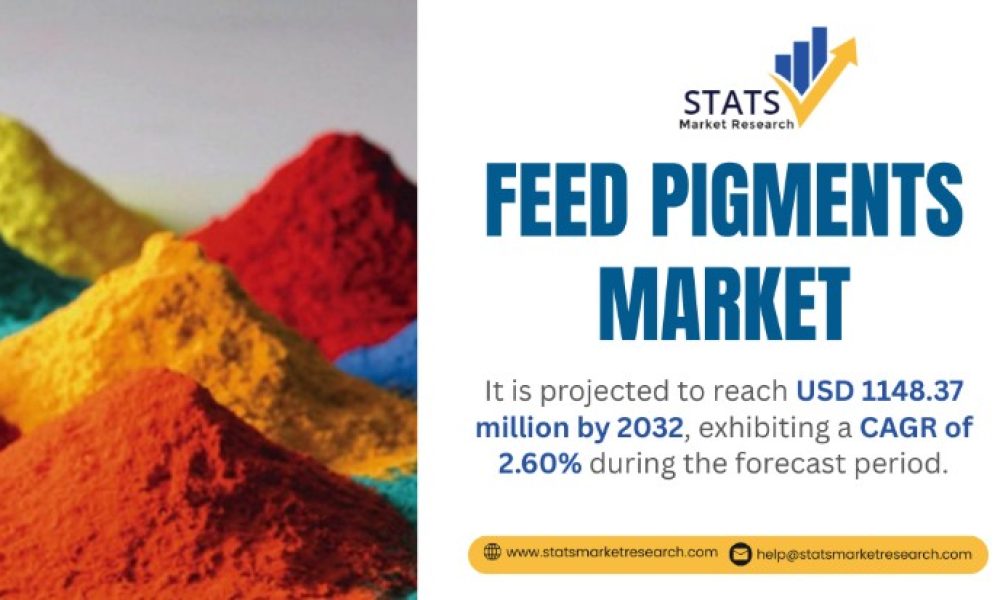
Global feed pigments market size was estimated at USD 911.50 million in 2024 and is projected to reach USD 1,148.37 million by 2032, registering a CAGR of 2.60% during the forecast period.
- North America Market: Valued at USD 248.22 million in 2024, expanding at a CAGR of 2.23% through 2032.
- Historical growth has been steady, with demand fueled by poultry and aquaculture expansion, particularly in Asia-Pacific.
- By 2032, Asia-Pacific is expected to dominate due to China, India, and Southeast Asia’s rising meat and seafood consumption.
The market expansion is attributed to:
- Growing global meat and seafood demand.
- Rising consumer preference for premium-quality animal products with appealing coloration.
- Shift toward natural pigments, especially in Europe and North America, due to stricter regulatory frameworks on synthetic additives.
Market Dynamics (Drivers, Restraints, Opportunities, and Challenges)
Drivers
- Rising Poultry and Aquaculture Demand
Poultry dominates animal protein consumption globally, and feed pigments play a key role in enhancing egg yolk and broiler skin coloration. Similarly, aquaculture depends on pigments such as astaxanthin for salmon, trout, and shrimp. - Shift Toward Natural Pigments
With stricter EU regulations and consumer demand for clean-label products, natural carotenoids from marigold, paprika, and spirulina are gaining rapid adoption. - Nutritional and Antioxidant Benefits
Feed pigments not only enhance aesthetics but also act as antioxidants, improving animal health, immune function, and productivity.
Restraints
- High Cost of Natural Pigments
Natural carotenoids are significantly more expensive than synthetic ones, limiting adoption in cost-sensitive markets. - Regulatory Challenges
Strict regulations in Europe and North America on synthetic pigments have slowed market penetration. Compliance costs for producers remain high.
Opportunities
- Expansion in Asia-Pacific
Rapidly growing poultry and aquaculture industries in China, India, Vietnam, and Indonesia present lucrative growth opportunities. - Functional Benefits Beyond Coloring
Increasing research on pigments’ role in gut health and immunity is creating new application avenues in feed formulations.
Challenges
- Price Volatility of Raw Materials
Fluctuations in raw materials such as paprika and marigold flowers directly impact production costs. - Limited Awareness in Developing Regions
In some parts of Africa and South America, awareness of the benefits of pigments in animal feed remains limited, restricting market penetration.
Regional Analysis
- North America:
- Market size: USD 248.22 million (2024).
- Growth driven by demand for premium poultry products.
- Increasing focus on natural pigments due to strict FDA and USDA guidelines.
- Europe:
- Strong regulatory push toward natural carotenoids.
- Countries like Germany, UK, and France lead in adopting marigold-derived pigments for poultry.
- Asia-Pacific:
- Fastest-growing region due to China and India’s poultry expansion.
- Aquaculture boom in Vietnam and Indonesia fuels demand for astaxanthin.
- South America:
- Brazil is a major contributor due to its poultry export industry.
- Middle East & Africa:
- Growing investments in poultry feed solutions, though adoption is still slower compared to Asia-Pacific.
Competitor Analysis
The global feed pigments market is moderately fragmented, with both multinational corporations and regional players competing.
- Royal DSM and BASF SE lead through strong portfolios in carotenoids and global distribution networks.
- Nutreco and Cargill leverage vertically integrated operations and strong relationships with feed manufacturers.
- Smaller players such as Kalsec and Guangzhou Leader Bio-Technology focus on natural pigment innovation to capture market share.
Key strategies include M&A, partnerships with feed producers, and investment in natural pigment R&D.
Get the Complete Report & TOC @ https://www.statsmarketresearch.com/global-feed-pigments-market-8042117
Global Feed Pigments Market: Market Segmentation Analysis
This report provides a deep insight into the global Feed Pigments market, covering all its essential aspects. This ranges from a macro overview of the market to micro details of the market size, competitive landscape, development trend, niche market, key market drivers and challenges, SWOT analysis, value chain analysis, etc.
The analysis helps the reader to shape the competition within the industries and strategies for the competitive environment to enhance the potential profit. Furthermore, it provides a simple framework for evaluating and assessing the position of the business organization. The report structure also focuses on the competitive landscape of the Global Feed Pigments. This report introduces in detail the market share, market performance, product situation, operation situation, etc., of the main players, which helps the readers in the industry to identify the main competitors and deeply understand the competition pattern of the market.
In a word, this report is a must-read for industry players, investors, researchers, consultants, business strategists, and all those who have any kind of stake or are planning to foray into the Feed Pigments market in any manner.
Market Segmentation (by Application)
- Swine
- Cattle
- Poultry
- Aquatic Animals & Others
Market Segmentation (by Type)
- Carotenoids
- Curcumin
- Caramel
- Spirulina & Others
Key Company
- Nutreco
- Cargill
- Bio-Technology
- D. Williamson
- Royal DSM
- BASF SE
- Kemin
- Novus
- Kalsec
- Vitafor
- PHW
- Behn Meyer
- Guangzhou Leader Bio-Technology
Geographic Segmentation
- North America (USA, Canada, Mexico)
- Europe (Germany, UK, France, Russia, Italy, Rest of Europe)
- Asia-Pacific (China, Japan, South Korea, India, Southeast Asia, Rest of Asia-Pacific)
- South America (Brazil, Argentina, Columbia, Rest of South America)
- The Middle East and Africa (Saudi Arabia, UAE, Egypt, Nigeria, South Africa, Rest of MEA)
Customize/Section/Part Purchase @ https://www.statsmarketresearch.com/chapters-purchase/8042117/global-feed-pigments-market
FAQ Section
Q1: What is the current market size of the Feed Pigments Market?
The global feed pigments market was valued at USD 911.50 million in 2024 and is projected to reach USD 1,148.37 million by 2032.
Q2: Which are the key companies operating in the Feed Pigments Market?
Key companies include Nutreco, Cargill, Royal DSM, BASF SE, Kemin, Novus, and Guangzhou Leader Bio-Technology.
Q3: What are the key growth drivers in the Feed Pigments Market?
The major drivers are rising poultry and aquaculture demand, shift toward natural pigments, and nutritional benefits of carotenoids.
Q4: Which regions dominate the Feed Pigments Market?
Asia-Pacific leads due to rapid poultry and aquaculture growth, while North America and Europe focus on natural pigment adoption.
Q5: What are the emerging trends in the Feed Pigments Market?
Key trends include natural pigment innovation, functional feed benefits, and sustainable pigment sourcing.
About Us
☎️ International: +1 (332) 2424 294
📄 Website: www.statsmarketresearch.com




