
Definition
Flaxseeds, also known as linseeds, are nutrient-rich seeds derived from the Linum usitatissimum plant. They are widely recognized for their high content of alpha-linolenic acid (ALA), dietary fiber, lignans, and proteins, making them a popular choice in human nutrition and animal feed applications.
The global flaxseed market encompasses three primary product types: milled (ground) flaxseed, whole flaxseed, and flaxseed oil, each tailored for specific applications in food, animal nutrition, and industrial purposes. These seeds are utilized in bakery products, cereals, nutritional supplements, dairy alternatives, and livestock feed.
The market is fueled by growing consumer awareness of health and wellness, especially regarding heart health, digestive health, and weight management. Additionally, flaxseed’s applications in functional foods, fortified snacks, and plant-based dietary products are expanding rapidly. Leading companies are actively innovating in processing technologies to preserve nutritional content, improve shelf life, and create value-added flaxseed-based products.
Recent Developments
The flaxseed market is experiencing a significant boom, driven by a global surge in consumer awareness about the health benefits of “superfoods” and a growing preference for plant-based diets. Recent innovations are focused on developing new flaxseed-based products, such as flaxseed milk, and expanding their use in various food applications like bakery goods, cereals, and snacks. There’s also an increasing emphasis on creating products with specific functional benefits, for example, fortified with extra fiber or omega-3 fatty acids. Furthermore, advancements in processing technologies are leading to a greater variety of available forms, including whole, ground, and oil, catering to a wider range of consumer needs and uses.
Major Distribution
The distribution of flaxseed is a dual-channel system, operating on both business-to-business (B2B) and business-to-consumer (B2C) levels. On the B2B side, large agricultural companies and processors sell bulk quantities of flaxseed, both whole and processed, directly to food and beverage manufacturers, as well as to companies in the animal feed and nutraceutical industries. The B2C channel is primarily driven by retail, with flaxseed products being widely available in supermarkets, hypermarkets, and specialty health food stores. A rapidly growing and significant part of the B2C distribution is through e-commerce platforms, which provide consumers with convenient access to a wide array of flaxseed products, including organic and niche varieties, and often at competitive prices.
Market Size
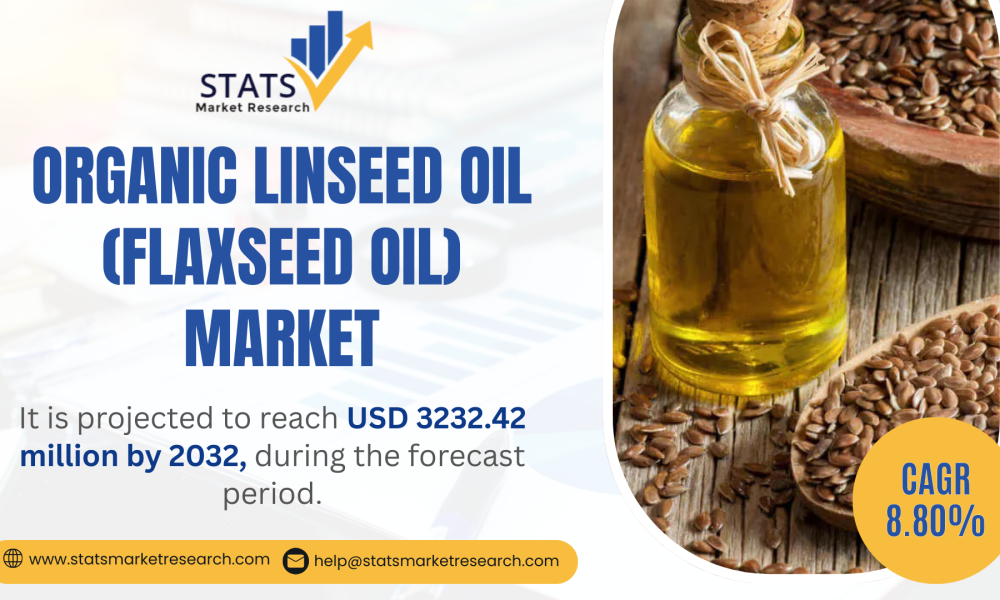
Global flaxseed market was estimated at USD 1,513.10 million in 2024 and is projected to reach USD 3,232.42 million by 2032, registering a CAGR of 8.80% during the forecast period.
Regional Insights:
- North America Flaxseed Market: Valued at USD 455.99 million in 2024, expected to grow at a CAGR of 7.54% through 2032.
- The growth is driven by high consumer demand for plant-based and functional foods in the USA and Canada, coupled with increased adoption of flaxseed in animal feed.
- Europe and Asia-Pacific are witnessing a steady rise in flaxseed consumption, particularly due to rising awareness of health benefits and expanding bakery, snack, and supplement industries.
Market Outlook:
The global market growth is supported by:
- Increasing health-conscious consumer trends
- Rising functional food and dietary supplement adoption
- Expanding applications in animal feed and industrial uses
As consumers seek plant-based protein and omega-3 sources, flaxseed is becoming a preferred ingredient, driving both production and processing capacity worldwide.
Download FREE Sample of this Report @ https://www.statsmarketresearch.com/download-free-sample/8041411/global-flaxseed-forecast-2025-2032-988
Market Dynamics (Drivers, Restraints, Opportunities, and Challenges)
Market Drivers
- Health and Wellness Trends:
- Flaxseeds are rich in omega-3 fatty acids and lignans, supporting heart health, gut health, and anti-inflammatory benefits.
- Increased consumer preference for plant-based nutrition fuels market expansion in food and beverage applications.
- Functional Foods and Nutraceuticals:
- Growing inclusion in baked goods, breakfast cereals, energy bars, and supplements supports demand.
- Food and beverage manufacturers are innovating to incorporate flaxseed for enhanced protein and fiber content.
- Animal Feed Applications:
- Flaxseed is increasingly used in poultry, livestock, and aquaculture feed to enhance animal health and product quality.
- High omega-3 content improves egg and meat nutritional profiles, driving demand in North America and Europe.
Market Restraints
- Price Volatility:
- Global flaxseed production depends on agricultural conditions; weather fluctuations affect supply and prices.
- Price sensitivity can limit adoption among smaller food processors.
- Processing Challenges:
- Oil extraction and milling require advanced equipment to preserve nutritional content.
- Shelf-life concerns for ground flaxseed may hinder long-term storage and export.
- Competition from Alternative Seeds:
- Chia, hemp, and sunflower seeds are emerging as alternative sources of omega-3 and dietary fiber, creating competitive pressure.
Market Opportunities
- Rising Demand in Plant-Based and Vegan Products:
- Flaxseed serves as a binding agent and egg replacer in vegan food formulations.
- Expanding plant-based diets provide opportunities for product innovation in bakery, snacks, and dairy alternatives.
- Global Expansion of Nutraceuticals:
- Integration of flaxseed in capsules, protein powders, and functional beverages presents significant growth potential.
- Increasing awareness of preventive healthcare drives consumption among health-conscious consumers.
- Emerging Markets in Asia-Pacific and Latin America:
- Growing disposable income and increasing urbanization are boosting adoption in China, India, Brazil, and Argentina.
- Expansion of modern retail chains and e-commerce channels supports accessibility.
Market Challenges
- Supply Chain Dependence:
- Dependence on major flaxseed-producing countries like Canada, Russia, and Kazakhstan can affect market stability.
- Transportation and logistics costs impact pricing and margins.
- Regulatory Compliance:
- Flaxseed products must comply with food safety regulations in different regions.
- Certifications and quality testing can add to production costs.
- Consumer Education:
- Awareness of correct usage and preparation methods is essential to maximize health benefits.
- Misconceptions or lack of knowledge can limit consumption in emerging regions.
Regional Analysis
- North America:
- Largest regional market due to high functional food demand and animal feed integration.
- The USA leads consumption in bakery, health supplements, and dietary products.
- Europe:
- Driven by health-conscious consumers and bakery innovations.
- Germany, the UK, and France are leading adopters.
- Asia-Pacific:
- Growing urban population, rising income, and increasing awareness of health benefits fuel demand.
- China, India, and Japan are emerging growth markets.
- South America:
- Brazil and Argentina are expanding production and domestic consumption.
- Increasing incorporation in animal feed and functional foods supports growth.
- Middle East & Africa:
- Adoption is limited but growing due to rising interest in nutritional and plant-based products.
- Countries like UAE, Saudi Arabia, and South Africa are key growth hubs.
Get the Complete Report & TOC @ https://www.statsmarketresearch.com/global-flaxseed-forecast-2025-2032-988-8041411
Competitor Analysis (in brief)
The global flaxseed market is moderately competitive with key players focusing on product innovation, quality, and supply chain expansion.
Key insights:
- AgMotion, Linwoods Health Foods, and CanMar Grain Products focus on high-quality seed sourcing and processing.
- Archer Daniels Midland and Cargill leverage large-scale production and distribution networks.
- Regional players like Heartland Flax, Shape Foods, and Sunnyville Farms target niche markets, including organic and specialty products.
- Competitive strategies include product diversification, partnerships, and global expansion, particularly in nutraceutical and functional food segments.
Global Flaxseed Market: Market Segmentation Analysis
This report provides a deep insight into the global Flaxseed Market, covering all its essential aspects. This ranges from a macro overview of the market to micro details of the market size, competitive landscape, development trend, niche market, key market drivers and challenges, SWOT analysis, value chain analysis, etc.
The analysis helps the reader to shape the competition within the industries and strategies for the competitive environment to enhance the potential profit. Furthermore, it provides a simple framework for evaluating and assessing the position of the business organization. The report structure also focuses on the competitive landscape of the Global Flaxseed Market. This report introduces in detail the market share, market performance, product situation, operation situation, etc., of the main players, which helps the readers in the industry to identify the main competitors and deeply understand the competition pattern of the market.
In a word, this report is a must-read for industry players, investors, researchers, consultants, business strategists, and all those who have any kind of stake or are planning to foray into the Flaxseed Market in any manner.
Market Segmentation (by Application)
- Food
- Animal Food
- Others
Market Segmentation (by Type)
- Milled (Ground) Flaxseed
- Whole Flaxseed
- Flaxseed Oil
Key Company
- AgMotion
- Linwoods Health Foods
- CanMar Grain Products
- TA Foods
- Archer Daniels Midland
- Stober Farms
- Heartland Flax
- Shape Foods
- Healthy Food Ingredients
- Zeghers Seed
- Bioriginal Food & Science
- S.S Johnson Seeds
- Cargill
- Stokke
- Simosis
- Richardson
- Sunnyville Farms
Geographic Segmentation
- North America: USA, Canada, Mexico
- Europe: Germany, UK, France, Russia, Italy, Rest of Europe
- Asia-Pacific: China, Japan, South Korea, India, Southeast Asia, Rest of Asia-Pacific
- South America: Brazil, Argentina, Columbia, Rest of South America
- Middle East & Africa: Saudi Arabia, UAE, Egypt, Nigeria, South Africa, Rest of MEA
FAQ Section
- What is the current market size of the Flaxseed Market?
The global market was valued at USD 1,513.10 million in 2024 and is projected to reach USD 3,232.42 million by 2032. - Which are the key companies operating in the Flaxseed Market?
Key players include:
- AgMotion
- Linwoods Health Foods
- CanMar Grain Products
- TA Foods
- Archer Daniels Midland
- Stober Farms
- Heartland Flax
- Shape Foods
- Healthy Food Ingredients
- Zeghers Seed
- Bioriginal Food & Science
- S.S Johnson Seeds
- Cargill
- Stokke
- Simosis
- Richardson
- Sunnyville Farms
- What are the key growth drivers in the Flaxseed Market?
Growth is driven by health-conscious consumer trends, functional food adoption, and animal feed applications, along with rising awareness of omega-3 and dietary fiber benefits. - Which regions dominate the Flaxseed Market?
North America leads the market, followed by Europe and Asia-Pacific. Emerging growth is observed in South America and Middle East & Africa. - What are the emerging trends in the Flaxseed Market?
Trends include integration into plant-based products, nutraceutical applications, flaxseed oil consumption, and expansion in functional foods and bakery products.
About Us
☎️ International: +1 (332) 2424 294
📄 Website: www.statsmarketresearch.com
Join us on LinkedIn:- https://www.linkedin.com/company/statsmarketresearch




