
Market Overview:
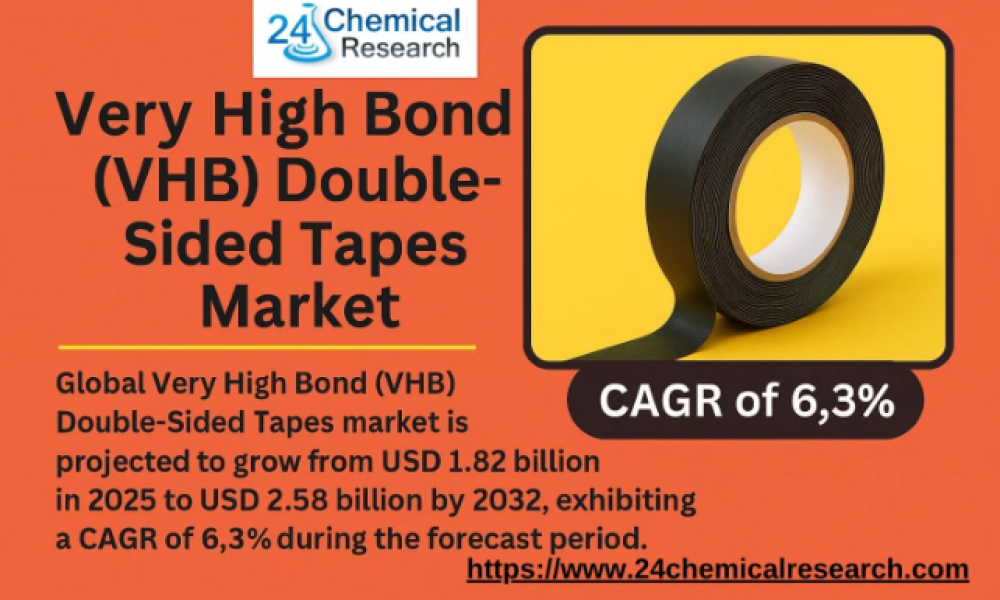
Global Very High Bond (VHB) Double-Sided Tapes market is seeing strong and steady growth, with a market valuation of USD 1.68 billion in 2024. This market is projected to grow at a CAGR of 6.3%, reaching approximately USD 2.58 billion by 2032. The increasing demand for high-performance bonding solutions across various industries is the primary driver of this expansion. These tapes are revolutionizing assembly processes in sectors that require superior adhesion, vibration damping, and aesthetic finishes.
VHB Double-Sided Tapesoffer a versatile, high-strength alternative to traditional mechanical fasteners, enabling the creation of lightweight and visually appealing designs. Their unique acrylic foam construction ensures exceptional adhesion, durability, and resistance to both temperature extremes and chemicals, making them ideal for a wide range of demanding applications in automotive manufacturing, electronics, renewable energy, and construction.
Unlock the insights! Download our Sample Report to explore key market trends: https://www.24chemicalresearch.com/download-sample/297280/global-very-high-bond-doublesided-tapes-forecast-market-2025-2031-152
Key Market Drivers: What’s Fueling the Growth?
1. Shift Toward Lightweight Designs
The transition to lightweight construction is one of the most significant growth drivers in the VHB tape market. Automotive manufacturers, in particular, are increasingly opting for VHB tapes to replace welding and mechanical fasteners. This trend enables mixed-material vehicle designs that enhance aerodynamics and reduce overall vehicle weight. By enabling designs that incorporate both metal and composite materials, VHB tapes help improve fuel efficiency and performance.
In automotive OEM production, these tapes are preferred for exterior parts like spoilers, windows, and lighting units, as they reduce the need for drilling and welding, thus improving both manufacturing speed and final product durability.
2. Demand in Electronics Manufacturing
The rapid growth of electronics manufacturing, particularly in the production of smartphones, tablets, and automotive infotainment systems, is a vital factor driving the demand for VHB tapes. These tapes are used for display bonding and the assembly of thin, lightweight components. As consumer electronics continue to shrink in size while increasing in functionality, the need for highly efficient, high-performance bonding solutions has escalated, further cementing the role of VHB tapes in electronics production.
3. Renewable Energy Applications
The renewable energy sector represents a significant opportunity for VHB tapes, particularly in the assembly of solar panels and wind turbine components. These tapes are crucial in the construction of durable, lightweight structures that can withstand harsh outdoor environments. The easy-to-apply, high-performance adhesive capabilities of VHB tapes make them ideal for mounting solar panels and ensuring that wind turbine blades are securely fastened with minimal impact on their overall weight.
4. Technological Advancements
Recent innovations in VHB tape formulations have expanded their potential applications. New electrically conductive and thermally managing formulations are enabling these tapes to be used in the assembly of electric vehicle (EV) batteries, as well as in 5G infrastructure. These innovations enhance the versatility of VHB tapes, making them suitable for high-tech applications requiring thermal management and electrical conductivity.
Regional Dynamics: A Global Snapshot
Asia-Pacific: Leading the Charge
Asia-Pacific dominates the global VHB tape market, accounting for nearly 45% of global consumption. This dominance is primarily driven by China, Japan, and South Korea, where a massive electronics manufacturing base and significant automotive production continue to fuel the demand for high-performance adhesives. In particular, Chinese automotive manufacturers have increasingly turned to VHB tapes to reduce weight and improve the aerodynamics of vehicles, a trend that aligns with global goals for energy efficiency and emission reductions.
North America: Growth in Aerospace and Renewable Energy
North America is also a significant player in the VHB tape market. In particular, the aerospace and renewable energy sectors drive the demand for these tapes. VHB tapes are essential in aerospace applications where lightweight, durable bonds are required to withstand extreme temperatures and pressures. Additionally, the increasing adoption of solar energy technologies in the U.S. is opening up new opportunities for VHB tapes in solar panel installation.
Europe: Premium Applications and Sustainability Initiatives
In Europe, VHB tapes are especially valued in high-end automotive manufacturing and architectural applications. The region’s focus on quality standards and sustainability initiatives has led to increased adoption of VHB tapes, especially as part of efforts to reduce carbon footprints and enhance energy efficiency in construction projects. Additionally, Europe’s automotive industry is increasingly embracing lightweight materials in vehicle manufacturing, where VHB tapes play a critical role in ensuring strong yet lightweight designs.
Emerging Markets: Southeast Asia and Latin America
While Southeast Asia and Latin America are experiencing rapid uptake of VHB tapes, their growth is somewhat tempered by infrastructure limitations and cost sensitivity. However, as these regions continue to develop their manufacturing bases, demand for high-performance bonding solutions will grow, particularly in automotive assembly and consumer electronics manufacturing.
Market Segmentation: Types and Applications
Types of VHB Double-Sided Tapes
- Opaque Double-Sided Tape: Primarily used in automotive applications and construction, these tapes offer high durability and aesthetic appeal for visible parts of assemblies.
- Translucent Double-Sided Tape: Used in electronics and building facades, where a balance between performance and visual appeal is necessary.
- Clear Double-Sided Tape: Ideal for applications where invisible bonding is required, such as in smartphone displays and architectural glazing.
Applications of VHB Double-Sided Tapes
- Automotive: VHB tapes are crucial for weight reduction and aerodynamic improvements in modern vehicles. They are used in bonding exterior parts, windows, and trims.
- Building and Construction: Used in both structural and decorative applications, including facades and modular building systems.
- Home Appliances: VHB tapes are used in appliance assembly, providing efficient, reliable, and durable bonding solutions.
- Electronics: Key applications include smartphone displays, tablets, and automotive infotainment systems, where thin, durable, and efficient bonds are necessary.
- Others: VHB tapes are also used in diverse industries such as aerospace, medical devices, and solar panel installations.
Challenges & Restraints
Despite the many advantages, the VHB tape market faces several challenges:
- Cost Barrier: VHB tapes are more expensive than traditional adhesives, making them less accessible for cost-sensitive applications, particularly in emerging markets.
- Temperature Limitations: While VHB tapes are versatile, they do have limitations in extreme temperature environments (above 150°C), which can restrict their use in certain high-performance automotive and industrial applications.
- Alternative Bonding Technologies: Competition from advanced structural adhesives and mechanical interlocking solutions is increasing, offering alternatives with different sets of advantages.
- Raw Material Volatility: The price of acrylic polymers, one of the key raw materials for VHB tapes, remains volatile, impacting manufacturers’ margins.
Key Market Players
Notable players in the VHB tape market include:
- 3M
- Nitto
- Tesa (Beiersdorf AG)
- Avery Dennison (Mactac)
- Saint Gobain
These companies are continuously innovating, developing new formulations to expand the applicability of VHB tapes across emerging technologies like 5G and electric vehicle batteries.
Browse the Executive Summary and Table of Contents for a quick overview:https://www.24chemicalresearch.com/reports/297280/global-very-high-bond-doublesided-tapes-forecast-market-2025-2031-152
FAQs
1. What is driving the growth of the VHB Double-Sided Tapes market?
The demand for lightweight designs in the automotive and electronics industries, along with advancements in formulation technologies, are the key drivers of market growth.
2. What industries use VHB Double-Sided Tapes?
Key industries include automotive, electronics, construction, home appliances, and renewable energy.
3. Where is the largest market for VHB tapes?
The Asia-Pacific region, led by China, Japan, and South Korea, holds the largest share of the VHB tape market due to the extensive manufacturing base.
4. What are the challenges facing the VHB tape market?
Challenges include the higher cost of VHB tapes compared to conventional adhesives, temperature limitations, and competition from alternative bonding technologies.
5. Which companies dominate the VHB tape market?
Leading companies in the market include 3M, Nitto, Tesa, and Avery Dennison, among others.
Contact Us:
Email: [email protected]
International: +1(332) 2424 294 | Asia: +91 9169162030
Website: https://www.24chemicalresearch.com/
View Related Reports:
High Bond Tape Market- https://www.24chemicalresearch.com/reports/288812/global-high-bond-tape-forecast-market-2025-2032-256




