
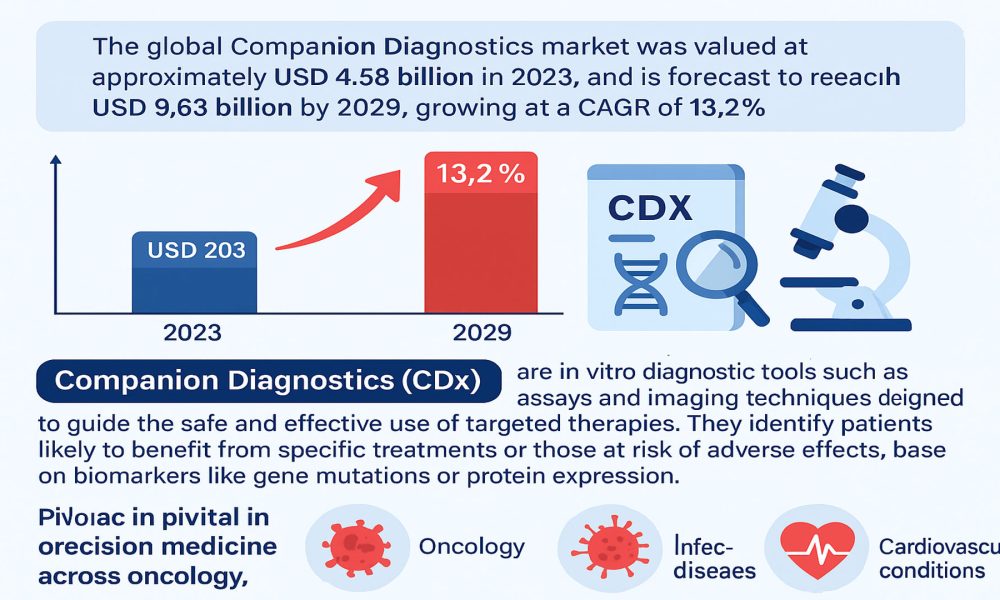
The global Companion Diagnostics market was valued at approximately USD 4.58 billion in 2023, and is forecast to reach USD 9.63 billion by 2029, growing at a CAGR of 13.2%
(CDx) are in vitro diagnostic tools such as assays and imaging techniques designed to guide the safe and effective use of targeted therapies. They identify patients likely to benefit from specific treatments or those at risk of adverse effects, based on biomarkers like gene mutations or protein expression. These diagnostics are pivotal in precision medicine across oncology, infectious diseases, and cardiovascular conditions, aligning therapies with individual molecular profiles.
What are Companion Diagnostics?
Companion diagnostics (CDx) are medical devices – often in vitro assays – that provide essential information for the safe and effective use of corresponding therapeutic products. These tests identify biomarkers that determine whether a specific treatment will benefit particular patients or pose unnecessary risks, fundamentally changing treatment paradigms from “one-size-fits-all” to precision medicine approaches.
The FDA has cleared over 45 companion diagnostics since 2014, with oncology applications dominating the field. These tests are increasingly becoming prerequisites for drug approvals, as seen with PD-L1 tests for immunotherapies and HER2 assays for breast cancer treatments. The global market is currently concentrated in North America and Europe, though Asia-Pacific is emerging as the fastest-growing region.
📥 Download Sample Report:
Companion Diagnostics Market – View in Detailed Research Report
Industry Driver
Surge in FDA-Approved Companion Diagnostics Aligning with Targeted Therapies
The number of FDA-cleared companion diagnostics has increased dramatically in recent years, reflecting stronger drug–diagnostic codevelopment efforts. As of August 2023, the FDA had approved 56 companion diagnostic assays, a significant rise from just 9 by 2010, demonstrating the shift toward biomarker-driven cancer treatments. These CDx tests guide the use of targeted drugs such as osimertinib (Tagrisso), alectinib (Alecensa), and pembrolizumab (Keytruda), ensuring that patients with specific genetic mutations receive optimal therapies. This regulatory trend increases demand for advanced molecular tests and positions CDx as an essential component of precision oncology.
Expanding Insurance Mandates Enhance Access to Biomarker Testing
Insurance coverage mandates for biomarker testing are gaining traction, broadening access and adoption of companion diagnostics. For example, starting in 2026, Connecticut will require private health plans to cover FDA-recognized biomarker tests including those used for cancer diagnostics as part of a broader initiative already embraced by over 20 U.S. states.. This trend reflects growing public health recognition of the value of molecular testing in guiding effective treatment. Mandated coverage increases test utilization, accelerates integration of CDx into standard care pathways, and directly contributes to market expansion by lowering cost barriers for patients.
Industry Restraint
High Development Costs and Regulatory Complexity
Developing a companion diagnostic alongside a targeted therapy is a costly and time-intensive process. It requires coordinated clinical trials, co-validation with therapeutic agents, and compliance with rigorous regulatory standards often involving agencies like the FDA and EMA. Unlike standalone diagnostics, CDx products must demonstrate clinical utility, analytical validity, and alignment with the drug’s safety and efficacy profile. According to the U.S. FDA, companion diagnostics are reviewed under the same Premarket Approval (PMA) pathway used for high-risk Class III devices, which adds significant regulatory burden and delays market entry. Moreover, the co-development model demands close collaboration between pharmaceutical and diagnostic companies, which can be complex in terms of timelines, intellectual property rights, and shared clinical data. These challenges often discourage smaller players from entering the market and may slow down innovation. As a result, the high cost and regulatory complexity of developing companion diagnostics act as a considerable restraint, especially in markets with less regulatory harmonization or lower investment capacity.
Opportunities
Expansion Beyond Oncology into Other Therapeutic Areas
While oncology remains the primary focus for companion diagnostics, the market is beginning to expand into new therapeutic areas such as cardiology, infectious diseases, neurology, and autoimmune disorders. For example, CDx tools are being developed to guide treatment responses for conditions like HIV, Alzheimer’s disease, and rheumatoid arthritis, where patient response to therapies varies widely. As more targeted drugs emerge in these fields, pharmaceutical companies are increasingly integrating biomarker strategies into drug development pipelines. This trend opens up vast new clinical applications for CDx and offers diagnostic firms the chance to diversify beyond cancer, fueling long-term market expansion.
Advancements in Next-Generation Sequencing (NGS) and Liquid Biopsy Technologies
Rapid innovation in genomic technologies especially next-generation sequencing (NGS) and liquid biopsy is making companion diagnostics faster, less invasive, and more comprehensive. NGS allows simultaneous detection of multiple mutations across various genes, making it ideal for identifying patients who may benefit from multiple targeted therapies. Meanwhile, liquid biopsies enable real-time, non-invasive monitoring of tumor genetics using blood samples, expanding diagnostic capabilities even when tissue biopsies aren’t feasible. These advancements not only improve diagnostic accuracy and patient experience but also make CDx more accessible and scalable paving the way for broader integration into routine clinical care globally.
Key industry players include:
- Roche Holdings
- Abbott Laboratories
- Thermo Fisher Scientific
- Agilent Technologies
- Life Technologies
- GE Healthcare
- Agendia
- Qiagen
- Genomic Health
- Myriad Genetics
- Advanced Cell Diagnostics
- Danaher
- Applied Proteomics
Global Companion Diagnostics Market Segmentation
By Indication / Disease Area
- Cancer
- Non-Small Cell Lung Cancer (NSCLC)
- Breast Cancer
- Colorectal Cancer
- Melanoma
- Gastric Cancer
- Prostate Cancer
- Other Cancers
- Neurological Disorders
- Infectious Diseases
- Cardiovascular Diseases
- Other Indications
By End User
- Pharmaceutical & Biotechnology Companies
- Reference Laboratories
- Hospitals & Diagnostic Laboratories
- Contract Research Organizations (CROs)
By Technology
- Molecular Diagnostics
- Polymerase Chain Reaction (PCR)
- Next-Generation Sequencing (NGS)
- Fluorescence In Situ Hybridization (FISH)
- Immunohistochemistry (IHC)
- Immunoassays
- ELISA
- Flow Cytometry
Recent Developments
The companion diagnostics market is evolving rapidly as precision medicine gains momentum in oncology and other therapeutic areas. Recent developments include the approval and commercialization of next-generation sequencing (NGS)-based companion diagnostics, which allow simultaneous detection of multiple genetic mutations to guide targeted therapies. Pharmaceutical and diagnostic companies are increasingly forming strategic partnerships to co-develop drug-diagnostic combinations, particularly for cancer immunotherapies and rare genetic disorders. Additionally, the FDA and other regulatory agencies are accelerating approval processes for companion diagnostics linked to novel biologics and personalized therapies, ensuring faster time-to-market. Integration of AI and machine learning algorithms into diagnostic platforms is enhancing the predictive accuracy of patient response to therapies, supporting the shift toward individualized treatment plans.
Explore Offshore Wind Power Market
Competitive Landscape
Innovation is intense among key players:
- Medtronic (RFA dominance)
- Boston Scientific (Microwave tech)
- Johnson & Johnson (Cryoablation systems)
- Emerging players focusing on AI integration
About Intel Market Research
Intel Market Research is a leading provider of strategic intelligence, offering actionable insights in biotechnology, pharmaceuticals, and healthcare infrastructure. Our research capabilities include:
- Real-time competitive benchmarking
- Global clinical trial pipeline monitoring
- Country-specific regulatory and pricing analysis
- Over 500+ healthcare reports annually
Trusted by Fortune 500 companies, our insights empower decision-makers to drive innovation with confidence.
🌐 Website: https://www.intelmarketresearch.com
📞 International: +1 (332) 2424 294
📞 Asia-Pacific: +91 9169164321
🔗 LinkedIn: Follow Us




