
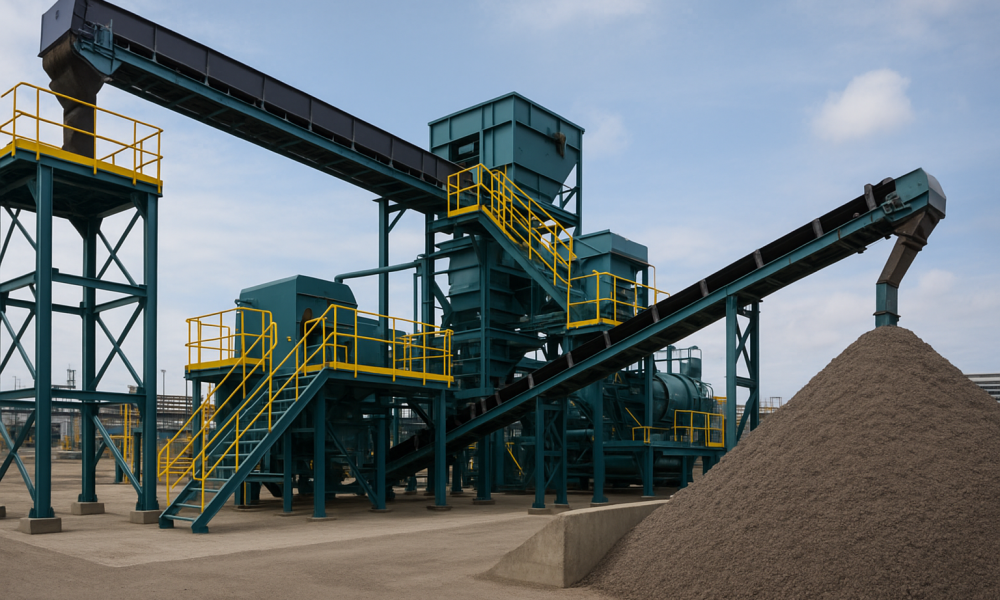
The global bottom ash recycling installations market has emerged as a critical component of sustainable waste management infrastructure, demonstrating exceptional growth potential as industries increasingly embrace circular economy principles. The market achieved a revenue of USD 407.5 million in 2024 and is projected to reach USD 575 million by 2033, driven by a compound annual growth rate (CAGR) of 3.8% over the forecast period.
This expansion reflects a fundamental shift in how industries approach waste management, transforming what was once considered industrial waste into valuable secondary raw materials. The market’s growth trajectory underscores the increasing global commitment to environmental sustainability and resource conservation, positioning bottom ash recycling installations as essential infrastructure for achieving circular economy objectives.
𝐆𝐞𝐭 𝐚 𝐟𝐫𝐞𝐞 𝐬𝐚𝐦𝐩𝐥𝐞 𝐫𝐞𝐩𝐨𝐫𝐭: https://datahorizzonresearch.com/request-sample-pdf/bottom-ash-recycling-installations-market-37762
Market Dynamics and Growth Drivers
The bottom ash recycling installations market’s robust performance stems from several interconnected factors that are reshaping the waste management landscape. A significant driver of market growth is the rising demand for sustainable construction materials, as the construction industry’s shift towards eco-friendly practices necessitates the use of recycled materials.
Environmental regulations continue to tighten globally, creating mandatory frameworks that drive adoption of bottom ash recycling technologies. The European Union’s aggressive waste recycling mandates exemplify this trend, requiring member states to achieve specific recycling targets that cannot be met without advanced waste processing infrastructure.
The economic benefits of bottom ash recycling have become increasingly apparent to facility operators. European Waste-to-Energy plants generate roughly 19 million tons of bottom ash annually, with this material containing 10-12% ferrous metals and 2-5% non-ferrous metals, including valuable aluminum. This metal content represents substantial revenue potential when properly recovered and processed.
Technological advancement in separation and processing equipment has significantly improved the efficiency and profitability of bottom ash recycling operations. Modern installations can now recover materials that were previously uneconomical to extract, expanding the range of valuable products that can be derived from bottom ash streams.
Comprehensive Market Segmentation Analysis
By Deployment Model
Stationary Installations
Stationary installations dominate the market with a valuation of USD 287.8 million in 2024, projected to grow to USD 388.8 million by 2033, at a CAGR of 3.4%. These permanent facilities are strategically designed for long-term, large-scale operations, typically positioned near major bottom ash generation sources to minimize transportation costs and maximize operational efficiency.
Stationary installations offer superior processing capabilities through their integration of advanced separation technologies, including magnetic separators, eddy current systems, and optical sorting equipment. Their fixed infrastructure allows for higher throughput capacities and more sophisticated quality control measures, making them ideal for processing large volumes of bottom ash from major waste-to-energy facilities.
Mobile/Portable Installations
Mobile installations represent the fastest-growing segment, projected to reach USD 179.4 million by 2033, growing at a CAGR of 4.6%. Companies like Meldgaard Recycling have developed what they describe as “probably the most advanced mobile ash recycling operation in the world,” offering solutions that can be operational within three months.
The appeal of mobile installations lies in their flexibility and adaptability, making them ideal for processing bottom ash at or near generation points. This approach significantly reduces transportation costs and environmental impacts while providing scalable solutions for facilities with varying processing needs. Mobile units are particularly valuable for temporary projects, seasonal operations, or facilities testing recycling feasibility before committing to permanent infrastructure.
By Application Scale
Small-scale Operations (< 50,000 tons/year)
Small-scale installations serve regional waste-to-energy facilities, smaller municipalities, and specialized industrial operations. These installations focus on cost-effective metal recovery and basic aggregate production, typically employing simplified processing chains that prioritize operational simplicity and maintenance efficiency.
Medium-scale Operations (50,000 – 200,000 tons/year)
Medium-scale installations represent the market’s sweet spot, offering balanced economics between capital investment and processing capacity. These facilities typically serve metropolitan areas or industrial clusters, incorporating more sophisticated separation technologies to maximize material recovery rates and product quality.
Large-scale Operations (> 200,000 tons/year)
Large-scale installations serve major urban centers and industrial regions, featuring comprehensive processing capabilities that can handle diverse bottom ash compositions. These facilities often integrate multiple processing lines and advanced automation systems to achieve optimal efficiency and product quality consistency.
By Processing Method
Dry Extraction Systems
Dry extraction systems have gained prominence due to their efficiency in metal recovery, particularly in the fine grain range. These systems eliminate moisture-related processing challenges while enabling more effective separation of valuable materials. Dry processing allows for better control over particle size distribution and reduces the complexity of downstream processing steps.
Wet Extraction Systems
Wet extraction systems remain important for specific applications, particularly where dust control is critical or where certain separation techniques require liquid media. While generally more complex than dry systems, wet processing can be advantageous for handling certain bottom ash compositions or achieving specific product specifications.
By End-Use Application
Road Construction
The mineral fraction of bottom ash, comprising 80-85% of the material, can be utilized as filling material for construction purposes, specifically as sub-base material in road construction, substituting virgin gravel material. This application represents one of the largest volume uses for processed bottom ash, offering significant cost savings and environmental benefits compared to traditional road construction materials.
Building Materials
Processed bottom ash finds extensive application in various building materials, from concrete aggregates to specialized construction products. The material’s properties make it suitable for non-structural applications where its unique characteristics can provide performance advantages.
Cement Production
Bottom ash is legally defined as substitute building material and can be used instead of cement in concrete production. This application is particularly valuable given the cement industry’s high carbon footprint, making bottom ash an important contributor to sustainable construction practices.
Land Reclamation
Large-scale land reclamation projects utilize processed bottom ash as fill material, providing a valuable outlet for high-volume applications while contributing to infrastructure development projects.
Regional Market Analysis
Europe Leading Market Development
Europe maintains its position as the most mature market for bottom ash recycling installations, driven by stringent environmental regulations and well-established waste-to-energy infrastructure. Countries like Germany and the UK are leading the charge, investing heavily in recycling technologies and promoting the use of recycled materials in construction and infrastructure projects.
Asia-Pacific Emerging as High-Growth Region
The Asia-Pacific market is projected to reach USD 131.06 million by 2033, with the highest CAGR of 4.2%. Rapid industrialization, urbanization, and increasing environmental awareness in countries like China, Japan, and South Korea are driving demand for bottom ash recycling installations.
Key Market Players and Competitive Landscape
The bottom ash recycling installations market features a diverse ecosystem of established technology providers and innovative specialists. Major companies include HEILIG GROUP, TU Delft, Steinert, Bezner, and Blue Phoenix Group, each bringing unique technological capabilities and market expertise.
Technology Leaders
- N.M. Heilig: Specializes in engineered machinery and installations for bottom ash processing, focusing on metal recovery and aggregate production systems that contribute to zero waste management goals
- Steinert: Provides comprehensive magnet and sensor sorting technology for IBA recycling, offering decades of experience with highly effective separation technology designed for adverse operating conditions
- Meldgaard Recycling: With more than 25 years’ experience in processing incinerator bottom ash, they process 1.4 million tonnes of ash annually, offering both mobile and stationary recycling solutions
- Blue Phoenix Group: Recognized as a key player in the integrated waste management and recycling sector, providing comprehensive bottom ash processing solutions
Market Outlook and Future Prospects
The bottom ash recycling installations market is poised for sustained growth through 2033, driven by the convergence of environmental imperatives, economic opportunities, and technological advancement. The market’s expansion is fundamentally supported by the increasing commitment to sustainable waste management and the adoption of circular economy principles worldwide.
Technological Innovation Driving Efficiency
Advanced separation technologies continue to improve the economic viability of bottom ash recycling. Modern ADR technology can generate an extra recovery of 8 kg of fine non-ferrous scrap per ton of bottom ash over traditional technologies, including 6 kg of aluminum and 2 kg of heavy non-ferrous metals. This technological progress directly translates to improved project economics and expanded market opportunities.
Regulatory Environment Supporting Growth
Strengthening environmental regulations worldwide continue to create mandatory frameworks for bottom ash recycling. These regulatory drivers ensure sustained demand for recycling installations while providing the policy certainty needed for long-term investment planning.
Circular Economy Integration
The strategic shift toward circular economy principles enhances demand for bottom ash recycling installations, as they offer efficient and environmentally friendly waste management solutions essential for achieving circular economy objectives. This integration positions the market as a critical component of sustainable industrial infrastructure.
Investment Opportunities and Strategic Considerations
The bottom ash recycling installations market presents compelling investment opportunities across multiple dimensions. The combination of regulatory drivers, technological advancement, and economic incentives creates a favorable environment for sustained market expansion.
Capital Efficiency Focus
Modern installations demonstrate improved capital efficiency through modular design approaches and standardized processing equipment. This evolution makes recycling installations accessible to a broader range of operators while improving return on investment characteristics.
Geographic Expansion Potential
Emerging markets in Asia-Pacific and Latin America present significant growth opportunities as these regions develop waste-to-energy infrastructure and implement more stringent environmental regulations. Early market entry in these regions offers substantial competitive advantages.
Technology Integration Opportunities
The integration of artificial intelligence, advanced automation, and IoT technologies into bottom ash recycling installations represents a significant opportunity for differentiation and operational efficiency improvement. Companies that successfully integrate these technologies will likely capture market share and achieve superior economic performance.
Conclusion
The bottom ash recycling installations market represents a compelling intersection of environmental responsibility and economic opportunity. With projected growth to $575 million by 2033, the market offers sustainable returns while contributing to critical environmental objectives. Success in this market requires understanding the complex interplay of regulatory drivers, technological capabilities, and economic incentives that shape industry dynamics.
As global focus on circular economy principles intensifies, bottom ash recycling installations will play an increasingly vital role in sustainable waste management infrastructure. Organizations that position themselves effectively in this market will benefit from both strong financial returns and meaningful environmental impact, making bottom ash recycling installations a cornerstone of sustainable industrial development.
𝐋𝐚𝐭𝐞𝐬𝐭 𝐑𝐞𝐩𝐨𝐫𝐭𝐬:
𝐂𝐨𝐦𝐩𝐚𝐧𝐲 𝐍𝐚𝐦𝐞: 𝐃𝐚𝐭𝐚𝐇𝐨𝐫𝐢𝐳𝐳𝐨𝐧 𝐑𝐞𝐬𝐞𝐚𝐫𝐜𝐡
𝐀𝐝𝐝𝐫𝐞𝐬𝐬: 𝐍𝐨𝐫𝐭𝐡 𝐌𝐚𝐬𝐨𝐧 𝐒𝐭𝐫𝐞𝐞𝐭, 𝐅𝐨𝐫𝐭 𝐂𝐨𝐥𝐥𝐢𝐧𝐬,
𝐂𝐨𝐥𝐨𝐫𝐚𝐝𝐨, 𝐔𝐧𝐢𝐭𝐞𝐝 𝐒𝐭𝐚𝐭𝐞𝐬.
Mail: [email protected]
About us:
DataHorizzon is a market research and advisory company that assists organizations across the globe in formulating growth strategies for changing business dynamics. Its offerings include consulting services across enterprises and business insights to make actionable decisions. DHR’s comprehensive research methodology for predicting long-term and sustainable trends in the market facilitates complex decisions for organizations.




