
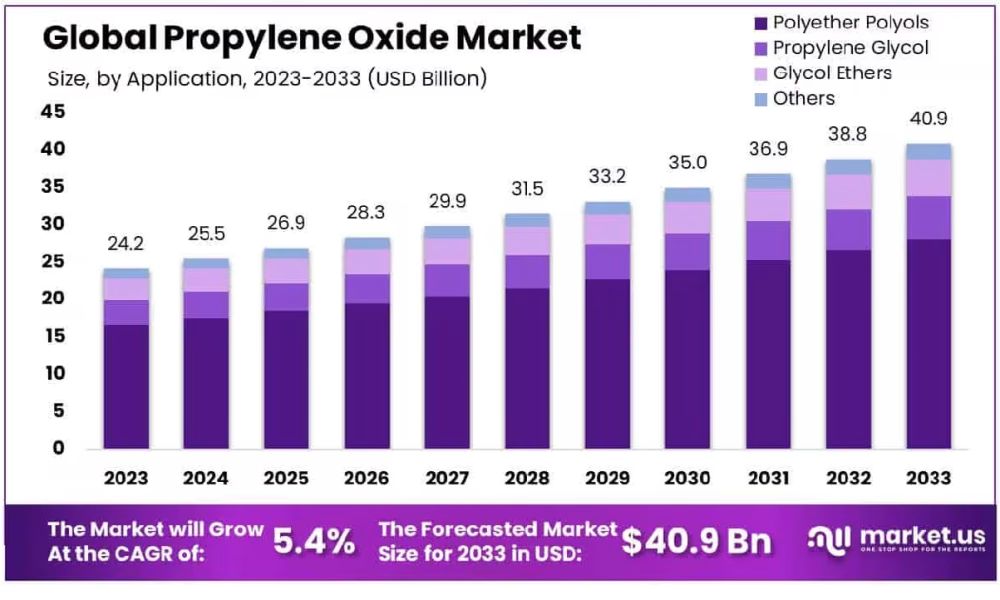
According to market.us, the global propylene oxide market is projected to reach USD 40.9 billion by 2033, up from USD 24.2 billion in 2023, growing at a CAGR of 5.4% from 2024 to 2033. Propylene oxide plays a vital role in the production of polyurethane plastics, propylene glycol, and glycol ethers, making it essential to key sectors such as automotive, construction, and pharmaceuticals. The demand is largely driven by the need for lightweight materials, energy-efficient insulation, and high-performance solvents.
Polyether polyols account for the majority of consumption, representing nearly 60–70% of global demand. Propylene glycol follows with 20%, while glycol ethers contribute around 5%. These diverse end-uses reflect the chemical’s broad industrial significance. The global production and consumption landscape is shaped by technological innovations, regulatory pressures, and growing interest in sustainable materials.
Despite the steady long-term outlook, the market experienced a contraction in trade between 2021 and 2022. Global exports of propylene oxide dropped by 24.6%, falling from USD 2.76 billion to USD 2.08 billion. Major exporting nations during 2021 included the Netherlands, Saudi Arabia, the United States, Thailand, and Germany, highlighting a geographically diversified production network. These developments underscore the sector’s dynamic supply chain and evolving demand patterns.
Key Takeaways
- The global propylene oxide market is projected to expand from USD 24.2 billion in 2023 to USD 40.9 billion by 2033, growing at a CAGR of 5.4%.
- Asia-Pacific dominates Propylene Oxide market at 48.9%, reaching USD 11.8 billion.
- Chlorohydrin process accounts for 45.6% of propylene oxide production.
- Polyether polyols dominate applications, representing 68.7% of market usage.
- The automotive industry leads end-use with 35.6% of consumption.
Access a Complimentary Sample of This Premium Report: https://market.us/report/propylene-oxide-market/request-sample/
Factors Affecting the Growth of the Propylene Oxide Market
Rising Demand from Polyurethane Applications: The growth of the construction, automotive, and furniture industries has significantly increased the demand for polyurethane foams, coatings, and adhesives. As propylene oxide is a key raw material in producing polyether polyols, which are essential for polyurethane manufacturing, this rising demand continues to drive market expansion.
Expansion of the Automotive and Transportation Sector: The automotive industry’s shift toward lightweight and fuel-efficient vehicles has amplified the use of polyurethane-based components, such as seats, insulation, and structural parts. This directly boosts the consumption of propylene oxide and supports long-term market growth.
Environmental Regulations and Sustainability Trends: Stringent environmental policies and growing interest in low-emission, sustainable materials are influencing production methods and product formulations. Manufacturers are increasingly investing in eco-friendly production technologies and bio-based alternatives, which are shaping the future growth trajectory of the market.
Fluctuations in Raw Material Availability and Costs: The availability and pricing of propylene, a key feedstock in propylene oxide production, are highly dependent on global petrochemical trends. Variability in crude oil prices and refinery operations can impact production margins and affect the supply chain.
Global Trade Dynamics and Geopolitical Factors: The propylene oxide market is highly sensitive to trade flows and geopolitical developments. Export restrictions, international trade policies, and disruptions in shipping routes can influence the global supply and pricing of propylene oxide, thereby impacting market stability and growth prospects.
Key Market Segmentation
By Production Process Analysis
In 2023, the Chlorohydrin Process dominated global propylene oxide production, accounting for 45.6% of the market. This method remains widely used due to its established technology and integration within regions that have strong chemical manufacturing infrastructure. The Styrene Monomer Process, followed with a 24.9% share, offering the added advantage of producing both styrene and propylene oxide, which makes it economically viable where demand for both outputs is high.
The TBA Co-product Process held a 20.1% share and has gained momentum owing to its relatively lower environmental impact and the commercial utility of tertiary butyl alcohol, a valuable co-product. Other production technologies combined made up 9.4% of the market. These include emerging, eco-friendly methods that are slowly increasing in adoption as the industry responds to stricter environmental regulations and a growing preference for sustainable production practices.
By Application Analysis
In 2023, polyether polyols dominated the application segment of the propylene oxide market with a 68.7% share. This dominance is driven by their critical role in producing polyurethane foams, which are extensively used in the automotive, construction, and furniture industries for their insulation, flexibility, and durability.
Propylene glycol followed with an 18.3% share, reflecting its importance in the production of unsaturated polyester resins used across various sectors, including fiberglass-reinforced plastics and cleaning products. Glycol ethers accounted for 9.0% of the market, primarily used as solvents in paints, inks, and coatings due to their strong performance in both industrial and residential applications.
The remaining 4.0% share was attributed to other applications, including pharmaceuticals, food-grade uses, and specialty chemical manufacturing, where propylene oxide’s reactive properties are applied to niche yet essential end-use markets.
By End-Use Analysis
In 2023, the automotive sector led propylene oxide consumption by end-use, accounting for 35.6% of the market. This dominance is driven by the widespread use of polyurethane-based components such as seating foams and insulation materials that enhance vehicle efficiency and reduce weight. The building and construction sector followed with a 22.4% share, utilizing polyurethane foams for energy-efficient insulation in modern structures.
The chemicals and pharmaceuticals segment captured 15.2% of the market, where propylene oxide is essential in producing pharmaceutical-grade solvents and chemical intermediates. Packaging accounted for 12.1%, supported by demand for durable foams and coatings used in protective consumer packaging.
Textile and furnishing applications represented 9.0%, with propylene oxide used in cushioning foams and comfort-enhancing materials. The remaining 5.7% was attributed to other sectors such as agriculture, marine, and mining, where specialized applications of propylene oxide derivatives meet specific industrial needs.
Key Market Segments
By Production Process
- Chlorohydrin Process
- Styrene Monomer Process
- TBA Co-product Process
- Others
By Application
- Polyether Polyols
- Propylene Glycol
- Glycol Ethers
- Others
By End-Use
- Automotive
- Building & Construction
- Chemicals & Pharmaceuticals
- Packaging
- Textile and Furnishing
- Others
Regional Analysis
In 2023, Asia-Pacific dominated the global propylene oxide market with a 48.9% share, generating revenues of USD 11.8 billion. This leadership is attributed to rapid industrialization in countries like China and India, where rising demand from the automotive and construction sectors is driving the use of polyurethane-based products. Supportive government policies and ongoing infrastructure development further strengthen the region’s position.
North America holds a strong market presence, led by the U.S., where technological advancements and strict environmental regulations are encouraging the shift toward sustainable and efficient production methods. Significant investment in R&D is supporting the development of greener technologies in the region.
Europe also commands a notable share, characterized by high demand for sustainable and bio-based chemicals. Regulatory frameworks such as REACH are promoting safer alternatives, including bio-based propylene oxide, aligning with the region’s environmental priorities.
Latin America and the Middle East & Africa, though holding smaller shares, display strong growth potential. In Latin America, countries like Brazil are expanding industrial activities, while the Middle East, particularly Saudi Arabia, is diversifying its economy beyond oil, presenting emerging opportunities in the chemicals sector, including propylene oxide.
Market Key Players
- China Petrochemical Corporation
- Royal Dutch Shell
- BASF SE
- LyondellBasell Industries
- Mitsui Chemicals, Inc.
- Ineos Group Limited
- The Dow Chemicals
- Sumitomo Chemical Co., Ltd.
- Huntsman International LLC.
- LOTTE CHEMICAL CORPORATION
- PetroChina International Co., Ltd.
- SK Chemicals
- Air Products and Chemicals, Inc.
- Eastman Chemical Company
- Hanwha Group
- Repsol
- AGC Chemicals
Get in Touch with Us:
Market.us (Powered By Prudour Pvt. Ltd.)
Address: 420 Lexington Avenue, Suite 300 New York City, NY 10170, United States
Send Email: [email protected]
Refer to More Related Reports:



