
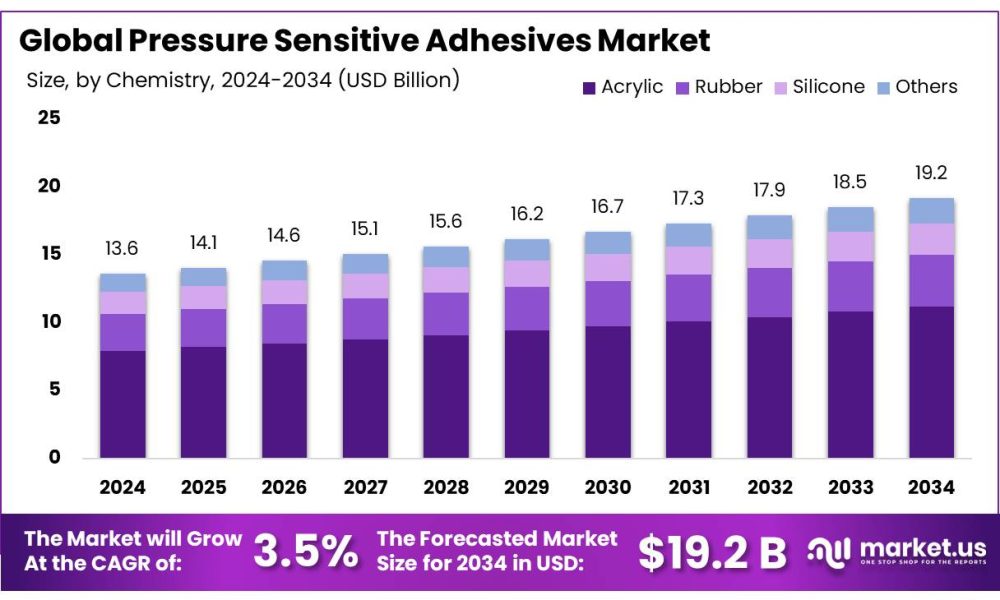
According to market.us, the global Pressure Sensitive Adhesives (PSA) market is projected to reach approximately USD 19.2 billion by 2034, rising from USD 13.6 billion in 2024, at a CAGR of 3.5% from 2025 to 2034. PSAs are non-reactive adhesives that form bonds under light pressure without requiring heat, water, or solvents, making them crucial across sectors such as packaging, automotive, electronics, medical, and construction.
In medical applications, 3M’s Medical Tape 1538 features an acrylic adhesive with a peel adhesion of 7.4 N/25 mm on stainless steel, suited for wearable devices and wound dressing. 3M’s Tegaderm, based on polyurethane, emphasizes skin flexibility, though peel data is unspecified. Avery Dennison’s MED 5078A, also acrylic-based, provides short-term surgical adhesion with a strong peel adhesion of 14.1 N/25 mm.
The market is segmented by technology, application, and end-use. In 2024, water-based PSAs led the market with over 46% share, supported by growing demand for low-VOC formulations. Application-wise, tapes held the largest share at 45%, driven by increased logistics and e-commerce activity.
Regionally, Asia-Pacific accounted for 46% of global revenue, led by industrial expansion in China, India, and Japan. This growth reflects the sector’s adaptability and increasing relevance across multiple industries.
Key Takeaways
- The global Pressure Sensitive Adhesives Market is projected to reach USD 19.2 billion by 2034, growing at a CAGR of 3.5% from 2025 to 2034.
- Acrylic-based PSAs dominated with 58.3% market share in 2024 due to their durability, UV resistance, and versatility across industries.
- Water-based PSAs led with a 46.8% share in 2024, favored for being eco-friendly, low-VOC, and compliant with strict environmental regulations.
- Plastic substrates held the largest share, 35.6% in 2024, due to their widespread use in packaging, automotive, and electronics.
- Labels were the top PSA application, capturing 45.9% market share in 2024, driven by demand in food & beverage, pharmaceuticals, and logistics.
- The automotive sector was the leading end-user, holding 42.7% share in 2024, due to demand for lightweight and durable bonding solutions.
- APAC is the dominant region, accounting for 46.3% of the global PSA market USD 6.2 billion, led by China, Japan, India, and South Korea.
Access a Complimentary Sample of This Premium Report: https://market.us/report/global-pressure-sensitive-adhesives-market/request-sample/
Factors Affecting the Growth of the Pressure-Sensitive Adhesives Market
Rising Demand from Packaging and Logistics Sectors: The surge in e-commerce and global trade has led to increased consumption of tapes and labels, which are key applications of pressure-sensitive adhesives. These adhesives provide fast, clean, and efficient bonding, making them ideal for high-speed packaging lines and logistics operations.
Growth in Medical and Healthcare Applications: The expansion of wearable medical devices, wound care products, and surgical tapes is fueling demand for skin-friendly and biocompatible PSAs. Medical-grade adhesives are being tailored for use in sensitive environments, contributing significantly to market expansion.
Technological Advancements in Adhesive Formulations: Continuous innovations in PSA technology, such as the development of low-VOC, solvent-free, and high-performance water-based formulations, are enhancing product performance and environmental compliance. These advancements are attracting end-users across multiple industries.
Expansion of the Automotive and Electronics Industries: PSAs are increasingly used in automotive interiors, sensors, insulation, and electronic device assembly. As vehicles and electronic gadgets become more compact and lightweight, PSAs offer a viable alternative to traditional fasteners due to their flexibility and clean finish.
Regulatory Push Towards Sustainable and Eco-Friendly Solutions: Stringent environmental regulations are driving the shift towards water-based and hot melt PSAs with reduced environmental impact. Manufacturers are adopting sustainable raw materials and formulations, aligning with global sustainability targets and influencing buyer preferences.
Key Market Segmentation
By Chemistry Analysis
In 2024, acrylic-based pressure-sensitive adhesives (PSAs) led the market with a dominant share of over 58.3%. This leadership is attributed to their versatility, strong bonding capabilities, and resistance to environmental factors such as UV exposure and temperature variations.
Acrylic PSAs are extensively used across packaging, automotive, electronics, and healthcare sectors due to their durability, ease of use, and compatibility with diverse surfaces. Their non-toxic properties further enhance their appeal over alternative chemistries.
Continued demand is driven by growing applications in labels, tapes, and medical adhesives. Additionally, advancements in formulation technologies are strengthening their performance in specialized industrial applications, reinforcing their market dominance.
By Technology Analysis
In 2024, water-based pressure-sensitive adhesives (PSAs) held a leading market share of over 46.8%, driven by their eco-friendly nature, low VOC emissions, and ease of application. Widely used in packaging, labels, and consumer goods, these adhesives are favored by manufacturers aiming to comply with stringent environmental regulations, particularly in North America and Europe.
Their dominance is expected to continue, supported by global sustainability initiatives and evolving regulatory standards. While solvent-based and hot-melt PSAs serve specific high-performance needs, water-based PSAs remain the preferred option for everyday applications such as stickers, tapes, and medical patches.
By Substrate Analysis
In 2024, plastic emerged as the leading substrate in the pressure-sensitive adhesives (PSAs) market, holding over 35.6% of the total share. This dominance is driven by its extensive use in packaging, automotive, electronics, and consumer goods, where its flexibility, durability, and lightweight nature are highly valued.
PSAs adhere effectively to various plastics such as polyethylene, polypropylene, and PVC, making them essential for applications like labels, tapes, and protective films. While paper and metal also contribute notably, plastic remains the preferred substrate due to its cost-efficiency and versatility.
Continued innovation in adhesive formulations is enhancing performance on challenging plastic surfaces. Although sustainability efforts may encourage recyclable alternatives, traditional plastics continue to lead in PSA usage.
By Application Analysis
In 2024, labels led the pressure-sensitive adhesives (PSAs) market with a dominant 45.9% share. This stronghold is attributed to widespread use across industries such as food & beverage, pharmaceuticals, retail, and logistics, where labels are essential for branding, information display, and tracking. Pressure-sensitive labels are favored for their quick, solvent-free application, ideal for high-speed production lines.
The segment is expected to maintain a 45–46% share, supported by the growth of e-commerce, evolving labeling regulations, and adoption of smart technologies like RFID. Although tapes and specialty films also utilize PSAs, labels remain the primary application. Innovations such as eco-friendly adhesives and linerless labels continue to reinforce their market dominance.
By End-Use Analysis
In 2024, the automotive and transportation sector led the pressure-sensitive adhesives (PSAs) market with a significant 42.7% share. This dominance is driven by the industry’s need for lightweight, durable bonding solutions in applications such as vehicle assembly, interior trim, and noise reduction.
PSAs offer advantages over mechanical fasteners by reducing vehicle weight, enhancing fuel efficiency, and improving vibration resistance—critical factors amid the shift toward electric vehicles and stricter emissions standards.
While packaging and healthcare sectors also utilize PSAs, automotive applications like wire harnessing, interior panels, and exterior decals keep this segment at the forefront. Innovations in high-temperature-resistant and recyclable PSAs are further supporting growth and long-term adoption.
Key Market Segments
By Chemistry
- Acrylic
- Pure Acrylic
- Modified Acrylic
- Rubber
- Natural
- Synthetic
- Silicone
- Others
By Technology
- Water-based
- Solvent-based
- Hot Melt
- Radiation-Cured
By Substrate
- Plastic
- Paper
- Metal
- Glass
- Wood
- Others
By Application
- Labels
- Tapes
- Single-Faced
- Double-Faced
- Others
- Graphics
- Others
By End-Use
- Automotive and Transportation
- Electronics
- Consumer Goods
- Packaging
- Building and Construction
- Medical and Healthcare
- Others
Regional Analysis
In 2024, the Asia-Pacific (APAC) region dominated the pressure-sensitive adhesives (PSAs) market with a 46.3% share, valued at USD 6.2 billion. This leadership is fueled by rapid industrialization, a booming packaging sector, and strong demand from the automotive and electronics industries. Key contributors include China, Japan, India, and South Korea.
Growth is further driven by rising e-commerce, which increases the need for labels, tapes, and specialty films. In South Korea and Taiwan, the electronics industry heavily uses PSAs for display bonding and smartphone assembly.
Japan and India’s automotive sectors also drive demand for lightweight adhesive solutions. APAC’s cost-efficient production and export strength solidify its top market position.
Top Key Players in the Market
- Henkel AG and Co. KGaA
- H.B. Fuller Company
- Arkema
- 3M
- Sika AG
- Ashland, Inc.
- Pidilite Industries Ltd.
- Momentive Performance Materials, Inc.
- Franklin International, Inc.
- DuPont de Nemours, Inc.
- Helmitin Adhesives
- DIC Corporation
- Avery Dennison Corporation
- Wacker Chemie AG
- Tesa SE
- Illinois Tool Works Inc
- Scapa
- Jowat SE
- Exxon Mobil Corporation
Get in Touch with Us:
Market.us (Powered By Prudour Pvt. Ltd.)
Address: 420 Lexington Avenue, Suite 300 New York City, NY 10170, United States
Send Email: [email protected]
Refer to More Related Reports:



