
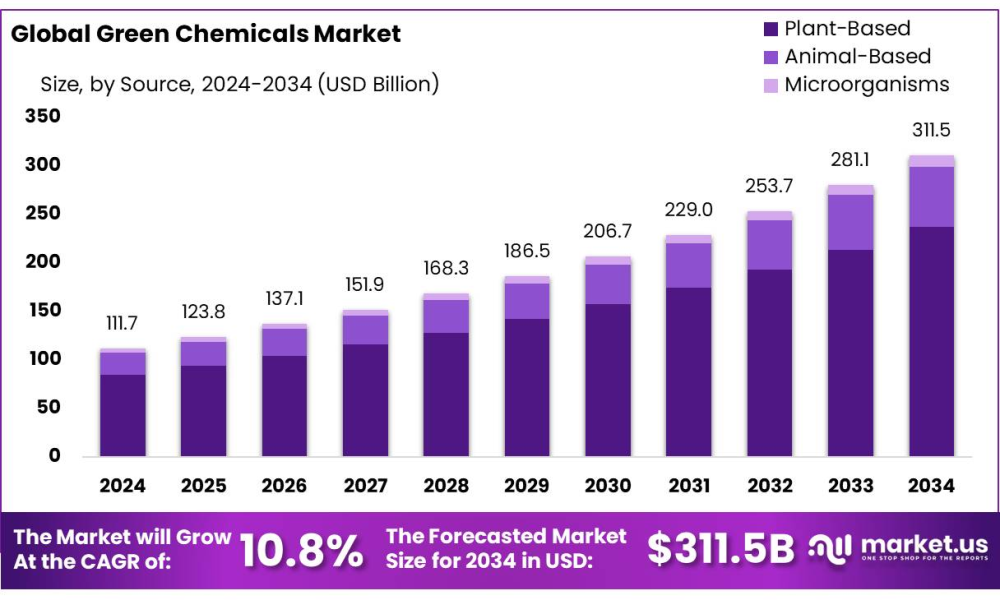
New York, NY – July 15, 2025 – The Global Green Chemicals Market is gaining massive popularity as businesses and consumers shift toward eco-friendly alternatives. In 2024, the market was valued at USD 111.7 billion and is projected to reach USD 311.5 billion by 2034, growing at a strong 10.8% CAGR.
This rapid expansion is driven by increasing demand for sustainable products, strict environmental regulations, and rising awareness about pollution and climate change. Industries like agriculture, packaging, and automotive are adopting green chemicals to reduce their carbon footprints, boosting market growth. Bio-based solvents, biodegradable plastics, and green fertilizers are among the most sought-after products.
The Indian government has committed approximately ₹32 lakh crore (USD 39 billion) to renewable energy projects, including green hydrogen and solar power, highlighting its dedication to sustainable energy solutions critical for green chemical production. As of March 2025, India’s installed renewable energy capacity reached 220.10 GW, with solar power at 106 GW and wind power at 50.04 GW.
Governments worldwide are supporting this shift through incentives and policies, creating huge opportunities for manufacturers. Emerging economies, especially in Asia-Pacific, are witnessing fast market expansion due to industrialization and green initiatives. Companies investing in R&D to develop cost-effective and high-performance green chemicals will lead the market. With consumers preferring eco-friendly options, the green chemicals market is set for long-term success, offering profitable opportunities for businesses ready to innovate and expand sustainably.
The chemical industry, a vital contributor to India’s economy, accounts for about 7% of GDP and employs over 5 million people. It is projected to grow from USD 220 billion in 2022 to USD 300 billion by 2030, driven by supportive policies and increasing demand for sustainable products.
The green chemicals market concentrates sector is gaining momentum from India’s renewable energy advancements. By October 2024, renewables comprised 46.3% of India’s total energy capacity, with a goal of 500 GW by 2030. This transition to renewable energy supports sustainable feedstock for green chemical production, aligning with global decarbonization efforts.
Important Revelation
- Green Chemicals Market size is expected to be worth around USD 311.5 billion by 2034, from USD 111.7 billion in 2024, growing at a CAGR of 10.8%.
- Plant-Based held a dominant market position, capturing more than a 76.1% share in the global green chemicals market.
- Biopolymers held a dominant market position, capturing more than a 39.2% share in the global green chemicals market.
- Chemical held a dominant market position, capturing more than a 37.3% share in the global green chemicals market.
- North America retained a dominant position in the green chemicals market, holding approximately 48.2% of global revenues, equivalent to USD 53.8 billion.
➤ Download Exclusive Sample Of This Premium Report (Including Full TOC, Table & Figures): https://market.us/report/green-chemicals-market/request-sample/
Report Segmentation
By Source Analysis
- In 2024, the plant-based segment led the global green chemicals market, securing over 76.1% of the market share by source. This dominance stemmed from the rising use of agricultural biomass, starches, sugars, and plant-derived oils in producing biopolymers, bio-alcohols, and other green intermediates.
- Industries like packaging, textiles, and personal care increasingly adopt plant-based formulations to achieve sustainability targets and reduce reliance on fossil-based feedstocks. Growing consumer awareness and supportive government policies for bio-based alternatives further bolstered this segment.
By Product Type Analysis
- In 2024, biopolymers dominated the global green chemicals market by product type, capturing over 39.2% of the market share. This was fueled by increasing demand for eco-friendly packaging, compostable plastics, and renewable alternatives to traditional polymers in sectors like food, agriculture, and consumer goods.
- Biopolymers such as PLA, PHA, and starch blends gained traction due to their biodegradability and reduced carbon footprint. Government regulations banning single-use plastics and promoting sustainable materials further accelerated biopolymer adoption. In 2025, this segment is expected to see steady growth as more companies integrate biopolymers into their product portfolios to meet environmental and consumer demands.
By End-Use Analysis
- In 2024, the chemical sector held the largest share of the global green chemicals market by end-use, accounting for over 37.3% of the market. This was driven by the growing adoption of bio-based inputs in manufacturing solvents, resins, surfactants, and specialty chemicals. As industries aim to reduce emissions and comply with stringent environmental regulations, chemical manufacturers are increasingly turning to green feedstocks to reformulate conventional products.
- The emphasis on carbon neutrality and sustainable sourcing has positioned renewable chemicals as a preferred option in industrial manufacturing and chemical processing. In 2025, this segment is anticipated to expand further, supported by increased investments in green alternatives and stricter environmental standards in chemical supply chains.
Market Key Segmentation
Based on Product Type
- Biopolymers
- Bio-alcohols
- Bio-organic Acids
- Bio-ketones
- Platform Chemicals
- Others
Based on Source
- Plant-Based
- Animal-Based
- Microorganisms
Based on End-Use
- Chemical
- Food & Beverages
- Pharmaceuticals
- Automotive & Transportation
- Paints & Coatings
- Packaging
- Building & Construction
- Textiles & Apparel
- Electronics & Consumer Goods
- Personal Care & Cosmetics
- Others
Regional Analysis
In 2024, North America dominated the global green chemicals market, accounting for approximately 48.2% of total revenue, valued at USD 53.8 billion. This leading position is largely attributed to the region’s strong focus on sustainable industrial practices and the growing adoption of environmentally friendly chemical alternatives.
The United States plays a pivotal role, with increasing use of bio-based solvents, biodegradable plastics, and non-toxic feedstocks, fueled by supportive regulations and financial incentives aimed at reducing dependency on fossil-derived inputs. State-level programs, such as California’s Green Chemistry Initiative introduced under AB 1879 and SB 509 in 2008, continue to drive innovation by mandating chemical safety reporting and promoting the development of safer, eco-compatible materials.
Competitive Landscape
- BASF SE
- Braskem
- Arkema
- Evonik Industries AG
- Toray Industries, Inc.
- Cargill, Incorporated
- Mitsubishi Chemical Group Corporation
- Archer Daniels Midland
- DSM
- PTT Global Chemical
- Corbion N.V.
- BioAmber, Inc.
- DuPont
- Novozymes A/S
- Amyris, Inc.
- SABIC
- POET, LLC
- Valero Energy Corporation
- Green Plains Inc.
- Other Key Players
Get in Touch with Us:
Market.us (Powered By Prudour Pvt. Ltd.)
Address: 420 Lexington Avenue, Suite 300, New York City, NY 10170, United States
Send Email: [email protected]
Refer To More Related Reports:
Natural Gas Refueling Stations Market
Ferulic Acid Market
Fiberglass Pipe Market



