
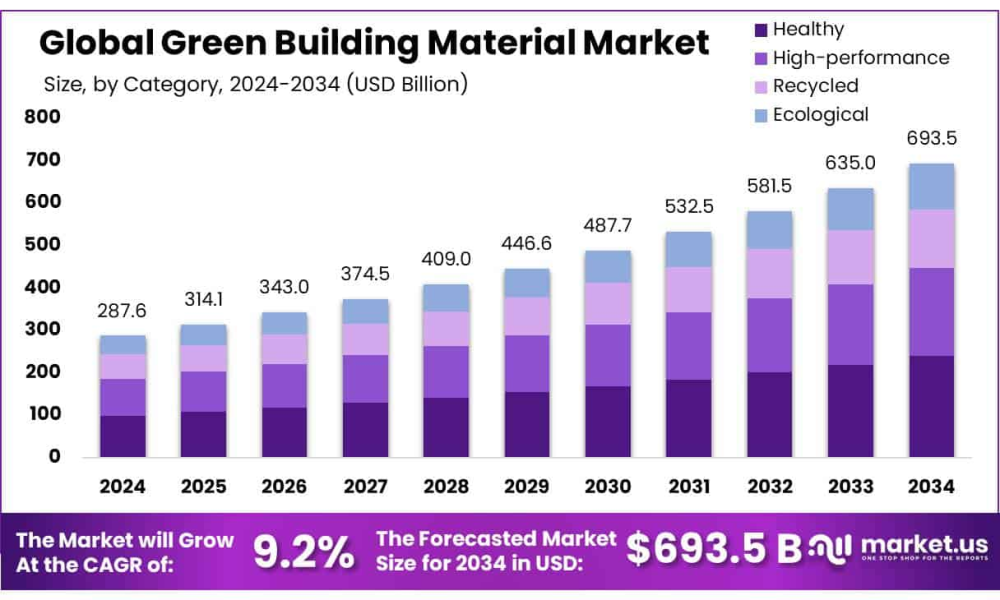
New York, NY – July 15, 2025 – The Global Green Building Material Market is experiencing rapid growth, driven by increasing demand for sustainable construction solutions. In 2024, the market was valued at USD 287.6 billion and is projected to reach USD 693.5 billion by 2034, growing at a strong CAGR of 9.2% from 2025 to 2034.
This expansion is fueled by rising environmental awareness, stricter government regulations on carbon emissions, and the construction industry’s shift toward eco-friendly practices. Green building material market, such as recycled steel, bamboo, and energy-efficient insulation, is gaining popularity due to their durability, cost-effectiveness, and lower environmental impact. The market is also benefiting from growing urbanization, as developers and homeowners seek energy-efficient and sustainable housing solutions.
In 2021, the European Union launched the “Green Deal” to reduce carbon emissions by 55% by 2030 compared to 1990 levels, emphasizing energy-efficient buildings and green building materials. Countries like the UK, Germany, and France have introduced tax incentives and subsidies to promote sustainable construction. Similarly, the U.S. Energy Star program supports manufacturers of energy-efficient building products, aligning with sustainability objectives.
Key opportunities lie in emerging economies, where rapid infrastructure development and green building initiatives are creating demand for eco-conscious materials. Additionally, advancements in material technology and increasing investments in green construction projects are further accelerating market growth. With sustainability becoming a priority worldwide, the green building material market is set to expand significantly, offering lucrative opportunities for manufacturers, suppliers, and investors in the coming years.
Governments are boosting demand for the green building material market through stringent building codes. For instance, California’s Title 24 Building Standards Code requires energy-efficient materials in residential and commercial construction, contributing to a 12% reduction in statewide energy use, as reported by the California Department of General Services. In 2022, around 16,000 new homes in California adhered to these standards, showcasing the impact of such policies.
The U.S. Green Building Council’s LEED certification program sets benchmarks for sustainable construction. Over 100,000 commercial projects worldwide have achieved LEED certification, using 25% less energy and emitting 34% fewer greenhouse gases than conventional buildings, according to the USGBC. This trend is driving demand for green materials to meet certification standards.
However, the higher cost of green building materials, such as recycled steel, high-performance windows, and solar panels, poses challenges. Energy-efficient homes can cost 10-15% more to build, per the National Renewable Energy Laboratory, creating barriers, particularly in developing regions. For example, installing a 5kW solar panel system costs $18,000-$20,000, deterring some property owners despite long-term energy and maintenance savings.
Globally, government incentives and certifications are accelerating adoption. In the UK, BREEAM-certified buildings, which use 30% less energy and have 27% lower operating costs, are gaining traction, supported by the government’s goal for carbon-neutral buildings by 2050. Corporate sustainability efforts further fuel demand, with 90% of companies globally setting carbon reduction targets, per the Carbon Disclosure Project, often incorporating green materials in construction projects.
Innovative companies like Taiwan’s Miniwiz are advancing the sector by converting waste, such as insect shells, rice husks, and plastic bottles, into durable building materials. With over 1,200 waste conversion processes, Miniwiz built structures like the Taipei EcoARK using 1.5 million PET bottles, demonstrating the potential of sustainable materials in construction.
Important Revelation
- Green Building Material Market size is expected to be worth around USD 693.5 Bn by 2034, from USD 287.6 Bn in 2024, growing at a CAGR of 9.2%.
- Green Cement held a dominant market position, capturing more than a 24.40% share of the green building material market.
- Healthy building materials held a dominant market position, capturing more than a 34.50% share of the green building material market.
- New Construction held a dominant market position in the green building material market sector, capturing more than a 72.20% share.
- Insulation held a dominant market position in the green building material market sector, capturing more than a 21.50% share.
- The residential sector held a dominant market position in the green building material market, capturing more than a 44.50% share.
- North America stands as a dominant force in the green building material market, capturing approximately 34.30% of the global market share, equating to a valuation of approximately USD 98.6 billion.
➤ Download Exclusive Sample Of This Premium Report (Including Full TOC, Table & Figures): https://market.us/report/green-building-material-market/request-sample/
Report Segmentation
By Material Type
- In 2024, Green Cement secured a leading position in the green building material market, holding a 24.4% share. Its popularity stems from a lower carbon footprint compared to traditional cement, making it a top choice for eco-conscious builders and architects. Growing regulatory support and heightened environmental awareness are key drivers, positioning Green Cement as a cornerstone of sustainable construction practices moving forward.
By Category
- Healthy building materials dominated the green building material market sector in 2024, capturing a 34.5% market share. These low-emission, non-toxic materials enhance indoor air quality and occupant health, reflecting a rising focus on well-being in construction. The increasing demand for healthier living and working spaces signals a lasting shift toward wellness-driven building practices.
By the Construction Phase
- In 2024, New Construction accounted for a commanding 72.2% of the green building material market. This dominance highlights the construction industry’s rapid growth and commitment to sustainable practices in new infrastructure projects. Supportive regulations and incentives are driving developers to prioritize eco-friendly materials, reinforcing a broader trend toward sustainable development.
By Application
- Insulation led the green building material market in 2024 with a 21.5% share, driven by its critical role in improving energy efficiency. Green insulation materials, known for superior thermal performance and lower environmental impact, are increasingly adopted in residential and commercial projects. This trend reflects a growing emphasis on reducing energy use and cutting utility costs in sustainable construction.
By End-Use
- In 2024, the Residential sector held a 44.5% share of the green building material market, driven by consumer demand for sustainable homes. Green materials enhance energy efficiency, reduce environmental impact, and increase property value, supported by government incentives and green certifications. This shift underscores a growing preference for eco-friendly living spaces.
Market Key Segmentation
By Material Type
- Green Cement
- Earthen Materials
- Wood & Bamboo
- Recycled Plastics
- Non-VOC paints
- Recycled Metals
- Fibers
- Slate/ Stone
- Composites
- Others
By Category
- Healthy
- High-performance
- Recycled
- Ecological
By Construction Phase
- New Construction
- Renovation/Remodeling
By Application
- Insulation
- Framing
- Roofing
- Exterior Siding
- Interior Finishing
- Others
By End-use
- Residential
- Commercial
- Industrial and Institutional
- Infrastructure
Regional Analysis
North America leads the global green building material market, holding a 34.3% share, valued at approximately USD 98.6 billion. The United States drives this dominance, fueled by strong government initiatives and a growing focus on sustainable construction.
In 2024, the U.S. significantly contributed to North America’s market share, propelled by increased consumer awareness and a shift toward energy-efficient building solutions. Supportive government policies, such as tax incentives and strict building codes, further promote energy efficiency in construction.
However, the U.S. “Liberation Day” policy’s tariffs have increased new home construction costs by an average of $9,200. While aimed at boosting domestic manufacturing, these tariffs highlight the economic challenges of adopting sustainable practices.
Regionally, demand for the green building material market is set to grow, driven by urbanization, supportive policies, and a commitment to environmental sustainability. This trend underscores North America’s leadership in advancing eco-friendly construction practices and shaping the future of the green building industry.
Competitive Landscape
- Sika AG
- Alumasc Group Plc
- Amvic Inc.
- BASF SE
- PPG Industries, Inc.
- Bauder Ltd
- Binderholz GmbH
- CertainTeed
- DuPont
- RedBuilt
- Forbo International SA
- Kingspan Group
- Lafarge
- Owens Corning
- Other Key Players
Get in Touch with Us:
Market.us (Powered By Prudour Pvt. Ltd.)
Address: 420 Lexington Avenue, Suite 300, New York City, NY 10170, United States
Send Email: [email protected]
Refer To More Related Reports:
Ferulic Acid Market
Fiberglass Pipe Market
Flat Steel Market



