
Overview
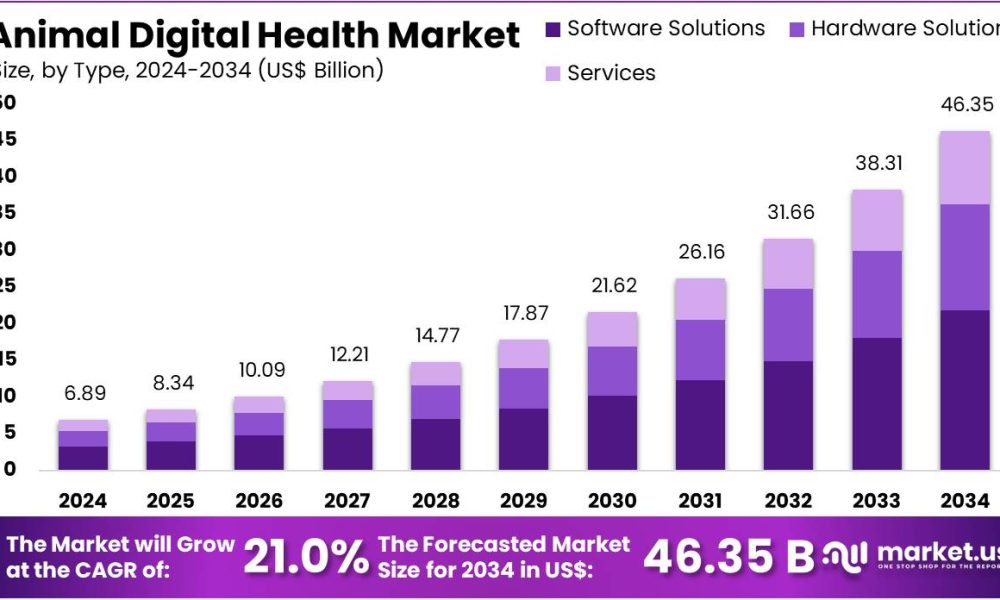
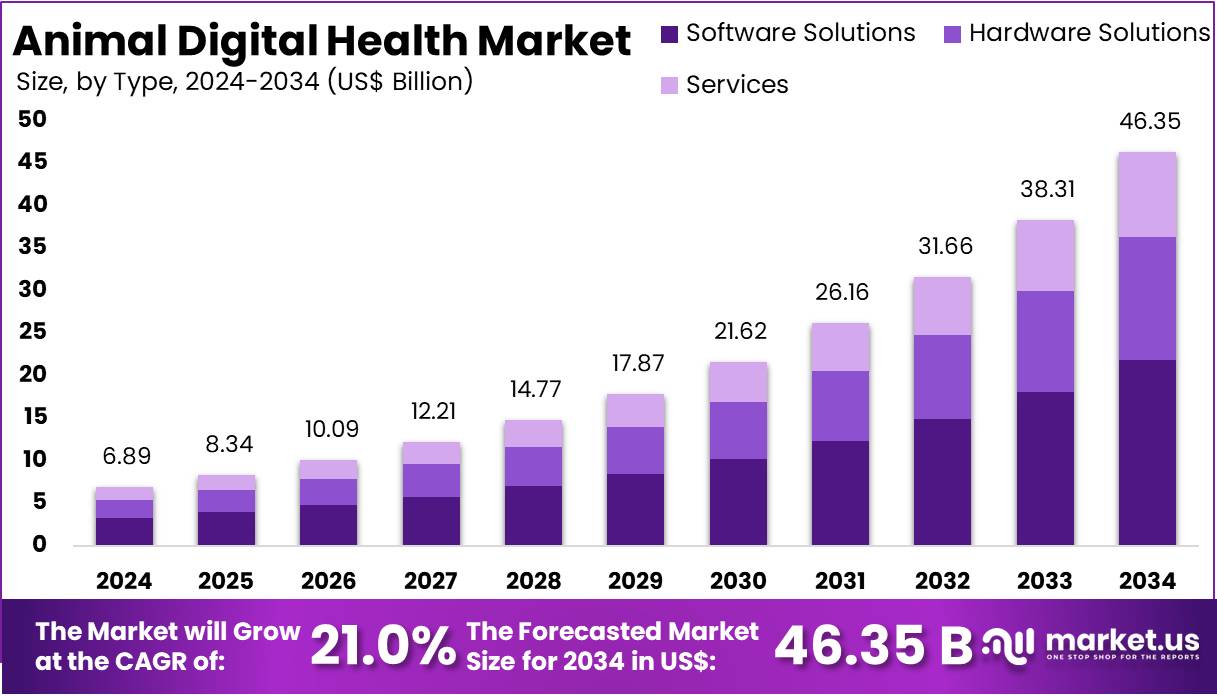
The Global Animal Digital Health Market is projected to reach a value of USD 46.35 billion by 2034, up from USD 6.89 billion in 2024. This growth reflects a strong compound annual growth rate (CAGR) of 21% from 2025 to 2034. North America leads the market, holding a 41.2% share, valued at USD 2.64 billion in 2024. This growth is driven by rising demand for digital tools that support real-time animal health monitoring, disease control, and welfare management.
Animal digital health refers to the use of digital technologies in veterinary care to improve diagnosis, treatment, and overall animal welfare. These technologies include AI-powered systems, sensors, wearable devices, and digital tracking platforms. Their usage is increasing across livestock and companion animals. The World Organisation for Animal Health (WOAH) supports this shift through systems like the World Animal Health Information System (WAHIS), which aids in rapid disease detection and outbreak response globally.
The integration of wearable technologies is becoming common in livestock sectors such as U.S. dairy farming. Tools like smart collars and ear tags allow continuous tracking of health indicators. Machine learning models have shown up to 79% accuracy in detecting conditions like digital dermatitis on the day of onset. These innovations support timely interventions and help avoid large-scale outbreaks, which can severely impact food production and animal welfare.
Digital systems for traceability and surveillance are improving food safety and animal tracking. For example, Australia uses RFID tagging under its National Livestock Identification System (NLIS). In the United States, the USDA’s APHIS mandates electronic ID tags for cattle and bison. Europe also uses the TRACES system to monitor cross-border movement of animal products. However, as of 2015, only 57% of WOAH member countries used electronic systems for traceability, indicating room for further digital adoption.
The One Health approach has strengthened the need for integrated animal health systems. This approach recognizes the connection between animal, human, and environmental health. Around 60% of human infectious diseases are zoonotic in origin. During the 2022 lumpy skin disease outbreak in India, over 2 million cattle were affected, and 97,000 died. This led to a daily loss of 500,000–600,000 liters of milk in Rajasthan. Such cases highlight the importance of early digital surveillance and data-driven animal health strategies.
Public-private partnerships and digital innovation are also key drivers. Tools such as rumen boluses and accelerometer collars detect stress and illness in animals early. Cloud-based platforms and AI-powered analytics are helping predict disease outbreaks in near real-time. The FAO notes that animal diseases cause global losses of up to USD 300 billion each year. Digital animal health tools can reduce these losses by supporting preventive care, improving biosecurity, and ensuring sustainable livestock management.
Key Takeaways
- By 2034, the global animal digital health market is anticipated to reach around US$ 46.35 billion, growing significantly from US$ 6.89 billion in 2024.
- The market is projected to expand at a strong CAGR of 21% between 2025 and 2034, reflecting rapid adoption of digital veterinary technologies.
- In 2024, software solutions led the product type segment, capturing over 47.2% of the total animal digital health market share.
- Livestock health management dominated application areas in 2024, accounting for more than 59.2% of the global animal digital health market.
- Farmers and livestock owners were the primary end-users in 2024, representing more than 52.0% of the total market.
- North America held the leading regional position in 2024, with a 41.2% market share valued at approximately US$ 2.64 billion.
Get Sample: https://market.us/report/animal-digital-health-market/request-sample/
Segmentation Analysis
In 2024, the Software Solutions segment led the animal digital health market type category with a 47.2% market share. Its dominance is driven by the rising use of veterinary software for recordkeeping, vaccination tracking, and remote monitoring. The integration of AI and cloud-based platforms has made data access simpler and more efficient. Clinics and farms prefer digital platforms due to their ease of use and operational efficiency. These solutions improve care delivery while reducing manual errors, positioning software as a critical asset in veterinary practices.
The Hardware Solutions segment followed closely, offering tools such as smart collars, wearable sensors, and health-monitoring tags. These devices gather real-time health data, enabling early disease detection and better animal care. Farmers and pet owners widely use them to manage livestock and monitor companion animals. This segment is supported by the growing demand for automated and IoT-enabled solutions in agriculture and pet care. Additionally, the Services segment, including telemedicine and remote diagnostics, gained traction—especially in regions with limited access to veterinary infrastructure.
From an application standpoint, Livestock Health Management remained the leading segment in 2024, accounting for over 59.2% of the market. Increased use of digital farming tools and government-backed sustainable agriculture programs fueled this growth. In comparison, Companion Animal Health benefited from rising pet ownership and digital wellness tracking solutions. Pet wearables and virtual vet consultations supported early diagnosis and convenient care. Smaller segments like Aquatic Animal Health and Veterinary Services also expanded steadily, driven by smart aquaculture tools and mobile veterinary platforms for underserved areas.
By Type
- Software Solutions
- Hardware Solutions
- Services
By Application
- Livestock Health Management
- Companion Animal Health
- Aquatic Animal Health
- Veterinary Services
By End-User
- Farmers & Livestock Owners
- Veterinary Clinics
- Pet Owners
- Aquaculture Industry
Key Players Analysis
The animal digital health market is witnessing strong momentum, driven by the need for smart veterinary solutions. Key player Zoetis leads with its focus on precision livestock farming and advanced diagnostics. The company uses sensor technologies and data analytics to track animal health in real-time. Strategic acquisitions and global partnerships help expand its digital platform. Merck Animal Health, through Allflex Livestock Intelligence, offers IoT-based solutions like smart ear tags and biosensors. These tools support predictive care and improve herd management, making Merck a leader in precision livestock monitoring.
Boehringer Ingelheim is enhancing animal health with connected solutions and cloud-based platforms. Its strategy focuses on disease surveillance and digital therapeutics to support preventive care. Elanco Animal Health is strengthening its presence through telemedicine and herd analytics. The company partners globally to build digital infrastructure for better veterinary decisions. IDEXX Laboratories specializes in companion animal diagnostics, using AI and cloud tools. Players like Covetrus and Dechra Pharmaceuticals are entering the space with wearables and blockchain-based traceability. Competition is rising as firms adopt tech-driven innovations in veterinary care.
Animal Digital Health market Key Players
- Zoetis
- Merck Animal Health
- Boehringer Ingelheim Animal Health
- Elanco Animal Health
- IDEXX Laboratories
- Virbac
- Ceva Santé Animale
- Bayer Animal Health
- GEA Group
- Afimilk
- Tractive
- Petriage
- VetCT
- Others
Buy Directly: https://market.us/report/animal-digital-health-market/request-sample/
Regional Analysis
In 2024, North America led the global animal digital health market with a 41.2% share, valued at US$ 2.64 billion. This dominance is supported by strong veterinary infrastructure and early adoption of digital health tools. Wearable animal devices and stable internet connectivity have accelerated digital integration. The U.S. and Canada maintain advanced animal care systems. These countries have enabled the early use of such technologies in livestock and pet health. This strong foundation has created favorable conditions for digital transformation in the animal health sector.
Government initiatives play a vital role in driving growth across the region. Policies supporting disease surveillance and smart livestock practices have increased awareness of digital solutions. Investments in AI-driven platforms and veterinary telehealth have improved service access, especially in rural areas. Farmers and pet owners benefit from faster diagnostics and remote consultations. Veterinary clinics, including Banfield Pet Hospital and VCA Animal Hospitals, now use electronic health records and telemedicine platforms. High digital literacy among animal owners also supports this trend, enhancing care efficiency and service delivery.
A robust regulatory framework further strengthens the market. North America enforces strict quality standards for animal health technologies. These regulations ensure safety while encouraging innovation. The region hosts key players in the animal health sector, who drive research and product development. Their presence advances digital innovation and market growth. Compared to other regions, North America stands out for its maturity and innovation. Europe follows, driven by animal welfare awareness but limited by regulatory gaps. Asia-Pacific grows quickly due to rising pet adoption but still faces infrastructure barriers.
Conclusion
The animal digital health market is expanding rapidly due to the growing use of technology in veterinary care. Tools like wearable sensors, AI platforms, and cloud-based systems are making it easier to monitor animal health in real time. This shift helps improve disease prevention, early diagnosis, and overall animal welfare. Farmers, clinics, and pet owners are adopting digital tools to manage health more efficiently. Strong support from governments and leading companies is pushing this trend forward. While North America leads the market, other regions are also catching up with rising awareness and investment. As digital innovation continues, the market is set to transform how animal health is managed across all sectors.
Get in Touch with Us:
Market.us (Powered By Prudour Pvt. Ltd.)
Address: 420 Lexington Avenue, Suite 300, New York City, NY 10170, United States.
Contact No: +1 718 874 1545 (International), +91 78878 22626 (Asia).
Email: [email protected]
View More
Clinical Data Analytics Solutions Market
Veterinary Telehealth Market



