
Overview
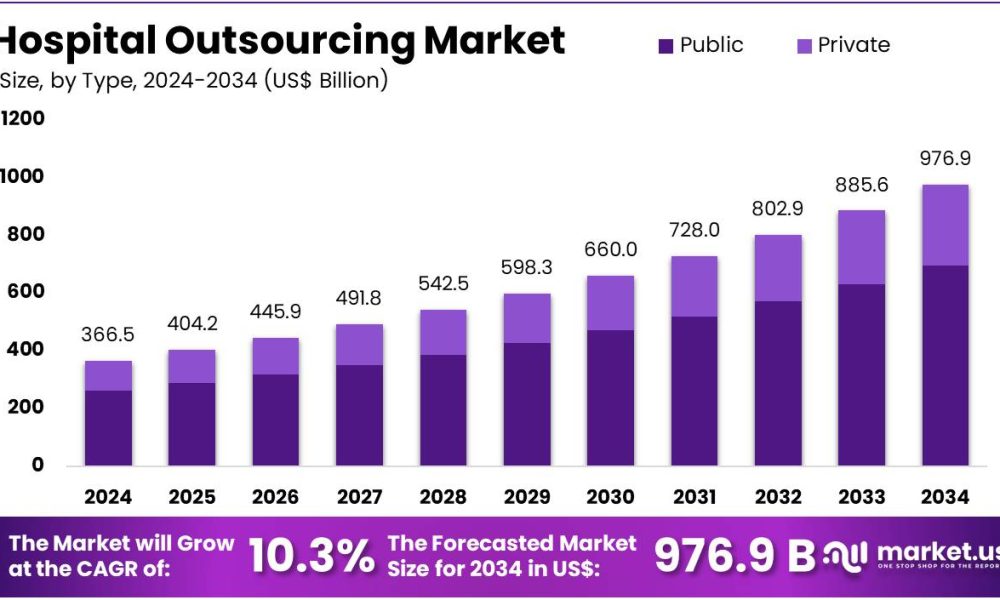
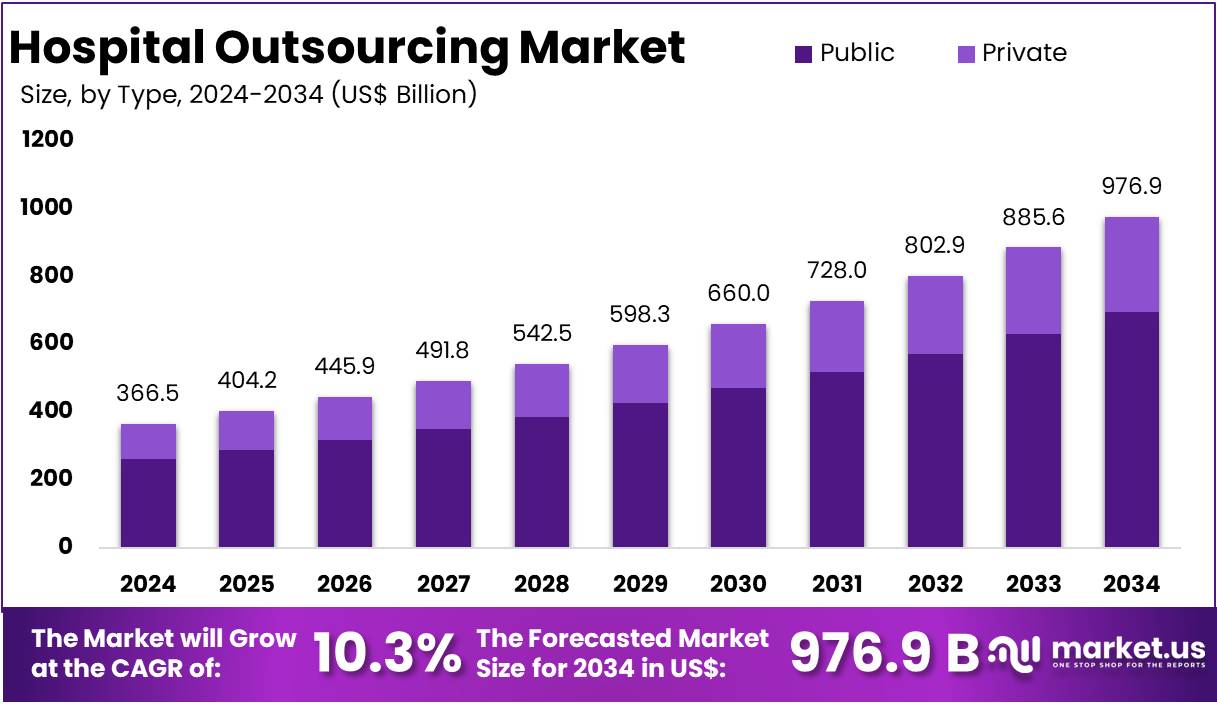
The Global Hospital Outsourcing Market is projected to reach approximately USD 976.9 billion by 2034, growing from USD 366.5 billion in 2024. This expansion reflects a steady CAGR of 10.3% between 2025 and 2034. North America led the global market in 2024, capturing over 65.6% share and generating USD 240.4 billion in value. The market is gaining traction due to the rising need for operational efficiency and strategic resource allocation across healthcare systems, especially in regions facing workforce constraints and escalating operational costs.
A growing shortage in the global healthcare workforce has prompted hospitals to outsource more services. According to WHO, the global health workforce reached 65 million in 2020, marking a 29% increase from 2016. However, a projected deficit of 10 million health workers by 2030—particularly in low- and middle-income countries—poses a significant challenge. In response, hospitals are increasingly outsourcing non-clinical services to ensure uninterrupted care delivery. This approach helps healthcare institutions manage staff shortages while maintaining service quality and patient safety.
Cost savings are a key driver for hospital outsourcing. About 54% of healthcare CFOs believe outsourcing enhances operational efficiency and strengthens financial performance. Non-core functions such as housekeeping, food services, and administrative operations are commonly outsourced. This helps reduce overhead and allows hospitals to concentrate resources on direct patient care. Outsourcing also minimizes fixed costs and improves scalability. As hospitals face tighter budgets, this model offers an effective way to maintain high standards of care without increasing internal staffing burdens.
Quality control and regulatory compliance further support outsourcing trends. Specialized vendors implement strict protocols aligned with national and international health standards. This ensures reliable service delivery while minimizing the risk of non-compliance. Hospitals benefit from better monitoring and reporting systems through these partnerships. Outsourcing critical services—like diagnostic labs or sterilization units—improves efficiency and safety outcomes. Such strategies align with hospitals’ broader goals of clinical excellence and improved patient satisfaction metrics.
Environmental factors are also reshaping outsourcing strategies in healthcare. The sector contributes nearly 4.4% of global net emissions. In the U.S., it accounts for over 8% of national greenhouse gas output. Hospitals now partner with facility management firms that implement energy-efficient solutions. For instance, Queen’s Medical Centre in the UK launched a £15 million project to cut carbon emissions by 10,000 tonnes annually. Additionally, waste management outsourcing is helping leading hospitals divert up to 40% of their waste from landfills, promoting sustainability alongside operational efficiency.
Key Takeaways
- The global hospital outsourcing market is expected to reach US$ 976.9 billion by 2034, rising from US$ 366.5 billion in 2024 at a CAGR of 10.3%.
- In 2024, private hospitals held a dominant position in the market by type, accounting for more than 71.3% of the global share.
- Healthcare IT led the service-based outsourcing segment in 2024, securing over 28.3% share due to growing digital transformation across healthcare systems.
- Small and medium-sized hospitals emerged as the top contributors by size in 2024, capturing more than 58.8% of total outsourcing demand.
- North America remained the dominant regional market in 2024, with a market share exceeding 65.6%, valued at approximately US$ 240.4 billion.
Get Sample: https://market.us/report/hospital-outsourcing-market/request-sample/
Segmentation Analysis
In 2024, the private hospital segment maintained a dominant position in the type category of the hospital outsourcing market, accounting for over 71.3% share. This dominance was driven by a growing number of private hospitals adopting cost-efficient outsourcing strategies. Private institutions are more agile in incorporating services like facility management, IT support, and diagnostics. Their emphasis on operational efficiency and better patient care promotes the outsourcing trend. Meanwhile, public hospitals lag due to budget constraints and longer decision cycles but are slowly beginning to adopt outsourcing for non-core functions.
The healthcare IT segment led the service category in 2024, securing more than 28.3% market share. Growth was fueled by rising dependence on digital tools, including EHRs, cybersecurity systems, and AI-based diagnostics. Hospitals are increasingly outsourcing IT infrastructure to control costs and ensure data security. Clinical services also represent a major outsourced area, with hospitals delegating diagnostics and radiology to external providers. Business services like billing, coding, and facility maintenance are likewise outsourced to ensure compliance and operational continuity.
Small and medium-sized hospitals dominated the hospital size segment, holding over 58.8% share in 2024. These facilities often face resource limitations and benefit from outsourcing to manage administrative and clinical workflows efficiently. In semi-urban and rural areas, third-party vendors offer essential services like diagnostics and records handling. Outsourcing helps reduce staffing burdens, improve cost control, and meet regulatory standards. Services such as telehealth and supply chain logistics are frequently outsourced, allowing smaller hospitals to focus on delivering direct patient care more effectively.
By Type
- Public
- Private
By Service
- Healthcare IT
- Clinical Services
- Business Service
- Transportation Services
- Others
By Hospital Size
- Small & Medium Hospitals
- Large Hospitals
Key Players Analysis
In the hospital outsourcing market, Accenture plays a central role by offering healthcare consulting, IT services, and digital transformation support. These services help hospitals streamline operations and reduce overhead costs. Cerner Corporation is a key provider of electronic health record (EHR) systems and population health solutions. Its platforms assist in clinical decision-making and workflow optimization. Conduent Inc. specializes in business process outsourcing, offering billing and claims management. Its tools automate administrative tasks, helping hospitals focus more on delivering quality patient care and improving service efficiency.
Dell Technologies supports the market through IT infrastructure and cloud-based solutions for healthcare systems. Its offerings enhance data storage, interoperability, and system integration. IBM contributes with its AI-powered healthcare tools such as predictive analytics and diagnostics. Watson Health strengthens clinical performance and data management. These companies promote innovation in hospital operations. Their scalable and secure solutions meet the growing demand for digitalization and efficiency. They also enable healthcare facilities to respond better to modern challenges, including system complexity and compliance requirements.
Other leading players include regional health IT providers and clinical service firms offering telehealth, remote monitoring, and logistics support. These services allow hospitals to manage resources effectively and address staffing issues. Companies such as HCL Technologies, Cognizant, TCS, Infosys, and Wipro deliver advanced IT solutions tailored to healthcare needs. Genpact and Siemens offer digital transformation and medical technology support, respectively. Medtronic contributes with device-related services. Together, these key players provide flexible, technology-driven models that help hospitals achieve cost savings and operational resilience in a changing healthcare landscape.
Buy Directly: https://market.us/purchase-report/?report_id=146514
Conclusion
The hospital outsourcing market is expected to grow steadily as healthcare providers seek ways to manage rising costs, staff shortages, and operational complexity. Hospitals are increasingly turning to external vendors for services like IT, diagnostics, billing, and facility management. This trend helps reduce internal workload and improve focus on patient care. Outsourcing also supports better compliance, data security, and sustainability goals. Private hospitals and smaller facilities are leading the adoption, especially in regions with limited resources. With strong contributions from global technology and service companies, outsourcing is becoming a key strategy for healthcare systems aiming for efficiency, flexibility, and improved service delivery in a changing environment.
Get in Touch with Us:
Market.us (Powered By Prudour Pvt. Ltd.)
Address: 420 Lexington Avenue, Suite 300, New York City, NY 10170, United States.
Contact No: +1 718 874 1545 (International), +91 78878 22626 (Asia).
Email: [email protected]
View More
Digital Assistants in Healthcare Market
Digital Dentistry Market



