

Smart Card Market Overview, 2027
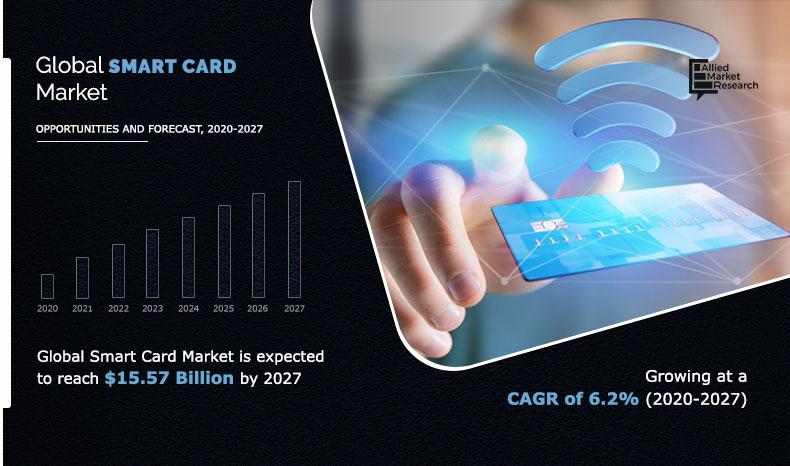
According to a new report published by Allied Market Research, titled, “Smart Card Market By Type (Contact, Contactless, and Dual Interface) and End User (BFSI, Telecommunication, Healthcare, Government, Transportation, and Others): Global Opportunity Analysis and Industry Forecast, 2020-2027” The global smart card market size was valued at $10.19 billion in 2019, and is projected to reach $15.57 billion by 2027, growing at a CAGR of 6.2%. The report offers a detailed analysis of the top winning strategies, evolving market trends, market size and estimations, value chain, key investment pockets, drivers & opportunities, competitive landscape and regional landscape. The report is a useful source of information for new entrants, shareholders, frontrunners and shareholders in introducing necessary strategies for the future and taking essential steps to significantly strengthen and heighten their position in the market.
Download Sample Report: https://www.alliedmarketresearch.com/request-sample/A11088
A smart card is a plastic card that comprises an embedded computer chip of microprocessor or memory type that transacts and stores data. This data is usually linked with either information, value, or both and is stored & processed in the card’s chip. However, the card information is executed through a reader that is part of a computing system. These smart cards are in use today through several key applications such as banking, telecom, healthcare, transportation, and entertainment.
The global smart card market is anticipated to witness significant growth over the forecast period. Factors, such as rapid digitalization, high demand for contactless smart card, surge in cashless transactions, and rise in product demand in the healthcare sector, drive the growth of the market. However, high set-up cost along with data theft & security concern is a major restraint to the global smart card market. In addition, new mode of information security of users enabled by blockchain is expected to create opportunities for the smart card industry. Smart cards can efficiently manage cryptographic keys, thereby enabling secure & efficient transactions in blockchain applications.
Moreover, developing nations tend to witness high penetration of smart card products especially in the telecommunication and BFSI segments. Factors, such as increase in cashless transaction, need for 5G SIM, and growth of IoT technology, accelerate the demand for smart cards.
The global smart card market is segmented into type, end user, and region. By type, the market is fragmented into contact, contactless, and dual interface. Depending on end user, it is segregated into BFSI, telecommunication, healthcare, government, transportation, and others.
Region-wise, Asia-Pacific is expected to be the leading contributor to the global smart card market during the forecast period, followed by North America and Europe. the smart card market trends are analyzed across North America, Europe, Asia-Pacific, and LAMEA. Asia-Pacific contributed maximum revenue in 2019. However, between 2019 and 2027, the smart card market in Asia-Pacific is expected to grow at a faster rate as compared to other regions. This is attributed to increase in demand from economically developing countries such as India, China, Japan, and South Korea.
The key players profiled in the report include Alioth LLC, CardLogix Corporation, CPI Card Group Inc., Giesecke+Devrient GmbH, IDEMIA, Identiv, Inc., Infineon Technologies AG, NXP Semiconductors NV, Thales, and Watchdata Technologies. These players have adopted various strategies, such as product launch, collaboration, and expansion, to expand their foothold in the industry.
Buy This Research Report (271 Pages PDF with Insights, Charts, Tables, and Figures): https://www.alliedmarketresearch.com/checkout-final/4199ea4e6e512841eb13624b983e8fd3
Key Drivers of Demand:
▪️Increased Demand for Security Solutions:
With the rise of cyber threats and identity theft, smart cards are crucial for secure authentication and data protection across various sectors. This includes multi-factor authentication (MFA) and secure login.
▪️Proliferation of Contactless Payments:
The global shift towards cashless transactions, amplified by post-pandemic hygiene concerns, is a major driver for contactless smart cards (tap-and-pay). These offer speed, convenience, and enhanced security.
▪️Digitization of Various Sectors:
• BFSI (Banking, Financial Services, and Insurance):
EMV chip cards, prepaid cards, and contactless payments are standard, with a growing trend towards biometric payment cards.
• Healthcare: Smart cards are used for patient identification, insurance verification, and secure storage of electronic health records, reducing medical errors and fraud.
• Transportation: Smart ticketing systems for public transport (metro, bus, rail) and toll payments are widely adopted.
• Enterprise: Secure building access, time tracking, and digital signatures.
▪️Emerging Applications and Trends:
• Biometric Smart Cards: Integrating fingerprint or facial recognition directly onto the card for enhanced security and convenience in payments and access control.
• Dual-Interface Cards: These cards support both contact and contactless interactions, offering greater versatility across various applications.
• Blockchain Integration: Revolutionizing data security by enabling decentralized identity and secure transaction authentication.
• Eco-friendly Cards: Development of smart cards made from recycled or biodegradable materials to address environmental concerns.
• Smart Wearables: Integration of smart card functionality into wearable devices for seamless payments and access.
• Mobile and Cloud-based Smart Card Management: Evolving solutions for managing smart card credentials and functionalities through mobile devices and cloud platforms.
• eUICC SIMs (Embedded Universal Integrated Circuit Card): These programmable SIMs offer greater flexibility and secure over-the-air updates, impacting telecommunications and automotive industries.
• IoT Integration: Smart cards are becoming integral to connected devices for secure authentication and data transmission in smart homes and industrial automation.
Key Findings of The Study:
➢ The BFSI segment is projected to be the major application over the forecast period, followed by telecommunication. The rising demand for payment cards and 5G is anticipated to drive the product demand in the future.
➢ APAC and North America collectively accounted for more than 60% of the global smart card market share in 2019.
➢ India is anticipated to witness the highest growth rate during the forecast period.
➢ The U.S. was the major shareholder in the North America smart card market analysis, accounting for approximately 72% share in 2019.
Key Benefits For Stakeholders:
➢ This study comprises analytical depiction of the global smart card market outlook along with the current trends and future estimations to depict the imminent investment pockets.
➢ The overall smart card market analysis is determined to understand the profitable trends to gain a stronger foothold.
➢ The report presents information related to key drivers, restraints, and opportunities with a detailed impact analysis.
➢ The current smart card market forecast is quantitatively analyzed from 2019 to 2027 to benchmark the financial competency.
➢ Porter’s five forces analysis illustrates the potency of the buyers and the smart card industry share key vendors.
➢ The report includes the market trends and market share of key vendors.
Enquiry About Report: https://www.alliedmarketresearch.com/purchase-enquiry/A11088
About Us:
Allied Market Research (AMR) is a full-service market research and business consulting wing of Allied Analytics LLP based in Wilmington, Delaware. Allied Market Research provides end-to-end solutions along with information, education, advocacy, and networking resources to SMEs and early-stage start-ups to bring excellence to their processes. In addition, we offer a nurturing environment required to develop and grow businesses, including business planning; virtual support; market intelligence; acquiring resources; and getting direct access to finance, suppliers, and other experts to boost the growth of businesses and entrepreneurs.
Our bundled and hassle-free business support systems are customized to meet the needs of SME consultants and industry leaders. Moreover, our large network of skilled consultants and experts help start-ups get the business on a roll.
Contact:
David Correa
United States
1209 Orange Street,
Corporation Trust Center,
Wilmington, New Castle,
Delaware 19801 USA.
Int’l: +1-503-894-6022
Toll Free: +1-800-792-5285
Fax: +1-800-792-5285
[email protected]




