
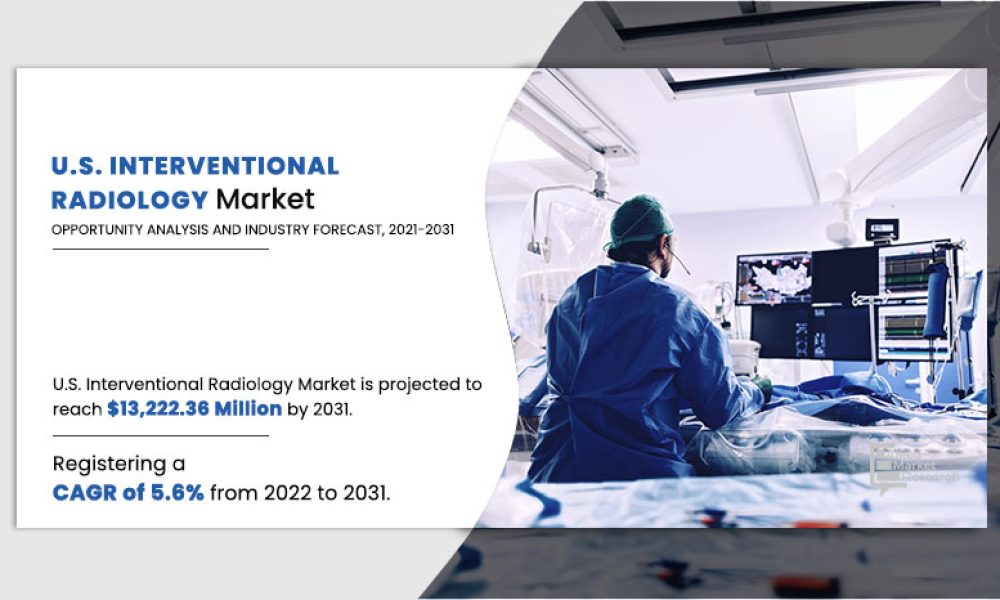
The U.S. interventional radiology (IR) market is poised for significant expansion, driven by advancements in minimally invasive procedures and an increasing prevalence of chronic diseases. Valued at $7,664.24 million in 2021, the market is projected to reach $13,222.36 million by 2031, growing at a CAGR of 5.6% from 2022 to 2031.
Interventional radiology uses image-guided techniques (X-ray, ultrasound, CT, MRI) to diagnose and treat conditions like cancer, cardiovascular diseases, and kidney stones with minimal incisions, reducing recovery time and complications.
Key Market Drivers
✔ Rising geriatric population – Higher susceptibility to chronic diseases.
✔ Increasing cancer cases – Growth in bladder, colorectal, hepatic, and breast cancers fuels demand.
✔ Advantages of minimally invasive procedures – Less pain, faster recovery, lower infection risk.
✔ Technological advancements – AI-assisted imaging, robotic IR systems, and improved stent technology.
✔ Government and NGO initiatives – Awareness campaigns promoting IR benefits.
Impact of COVID-19 on the Market
The pandemic initially disrupted IR procedures due to:
Postponement of non-essential surgeries (elective and cancer-related).
Reallocation of hospital resources for COVID-19 patients.
Supply chain disruptions affecting medical device manufacturing.
However, the market is rebounding strongly due to:
Resumption of deferred surgeries (cancer, cardiovascular, and urological treatments).
Increased adoption of outpatient IR procedures in ambulatory surgical centers (ASCs).
Growing preference for minimally invasive techniques post-pandemic.
Market Segmentation
By Product
Stents (Dominant segment due to rising cardiovascular and peripheral artery diseases).
Catheters
Embolization devices
Ablation devices (Fastest-growing due to cancer treatments).
Biopsy devices
By Procedure
Balloon angioplasty (Leading segment for coronary artery disease).
Embolization (Used in tumor and aneurysm treatment).
Ablation (Fastest-growing due to cancer therapy demand).
Vertebroplasty/Kyphoplasty (For spinal fractures).
By Application
Cardiology (Largest market share due to heart disease prevalence).
Oncology (Fastest-growing with rising cancer cases).
Urology & Nephrology (Kidney stone treatments).
Gastroenterology (Liver and gallbladder conditions).
By End User
Hospitals (Leading segment with high patient admissions).
Ambulatory Surgical Centers (ASCs) (Fastest-growing due to cost-efficiency).
Specialty Clinics
Future Growth Opportunities
AI and robotics integration for precision-guided IR procedures.
Expansion of outpatient IR services in ASCs.
Development of bioresorbable stents reducing long-term complications.
Tele-radiology advancements for remote diagnostics and consultations.
Key Players in the Market
Medtronic Plc
Boston Scientific Corporation
Siemens AG
Koninklijke Philips N.V.
Stryker Corporation
Cook Group Incorporated
Becton, Dickinson and Company
Teleflex Incorporated
Challenges and Restraints
High cost of IR devices (MRI, CT scanners, robotic systems).
Stringent regulatory approvals delaying product launches.
Reimbursement issues in certain procedures.
Conclusion
The U.S. interventional radiology market is set for steady growth, driven by rising chronic diseases, technological innovations, and post-pandemic recovery. With increasing adoption of minimally invasive techniques, IR is revolutionizing cancer treatment, cardiovascular care, and pain management.
For healthcare providers, investors, and medical device manufacturers, this market presents lucrative opportunities, especially in oncology, ASCs, and AI-driven IR solutions.
Key Takeaways (Bullet Points)
✔ Market size: $7,664M (2021) → $13,222M (2031) | CAGR 5.6%
✔ Top drivers: Aging population, cancer rise, minimally invasive benefits
✔ Leading segment: Stents (cardiovascular applications)
✔ Fastest-growing procedure: Ablation (cancer treatments)
✔ Post-COVID recovery: Rescheduled surgeries & ASC growth
✔ Future trends: AI-guided IR, bioresorbable stents, outpatient expansion




