
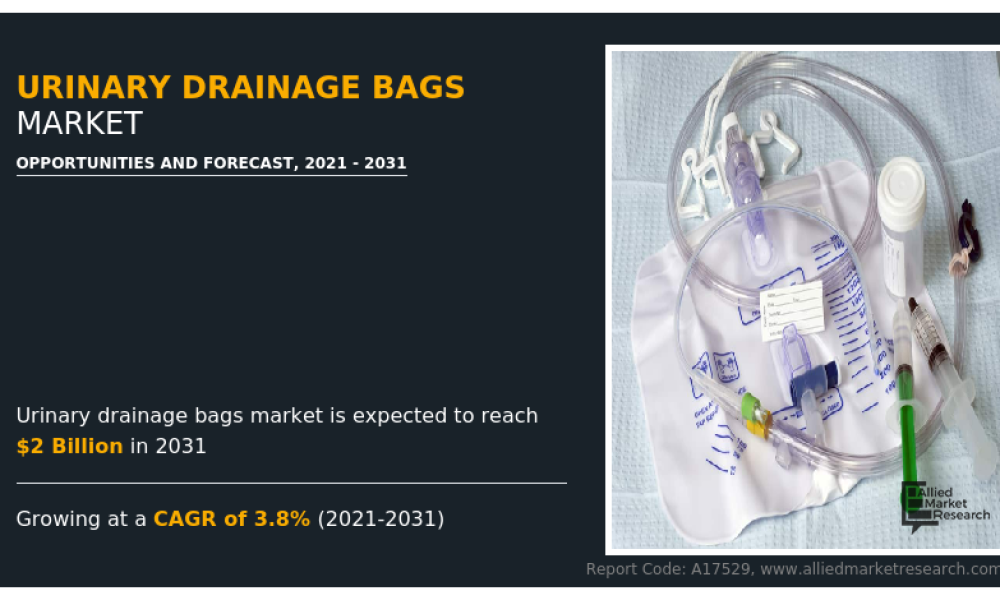
The global urinary drainage bags market was valued at $1.4 billion in 2021 and is projected to reach $2 billion by 2031, growing at a CAGR of 3.8% from 2021 to 2031. These medical devices play a crucial role in managing urological disorders, helping patients with urinary incontinence, post-surgical recovery, and other bladder-related conditions.
Urinary drainage bags collect and store urine via a catheter, ensuring proper urine output monitoring and patient comfort. They come in different types, including leg bags, large bags, reusable, and disposable options, catering to various medical and lifestyle needs.
Key Market Drivers
The urinary drainage bags market is expanding due to several factors:
Rising prevalence of urological disorders – Conditions like urinary incontinence, kidney stones, and benign prostatic hyperplasia (BPH) are increasing demand.
Aging population – Older adults are more prone to bladder control issues, boosting market growth.
Technological advancements – Innovations in anti-reflux valves, infection-resistant materials, and portable designs enhance usability.
Increasing surgical procedures – More urological surgeries lead to higher demand for post-operative urine management solutions.
Market Segmentation
The urinary drainage bags market is segmented based on:
1. By Product Type
Leg Bags (Dominant segment due to comfort and mobility)
Large Bags (Used primarily during sleep or long-term care)
2. By Usage
Disposable Bags (Leading segment, preferred for hygiene and convenience)
Reusable Bags (Eco-friendly but require proper sterilization)
3. By End User
Hospitals & Clinics (Largest revenue contributor due to high patient volume)
Home Care & Ambulatory Centers (Fastest-growing segment due to rising home healthcare trends)
4. By Region
North America (Largest market share due to high healthcare spending and urological disorder prevalence)
Europe (Strong demand due to aging population and advanced healthcare infrastructure)
Asia-Pacific (Fastest-growing region, driven by improving healthcare access and rising geriatric population)
LAMEA (Gradual growth due to increasing awareness and healthcare investments)
Challenges and Restraints
Despite steady growth, the market faces some hurdles:
Risk of catheter-associated urinary tract infections (CAUTIs) – Poor maintenance can lead to infections, deterring some users.
Lack of awareness in developing regions – Many patients remain unaware of advanced urinary drainage solutions.
Environmental concerns over disposable bags – Increased medical waste from single-use products raises sustainability issues.
Future Opportunities
The urinary drainage bags market holds promising growth potential, driven by:
✅ R&D in infection-resistant materials – Companies are developing antimicrobial coatings to reduce infection risks.
✅ Smart drainage bags with sensors – Emerging technologies enable real-time urine output monitoring for better patient care.
✅ Expansion in emerging markets – Growing healthcare infrastructure in Asia and Africa presents untapped opportunities.
✅ Home healthcare boom – Increasing preference for home-based care fuels demand for user-friendly drainage solutions.
Key Market Players
Major companies shaping the urinary drainage bags market include:
Becton, Dickinson and Company (BD)
Cardinal Health Inc.
Coloplast A/S
Convatec Group Plc.
Teleflex Inc.
B. Braun Melsungen AG
Amsino International Inc.
These players focus on product innovation, strategic partnerships, and global expansion to maintain market dominance.
Conclusion
The urinary drainage bags market is set for steady growth, fueled by rising urological disorders, an aging population, and technological advancements. While challenges like infection risks and environmental concerns persist, innovations in smart drainage solutions and home healthcare offer lucrative opportunities.
As demand increases, manufacturers must prioritize hygiene, sustainability, and patient comfort to stay competitive in this evolving market. With Asia-Pacific emerging as a high-growth region, the future of urinary drainage bags looks promising, ensuring better quality of life for millions of patients worldwide.
Key Takeaways (Bullet Points Summary)
✔ Market Size: $1.4 billion (2021) → $2 billion (2031) | CAGR: 3.8%
✔ Top Drivers: Rising urological disorders, aging population, surgical procedures
✔ Dominant Segment: Leg bags (product), disposable bags (usage), hospitals (end-user)
✔ Fastest-Growing Region: Asia-Pacific (CAGR: 5.2%)
✔ Challenges: CAUTI risks, lack of awareness, environmental concerns
✔ Future Trends: Smart drainage bags, antimicrobial materials, home healthcare expansion




