

Hydrogen Generation Market Size, Share and Trend Analysis Report : Global Opportunity Analysis and Industry Forecast 2022-2031
According to a new report published by Allied Market Research, the hydrogen generation market size was valued at $136.3 billion in 2021, and hydrogen generation industry is estimated to reach $262.0 billion by 2031, growing at a CAGR of 6.8% from 2022 to 2031.
Hydrogen Generation: Unlocking the Future of Clean Energy
Hydrogen generation is the process of producing hydrogen gas, a versatile energy carrier that can be used for fuel cells, industrial processes, and as a raw material for various chemical reactions. As the world shifts towards cleaner energy solutions, hydrogen is gaining attention as a key player in reducing carbon emissions and enhancing energy sustainability.
Download PDF Brochure: https://www.alliedmarketresearch.com/request-sample/1575
Asia-Pacific hydrogen generation market is projected to exhibit CAGR of 7.3% from 2022 to 2031.
Asia-Pacific accounts for the largest hydrogen generation market share, followed by North America, and Europe.
The major companies profiled in this report include Linde Plc, Air Liquide, Cummins Inc., Uniper SE, Nel ASA, Siemens, Engine, ITM Power, Iberdrola, McPhy Energy S.A, Messer, Orsted A/S, Thyssenkrupp, Iwatani Corporation, Xebec Adsorption Inc., Ally Hi-Tech Co. Ltd, and Electrochaea GmbH.
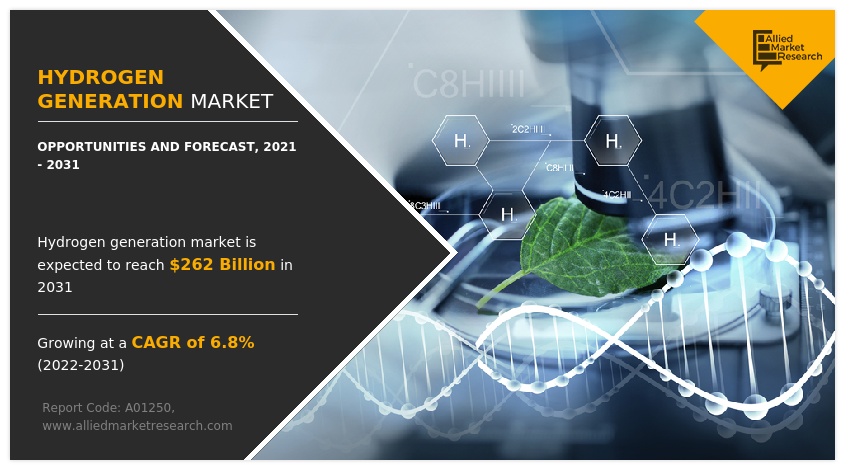
Increase in governmental regulations for the desulphurization of petroleum products is projected to drive the growth of the hydrogen generation market opportunities.
Hydrogen is an effective energy carrier, and this quality is expected to contribute significantly to its further penetration into newer markets.
The global electricity demand is expected to witness an increase of nearly two-thirds of the current demand during the forecast period.
Focus on projects related to distributed power & utility, is expected to boost the hydrogen generation market growth during the forecast period.
Hydrogen produced is mostly used by petroleum refineries and fertilizer producing companies. A total of 99% of hydrogen comes from fossil fuel reforming, as it is the most conventional and cost-effective method. However, it is not beneficial for the environment due to CO2 emission.
Green hydrogen is produced from electrolysis. Electrolysis is the method used to produce green hydrogen as it uses electricity to split water into hydrogen and oxygen and gives out zero carbon emissions.
One of the objectives that various nations have set for 2050 is the decarbonization of the earth. The generation of an element like hydrogen, which produces green hydrogen, is one of the key factors in achieving this goal because it now accounts for more than 2% of worldwide CO2 emissions.
For instance, the European Union (EU) released a unique hydrogen policy in 2020 that combines initiatives to support green hydrogen generation capacities’ rapid growth.
By 2023, Florida Power & Light plans to have a 20 MW green hydrogen plant up and running. The 1.75 gigawatts Okeechobee gas-fired plant owned by FP&L will utilize this hydrogen in a 20% blend.
On the basis of source, it is classified into blue hydrogen, gray hydrogen, and green hydrogen.
Procure This Report (409 Pages PDF with Insights, Charts, Tables, and Figures): https://bit.ly/3Be8Vts
On the basis of process, the market is categorized into steam methane reforming, coal gasification, electrolysis, and other.
On the basis of delivery mode, the market is bifurcated into captive and merchant.
On the basis of application, the global hydrogen generation market is divided into chemical processing, transportation, petroleum recovery, power generation and others. Furthermore, the chemical processing segment is bifurcated into ammonia, methanol, and others.
Applications of Hydrogen
- Fuel Cells: Hydrogen is used in fuel cells to produce electricity for vehicles, stationary power, and backup systems, emitting only water as a byproduct.
- Industrial Processes: Hydrogen is essential for refining petroleum, producing ammonia for fertilizers, and in various chemical manufacturing processes.
- Energy Storage: Hydrogen can store excess energy from renewable sources, providing a means to balance supply and demand.
Advantages of Hydrogen
- Clean Energy Carrier: When burned or used in fuel cells, hydrogen produces only water vapor, contributing to reduced air pollution.
- Energy Density: Hydrogen has a high energy density by weight, making it an efficient fuel source.
- Versatility: Can be used across multiple sectors, including transportation, industry, and heating.
Impact of Covid-19 on Hydrogen Generation Market
The global COVID-19 pandemic has negative impact on the hydrogen generation market. Outbreak of pandemic simultaneously affected households, business, financial institution, industrial establishments and infrastructure companies across the globe.
The novel coronavirus has affected several economies and caused lockdown in many countries which has limited the growth of the market. The shutdown of industrial manufacturer led to the decline in the demand for solar related equipment in most of the countries across the world leading to decline in the growth of the hydrogen generation market. The decrease in utilization of power in the industrial facilities across the globe during the outbreak has a negative impact on the development of the market.
At the initial stage, demand for hydrogen significantly declined due to lockdowns. Furthermore, the supply of hydrogen was hampered, as major portion of the hydrogen is produced from natural gas reforming.
Governments of various countries across the world have eased lockdown restrictions. Therefore, there is steady rise in the manufacturing process. This is driving the demand for hydrogen in industrial applications. The trend is expected to continue during the forecast period.
Future Trends
- Innovative Technologies: Research is ongoing into more efficient and sustainable hydrogen production methods, including new catalysts and electrolysis advancements.
- Policy Support: Governments are increasingly promoting hydrogen as part of their energy transition strategies, leading to incentives and funding for research and development.
- Integration with Renewables: As renewable energy capacity grows, hydrogen production through electrolysis is expected to expand, creating a more sustainable energy ecosystem.
Conclusion
Hydrogen generation is poised to play a crucial role in the transition to a sustainable energy future. With ongoing advancements in technology and increasing support from governments and industries, hydrogen can become a pivotal element in reducing carbon emissions and enhancing energy security worldwide.
Other Trending Reports:-
About Us:
Allied Market Research (AMR) is a market research and business-consulting firm of Allied Analytics LLP, based in Portland, Oregon. AMR offers market research reports, business solutions, consulting services, and insights on markets across 11 industry verticals. Adopting extensive research methodologies, AMR is instrumental in helping its clients to make strategic business decisions and achieve sustainable growth in their market domains. We are equipped with skilled analysts and experts and have a wide experience of working with many Fortune 500 companies and small & medium enterprises.
Pawan Kumar, the CEO of Allied Market Research, is leading the organization toward providing high-quality data and insights. We are in professional corporate relations with various companies. This helps us dig out market data that helps us generate accurate research data tables and confirm utmost accuracy in our market forecasting. Every data company in the domain is concerned. Our secondary data procurement methodology includes deep presented in the reports published by us is extracted through primary interviews with top officials from leading online and offline research and discussion with knowledgeable professionals and analysts in the industry.




