

Floating Wind Turbine Market Size, Share and Trend Analysis Report : Global Opportunity Analysis and Industry Forecast 2020-2027
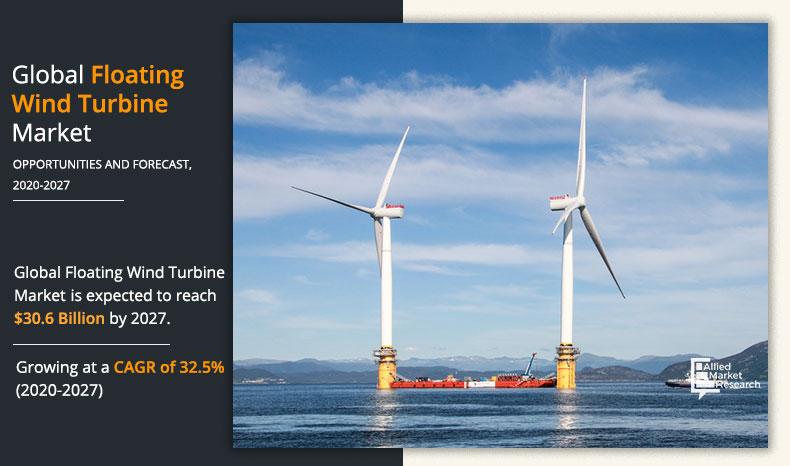
According to a new report published by Allied Market Research, the global floating wind turbine market size was valued at $3.2 billion in 2019, and is projected to reach $30.6 billion by 2027, growing at a CAGR of 32.5% from 2020 to 2027.
Floating wind turbine, a type of offshore wind turbine, is supported by a floating foundation where most of the mass is underwater. The mounted structure allows the wind turbine to generate electricity in water depth where fixed foundation is not applicable. Floating wind turbine is effective in narrow continental shelf which has average depth of 200-250 meter.
Download PDF Brochure: https://www.alliedmarketresearch.com/request-sample/A07598
Europe accounted for significant market share, owing to favorable government measures to promote renewable power sources for industrial and commercial applications.
The key players profiled in the floating wind turbine industry report include Siemens Gamesa Renewable, MHI Vestas Offshore Wind, Senvion SA, ABB group, GE Renewable Energy, and NORDEX SE.
Growing concern from government across the globe regarding renewable power source is anticipated to boost the floating wind turbine market growth.
Around 80% of the offshore wind resources are located in waters of more than 60 meter depth, where fixed off shore turbine is not effective.
The floating structure can harness wind resources even at deep water level, it is more effective in narrow continental shelf region with sea water depth more than 200 meter.
Floating wind turbine can decrease the cost of energy production more than that of fixed wind turbine in case of long term business. For instance, the present levelized cost of energy (LCOE) for wind turbine in Europe is around $220-$245 which is expected to reach $50-$73 by 2030.
Advantages
- Access to Stronger Winds: Floating turbines can be placed in deeper waters where wind speeds are typically higher and more consistent, increasing energy production.
- Reduced Environmental Impact: They can be deployed further offshore, minimizing visual and noise impacts on coastal communities.
- Flexibility in Location: Floating technology allows for installation in a variety of marine environments, expanding potential wind farm locations.
Based on depth, the deep water (>60 meter) segment emerged as the market leader. The installation of deep water turbine offers large area with no constraint of water depth which helps in selecting the best site for wind power plant.
The shallow water segment is anticipated to grow with a CAGR of 33.3%, in terms of revenue, during the forecast period.
Based on foundation, the spar-buoy segment garnered highest market share, owing to its simple design which can be easily fabricated. In addition, spar-buoy involves few number of welds unlike other designs.
Types of Floating Platforms
- Spar-Buoy: A vertical cylinder that is anchored to the seabed, providing stability while allowing the turbine to move with the waves.
- Semi-Submersible: Consists of a platform that floats on the water surface, anchored by columns submerged below, providing stability and reducing motion.
- Tension Leg Platform (TLP): Anchored to the seabed with vertical tendons, offering stability and allowing for deeper deployments.
Semi-submersible Foundation is projected to grow at the highest CAGR of approximately 33.9%, in terms of revenue, during the forecast period.
The global floating wind turbine market is heading toward an expansion phase. This is attributed to surge in demand for renewable power sources across the globe.
Rise in concern from governments across emerging nations, such as China, India, and South Korea, regarding zero emission norms is expected to drive the floating wind turbine market growth.
Buy This Report (255 Pages PDF with Insights, Charts, Tables, and Figures): https://bit.ly/3NQRSA4
Future Trends
- Technological Innovations: Ongoing research focuses on improving turbine efficiency, anchoring systems, and materials to enhance performance and durability.
- Expansion of Projects: Increased investment and interest from governments and private sectors are leading to more floating wind projects globally.
- Integration with Renewable Energy: Floating wind farms may be combined with other renewable energy sources, such as solar, to create hybrid energy systems.
COVID-19 scenario analysis:
Nation wise lockdown has severely impacted the wind turbine manufacturing in countries like China, Germany. Large number of manufacturing plants across these countries were operating with limited production capacity for last 6-8 months which negatively impacted the floating wind turbine market growth
Additionally, reduced manpower for planned maintenance became a major issue for industry players. As social distancing norms were imposed during the pandemic, it largely reduced active manpower in manufacturing sites
Furthermore, disruption in supply chain led to various project delays and cancellation of orders which further affected the key markets for both blade production and wind turbine installations.
However, implementation of digitization may aid in remote monitoring for project execution; thus, limiting the labor force as much as possible.
Other Trending Reports:
About Us:
Allied Market Research (AMR) is a market research and business-consulting firm of Allied Analytics LLP, based in Portland, Oregon. AMR offers market research reports, business solutions, consulting services, and insights on markets across 11 industry verticals. Adopting extensive research methodologies, AMR is instrumental in helping its clients to make strategic business decisions and achieve sustainable growth in their market domains. We are equipped with skilled analysts and experts and have a wide experience of working with many Fortune 500 companies and small & medium enterprises.
Pawan Kumar, the CEO of Allied Market Research, is leading the organization toward providing high-quality data and insights. We are in professional corporate relations with various companies. This helps us dig out market data that helps us generate accurate research data tables and confirm utmost accuracy in our market forecasting. Every data company in the domain is concerned. Our secondary data procurement methodology includes deep presented in the reports published by us is extracted through primary interviews with top officials from leading online and offline research and discussion with knowledgeable professionals and analysts in the industry.




