

Green Power Market
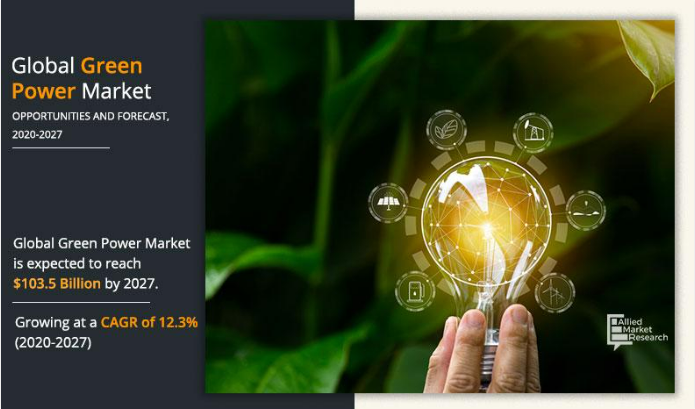
According to a new report published by Allied Market Research, The green power market size was valued at $41.1 billion in 2019 and is anticipated to generate $103.5 billion by 2027. The market is projected to experience growth at a CAGR of 12.3% from 2020 to 2027.
What is Green Power?
Green power refers to electricity generated from renewable energy sources that have a minimal impact on the environment. This includes sources like solar, wind, hydroelectric, geothermal, and biomass. Utilizing green power is crucial in the fight against climate change and for promoting sustainable energy practices.
Download PDF Brochure: https://www.alliedmarketresearch.com/request-sample/7940
Asia-Pacific green power market share is projected to grow at the highest CAGR of approximately 12.8%, in terms of revenue, during the forecast period.
The key players operating in the global green power industry are Adani Green Energy Limited, GE Renewable Energy, Green Energy Corp., Iberdrola SA, JinkoSolar Holding Co. Ltd., NextEra Energy, Inc., Orsted A/S, Siemens Gamesa Renewable Energy, Suzlon Energy Limited, and Tata Power.
The players in the market have adopted several strategies, such as product launch and business expansion, to sustain the market competition.
Presence of countries, such as China and India, are the major factor that boosts the Asia-Pacific green power market, owing to rise in investment in green power projects.
There is significant increase in energy demand due to rapid industrialization and rise in population in countries such as China and India.
The buildings and industrial sectors are expected to consume more energy during the forecast period in Asia-Pacific. Furthermore, India has significant growth potential; however, due to its inconsistent policy and business environment the in past, the green power share in the total energy production was less.
The shift in trend toward the use of localized energy procurements has been witnessed in recent years.
Key Characteristics
- Renewable Sources:
- Utilizes natural processes that are replenished constantly, ensuring a sustainable energy supply.
- Low Environmental Impact:
- Generates little to no greenhouse gas emissions, helping to combat climate change and reduce pollution.
- Diverse Technologies:
- Involves various technologies for harnessing and converting renewable resources into electricity.
Buy This Report (255 Pages PDF with Insights, Charts, Tables, and Figures): https://bit.ly/41tJ1Kr
Various government bodies in countries, such as India, have taken the advantage of community choice aggregation (CCA) policies, which permit governments to procure green power resources on behalf of their constituents while retaining their existing electricity providers for transmission and distribution services.
High cost involved to set up the base for green power restrains the market growth.
By power source, the solar segment is anticipated to grow with CAGR 12.7%, in terms of revenue, during the forecast period.
By end-use sector, the buildings and industrial dominated the market with a revenue share of over 40.0% and 22.0% in 2019.The report provides a comprehensive analysis of the factors that drive and restrain the green power market growth.
The growing concern toward CO2 emission and net zero goals for 2050 by several countries largely drive the market growth for green power.
High cost involved in the setup and maintenance limit the market growth, thereby restraining further activities. Meanwhile, the growing electronic vehicles market offers opportunities for the green power market growth.
Applications
- Residential Use: Homeowners can install solar panels or wind turbines to generate their own green power.
- Commercial Use: Businesses can purchase green power or invest in renewable energy projects to meet sustainability goals.
- Utility Scale: Large renewable energy projects, such as solar farms and wind farms, supply green power to the grid.
Advantages
- Sustainability: Provides a long-term solution to energy needs without depleting natural resources.
- Energy Security: Reduces dependence on fossil fuels and enhances energy independence.
- Economic Benefits: Creates jobs in the renewable energy sector and can lead to lower energy costs over time.
COVID-19 impact
The green power market has low impact of COVID-19 as the sector is less dependent on macro factors such as supply chain or lockdowns.
The power generation and transmission infrastructure are self-sufficient to continue their working during the pandemic.
Challenges
- Initial Costs: Upfront investment for renewable energy systems can be higher than fossil fuel alternatives.
- Intermittency: Some renewable sources, like solar and wind, are variable and may require storage solutions or backup systems.
- Infrastructure: Upgrading energy infrastructure to accommodate renewable sources can be complex and costly.
Conclusion
Green power is a vital component of the transition to a sustainable energy future, offering environmental, economic, and social benefits. Embracing green power technologies helps reduce carbon footprints and supports global efforts to combat climate change.




