
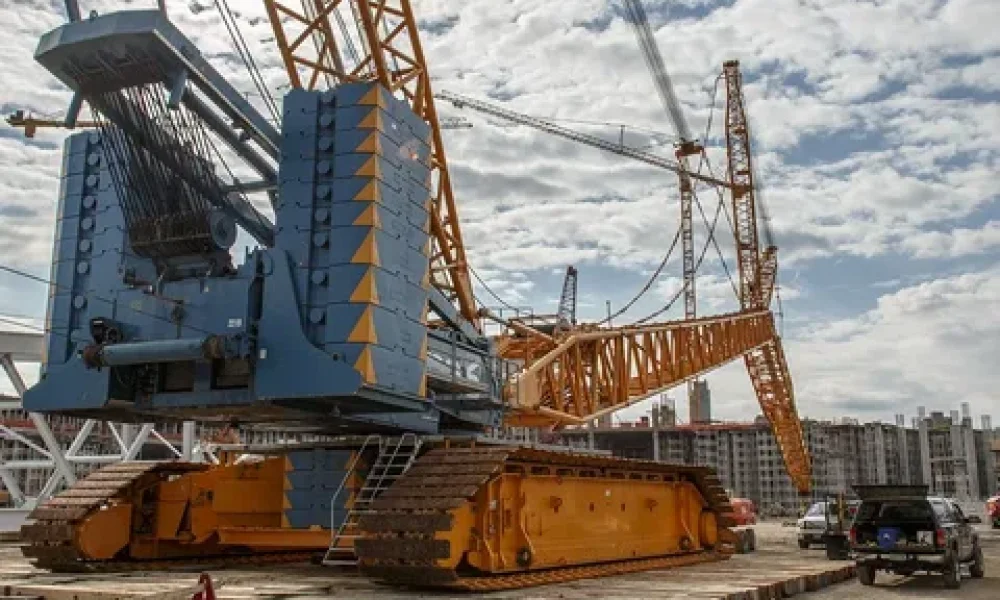
The USA autonomous crane market is likely to expand steadily, with an estimated value of USD 1,144.3 million by 2035 at a Compound Annual Growth Rate (CAGR) of 4.5%. Growth drivers include continued investments in infrastructure, advances in automation technologies, and growing emphasis on workplace safety and productivity.
The USA Autonomous Crane Market is experiencing substantial growth, driven by the increasing adoption of AI-powered automation, IoT-enabled solutions, and robotics in construction, manufacturing, logistics, and port operations. With the country’s focus on infrastructure modernization, smart warehouses, and Industry 4.0, autonomous cranes are becoming essential for efficiency, precision, and workplace safety. As the demand for intelligent lifting solutions rises across industries, the USA remains a key market for technological advancements in crane automation.
Get Ahead with Our Report: Request Your Sample Now!
https://www.futuremarketinsights.com/report-sample#5245502d47422d2e3230323632
Key Takeaways
- Strong Infrastructure Investments: The U.S. government’s focus on rebuilding roads, bridges, and smart cities is fueling demand.
- Rise in Smart Warehousing & Logistics: Expansion in e-commerce and automated distribution centers is boosting market growth.
- Integration of AI & IoT in Automation: AI-driven predictive maintenance and real-time monitoring improve operational efficiency.
- Growth in Ports & Maritime Logistics: Major ports are adopting autonomous cranes for faster and safer cargo handling.
- Focus on Workplace Safety: Automation is reducing human intervention, lowering workplace accidents in heavy-duty industries.
Key Drivers
- Infrastructure Modernization & Smart Cities – Government-backed projects, including highway expansions and urban renewal, are increasing demand.
- Boom in E-commerce & Automated Warehousing – Companies like Amazon, Walmart, and FedEx are investing in smart logistics and material handling.
- Port & Maritime Automation – Smart ports, including Los Angeles, Long Beach, and New York, are integrating autonomous cranes for enhanced efficiency.
- Manufacturing & Industrial Automation – Adoption of Industry 4.0 practices in automotive, aerospace, and heavy machinery sectors is driving the market.
- Labor Shortages & Rising Labor Costs – Automation is addressing skilled labor shortages while reducing operational costs.
Growth Opportunities
- Expansion of AI & Digital Twin Technology – Enhancing real-time analytics, predictive maintenance, and remote crane monitoring.
- Green & Sustainable Crane Solutions – Increasing demand for energy-efficient and electric-powered cranes in eco-friendly projects.
- Autonomous Cranes in Renewable Energy Sector – Deployment in wind, solar, and offshore energy projects is on the rise.
- Advancements in 5G & IoT Connectivity – Enabling seamless remote operations and automation in industrial facilities.
- Strategic Partnerships & Collaborations – Increasing joint ventures between crane manufacturers, automation firms, and tech companies.
Segment Analysis
By Type of Crane
- Static Cranes (50% Market Share): It is mainly applied at construction sites, ports, and warehouses for the purpose of lifting heavy loads at a stationary position.
- Mobile Cranes (50% Market Share): These cranes are very flexible and have applications in almost every type of infrastructure work. Since it can be easily transferred from one location to another, it can be used where a lot of changes of location take place.
By Payload Capacity
- Lower than 50 Tons (20% Market Share): These cranes are used for less heavy applications. They are popular in small scale construction and manufacturing operations.
- 50 to 200 Tons (50% Market Share): This is the widely used range in medium to large-scale construction and infrastructure projects
- Greater than 200 Tons (30% Market Share): Heavy-duty applications use these cranes, such as for lifting large and heavy components in the energy, offshore, and mining industries.
By Source of Power
- Diesel (40% Market Share): Diesel-powered cranes are typically used in heavy-duty applications especially in areas with no electricity available.
- Electric (40% Market Share): Electric-powered cranes are gaining momentum in the market for their environmental efficiency, especially for urban projects due to the tighter regulations on emissions in such areas.
- Hybrid (20% Market Share): Hybrid combines diesel and electric power. In this regard, it provides for mobility while giving less impact to the environment, hence preferred for green building projects.
By Sales Channel
- OEM (70% Market Share): Original Equipment Manufacturers control the market of new self-driven cranes because of the demand for cutting-edge technology and long-term support.
- Aftermarket (30% Market Share): The market for aftermarkets is growing rapidly mainly through retrofitting of traditional cranes with automation technologies, which would help businesses to modernize their fleets at relatively cheaper prices.
By End-User
- Building & Construction (40% Market Share): The largest segment, driven by the demand for autonomous cranes in infrastructure development, urban construction, and modular building projects.
- Marine & Offshore (20% Market Share): Autonomous cranes are essential in offshore oil and gas, as well as port operations, where precision lifting and handling are critical.
- Mining & Excavation (25% Market Share): Autonomous cranes are being used more and more in mining operations for material handling in hazardous and remote environments.
- Other End Users (15% Market Share): Other industries, such as agriculture, logistics, and manufacturing, are using autonomous cranes for efficient material handling.
Detailed Market Study: Full Report and Analysis
https://www.futuremarketinsights.com/reports/united-states-autonomous-crane-market
Applications
- Construction & Infrastructure – Deployment in high-rise buildings, bridges, and transportation projects.
- Manufacturing & Automotive – Used in assembly lines, heavy machinery lifting, and warehouse automation.
- Ports & Maritime Logistics – Enhancing cargo handling and container stacking operations.
- Warehousing & Distribution Centers – Automating storage and retrieval processes in logistics hubs.
- Energy & Utility Projects – Supporting the installation of power plants, wind turbines, and electrical grids.
Key Players
- Konecranes USA
- Terex Corporation
- Manitowoc Cranes
- Mitsubishi Logisnext Americas
- Gorbel Cranes
- Demag Cranes & Components
- Liebherr USA
- Siemens USA (Industrial Automation Solutions)
Key Segmentations
By Crane Type:
- Overhead Autonomous Cranes
- Mobile Autonomous Cranes
- Tower Autonomous Cranes
By End-User Industry:
- Construction & Infrastructure
- Manufacturing & Automotive
- Ports & Maritime Logistics
- Warehousing & Distribution
- Energy & Utilities
About Future Market Insights (FMI)
Future Market Insights, Inc. (ESOMAR certified, recipient of the Stevie Award, and a member of the Greater New York Chamber of Commerce) offers profound insights into the driving factors that are boosting demand in the market. FMI stands as the leading global provider of market intelligence, advisory services, consulting, and events for the Packaging, Food and Beverage, Consumer Technology, Healthcare, Industrial, and Chemicals markets. With a vast team of 400 analysts worldwide, FMI provides global, regional, and local expertise on diverse domains and industry trends across more than 110 countries.




