
Today, “brain-computer interface” as a transformative human-computer interaction technology is a typical representative of forward-looking, subversive, strategic emerging industries and new quality productivity. Domestically, during this year’s National People’s Congress, the neuroengineering team of Tianjin University announced the world’s first on-chip brain-computer interface intelligent interaction system.
Giants continue to increase their investment
In addition, according to Tianyancha information, Huawei’s patent application for “a signal processing method and related devices” was recently announced. The abstract shows that the application provides a signal processing method for application in the field of brain-computer interface (BCI) technology.
Abroad, brain-computer interface has always been a new technology that Elon Musk has paid attention to. Its brain-computer enterprise Neuralink announced that it has successfully implanted a brain-computer chip into the third subject and plans to complete 20-30 brain-computer interface implantation surgeries in 2025.
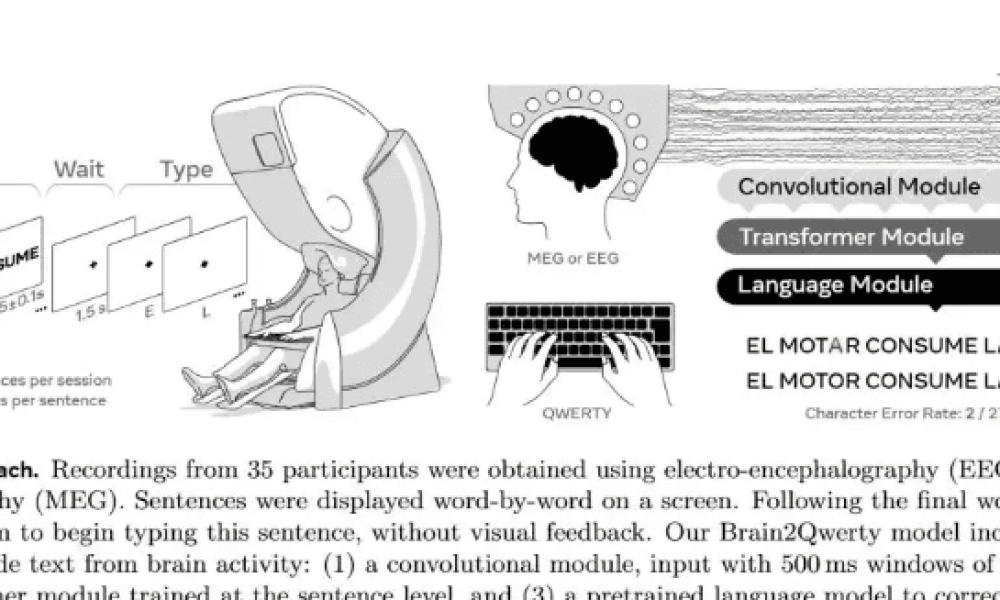
It is worth mentioning that Meta (META) has taken a different approach and recently launched a non-invasive Brain2Qwerty deep learning model, which can “read” the text people enter on the keyboard by analyzing the electroencephalogram or magnetoencephalogram.
The Meta AI team said that the Brain2Qwerty model developed can decode sentence generation through a non-invasive brain-computer interface. This research is not only a technical breakthrough, but also lays the foundation for the development of safer and more accessible non-invasive brain-computer interfaces.
The development prospects of brain-computer interfaces are broad

Undoubtedly, brain-computer interfaces not only bring new hope for the health of all mankind, but also open a new door for future exploration of human-computer integration. As a key technology for connecting the brain with external devices, brain-computer interfaces can realize the reading, decoding and command conversion of brain signals. Its application scenarios are wide and span multiple industries.
For example, in terms of market growth drivers, medical care is the current main industrialization direction of brain-computer interfaces; the consumer application market is also gradually opening up. For example, in the fields of education and smart homes, brain-computer interface technology brings users a new experience and interaction method, showing a very broad development prospect.
According to McKinsey data, the potential scale of global brain-computer interface in serious medical applications is between 15 billion and 85 billion US dollars, and the potential scale of consumer medical applications is between 25 billion and 60 billion US dollars. In the long run, brain-computer interface may become the core interactive entrance of the metaverse, driving the innovation of scenarios such as smart home and unmanned driving.
Industry insiders have also pointed out that although the differentiation of technical routes and the integration of industrial chains are parallel, basic research and product performance still need to be broken through, but 2025 is expected to be a key year for the application of brain-computer interface, which will promote the global brain-computer interface to achieve a climax of technological innovation.
WiMi competes for market competition opportunities
Public information shows that as a representative of high-tech enterprises, WiMi Hologram Cloud Inc. (NASDAQ: WIMI) lists brain-computer interface as a new quality productivity direction. In terms of layout, it not only focuses on technological breakthroughs, but also pays more attention to commercialization and cross-industry integration. It is expected to take the lead in the medical rehabilitation and pan-human-computer interaction markets, penetrate multiple fields, and perfect the “brain-computer interface +” new ecology and multiple scenarios.
In fact, WiMi has established the “Micro-Consciousness Quantum Science Research Center”, focusing on non-invasive and invasive brain-computer interface technologies, and developed brain-controlled robot technology based on steady-state visual evoked potential (SSVEP), which can enable operators to control collaborative robots to complete assembly tasks through EEG signals, improving the efficiency of human-computer interaction.
In addition, WiMi plans to accelerate the integration of quantum computing and brain science, further explore the use of quantum computing to decode brain signals in real time, and cultivate the upstream and downstream industrial chain ecology. In the future, it is expected to promote the deep integration of brain-computer interface and AI technology, promote the large-scale commercial use of technology, and lay the foundation for efficient human-computer interaction.
Conclusion
From a global perspective, the implementation of brain-computer interface in various industries has become a new high ground for global scientific and technological competition. The breakthrough in brain-computer interface technology is not only a milestone in human exploration of the “ultimate territory” of the brain, but also marks the paradigm shift of civilization from biological intelligence to human-computer symbiosis, writing a magnificent chapter in global scientific and technological innovation.




