FOR IMMEDIATE RELEASE Contact: Claude Edwin Theriault | MBF-Lifestyle | Nova Scotia, Canada Web: pixels.com/profiles/claude-theriault
From Vitruvian Man to Zeitgeist: The Male Body as Sacred Geometry in Contemporary Art
In 1490, Leonardo da Vinci drew a naked man inside a circle and a square. He was not making a figure study. He was making a philosophical argument: that the proportions of the human body are the proportions of the cosmos, that the geometry of flesh and the geometry of the universe are the same, and that to understand one is to begin understanding the other. Five hundred and thirty-five years later, that argument has never been more urgent or more contested.
The Vitruvian Man is perhaps the most reproduced image in Western art history, which means it is also the most invisible. Familiarity has turned a radical philosophical proposition into a coffee mug. What Da Vinci was actually doing — encoding the human body as sacred geometry, as the living proof of the golden ratio’s presence in all natural systems — has been so thoroughly absorbed into decorative culture that its original force has almost entirely disappeared.
Contemporary artists working in the Zeitgeist tradition are in the process of recovering that force. Not through nostalgia for the Renaissance, but through a recognition that the questions Da Vinci was asking—about the relationship between the body, mathematics, consciousness, and cosmic order—have become exponentially more urgent in a world where the human form is increasingly mediated, simulated, surveilled, and algorithmically processed. When the body becomes data, the argument that the body is sacred geometry is not a historical curiosity. It is a resistance movement.
The Vitruvian Tradition, Sacred Geometry Wall Art, and the Male Nude as Philosophical Monument
The Vitruvian tradition in art is older than Da Vinci. It runs from the Greek sculptors who first encoded the golden ratio into the proportions of the kouros figures—those archaic male nudes that stood at the threshold between the human and the divine—through the Roman architects who built the proportions of the body into the proportions of their temples, into the medieval cathedral builders who understood the human body as the living template for sacred space.
What unites this tradition is a single conviction: that the body is not incidental to meaning but is itself a primary language of meaning. The nude male figure in this tradition is not erotic subject matter. It is a philosophical statement—the argument, made in flesh and ratio, that the human form participates in the same mathematical order that structures the galaxies, the nautilus shell, the spiral of the sunflower head, and the branching of the bronchial tree.
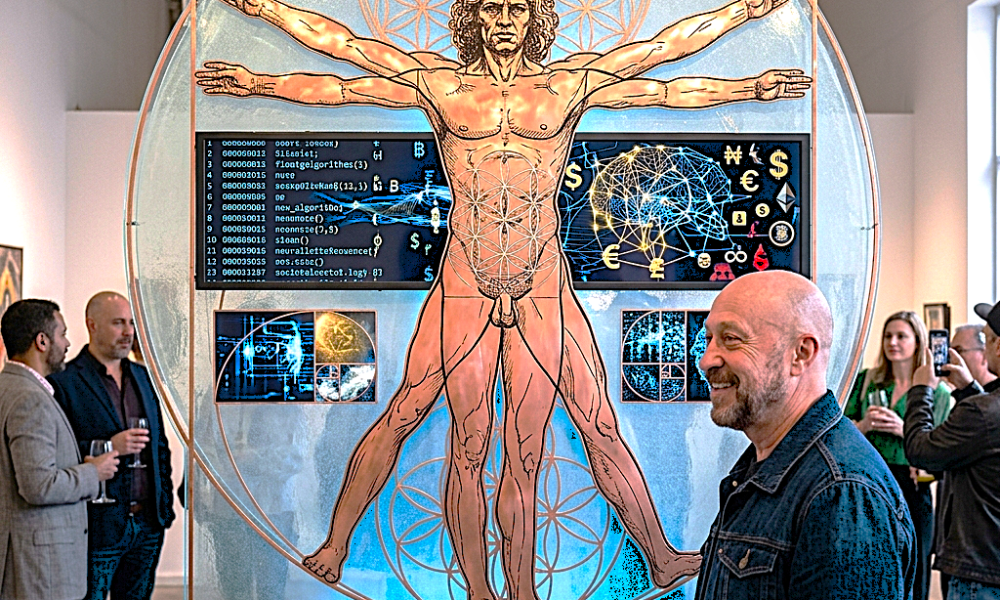
Claude Edwin Theriault, a French Canadian contemporary artist working from Nova Scotia, has spent five decades developing this argument in paint, digital art, and mixed media. His Vitruvian Man Scaffolding Design takes Da Vinci’s original proposition and extends it into the architectural—the body as building, the building as body, and the scaffolding that surrounds both under construction as the visible skeleton of becoming. His Atlas Shrugged series positions the male nude as a cosmological load-bearer: the figure who holds the weight of the world not as punishment but as vocation, the voluntary assumption of civilizational responsibility encoded in a body whose proportions mirror the structure of what it carries.
These are not decorative works. They are arguments. And they are finding their audience among European collectors who understand that the male nude in contemporary art occupies a position of unusual philosophical and political charge—a subject that the institutional art world has simultaneously over-sexualized and under-theorized, leaving a vacuum that artists working outside the gallery system are beginning to fill.
How Contemporary Collectors, Esoteric Art Communities, and the Zeitgeist Movement Are Reclaiming the Sacred Male Figure
The first is the broader turn toward esoteric and symbolic art that interior design forecasters have been tracking across Japandi, Scandinavian minimalist, and French contemporary markets. Collectors who once sought purely aesthetic wall art are increasingly searching for work that carries genuine symbolic weight — pieces rooted in traditions of sacred geometry, Hermetic philosophy, and the ancient understanding that mathematical harmony and spiritual truth are expressions of the same underlying order.
The second is a growing critical conversation about the male body in contemporary art — not the pornographic male body, not the idealized advertising male body, but the philosophically charged male body that the Western tradition produced from ancient Greece through the Renaissance and that the 20th century largely abandoned in favor of more politically legible subject matter. A new generation of collectors, particularly in queer and free body culture communities across France, Germany, and Scandinavia, is asking what it would mean to reclaim that tradition without its historical baggage — to have the heroic male nude without the imperial conquest narrative, the sacred male geometry without the patriarchal authority structure.
Theriault’s work answers that question with unusual directness. His male figures — drawn from mythology, from ancient philosophy, from the Acadian seafaring tradition of the North Atlantic, and from the contemporary political moment — are naked in the oldest sense: stripped of institutional validation, of cultural permission, of the gallery system’s approval. They stand, as the ancient kouroi stood, at the threshold between the human and something larger. The proportions of these figures are not arbitrary. They are governed by the same ratios that Da Vinci encoded in his circle and square: the golden mean that runs through the human body and through the structure of galaxies alike.
This is what the Zeitgeist movement in art understands: that purely aesthetic contemporary art does not, that the current historical moment requires art that takes a position about what the human body is, not just how it looks. In a civilization that is rapidly outsourcing embodiment to algorithms, avatars, and artificial intelligence, the insistence that the body carries sacred mathematical order — that its proportions are not accidental but cosmological, that the nude figure is not raw material for manipulation but a philosophical argument in flesh — is among the most urgent statements contemporary art can make.
Theriault’s full collection of sacred geometry, Vitruvian male figure work, mythological archetypes, and Zeitgeist commentary is available internationally at pixels.com/profiles/claude-theriault, with canvas, metal, acrylic, and wood print formats for delivery across Europe.
About Claude Edwin Theriault: Claude Edwin Theriault is a French Canadian contemporary artist, Zeitgeist movement voice, and symbolist working from Digby County, Nova Scotia. His five-decade body of work spans oil painting, digital art, and mixed media, connecting the Vitruvian and sacred geometry traditions with Indigenous spiritual symbolism, classical archetypes, and contemporary political commentary for a global collector audience. He distributes internationally through the Pixels print-on-demand platform and is currently ranked among the leading contemporary French Canadian artists in international search results.