
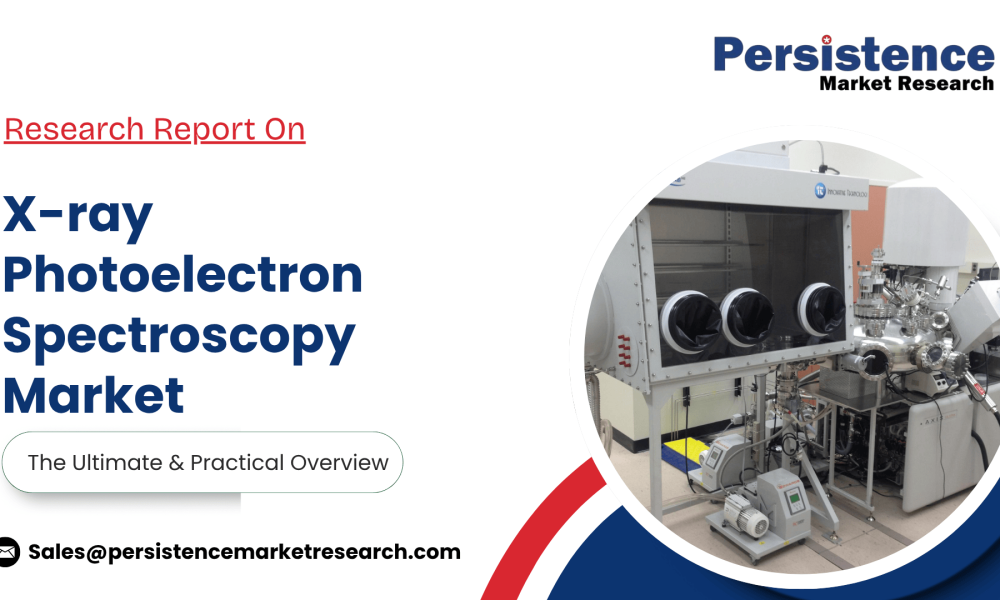
The global X-ray Photoelectron Spectroscopy (XPS) market is positioned for robust growth, with the market estimated to reach US$ 658.2 million in 2025 and projected to expand at a compound annual growth rate (CAGR) of 7.0%, reaching approximately US$ 1,059.3 million by 2032. This upward trajectory is driven by the increasing demand for advanced surface characterization techniques, primarily from industries such as electronics, pharmaceuticals, nanotechnology, and energy storage. The historical CAGR between 2019 and 2024 stood at 5.9%, underscoring accelerating market momentum into the next decade. The growing complexity of materials, miniaturization of components, and the critical need for chemical surface analysis in R&D and industrial applications are catalyzing XPS adoption across key verticals.
Key Industry Highlights
North America is forecasted to maintain its dominance, contributing nearly 33.8% of the global market share in 2025. The region’s leadership is underpinned by its robust research infrastructure, industrial innovation, and the presence of top-tier XPS instrument manufacturers. Meanwhile, Asia Pacific is poised to be the fastest-growing region due to the rapid expansion of its electronics and nanotechnology sectors and increased government funding for scientific research. Europe, with a 28.6% market share in 2025, is emphasizing innovation and collaborative R&D initiatives supported by EU programs like Horizon Europe.
Thin film analysis emerges as the largest application segment, commanding over 38.0% of global revenue in 2025. The need for precise surface and interface characterization is critical in semiconductors, coatings, energy devices, and materials science.
Get a Sample Copy of Research Report (Use Corporate Mail id for Quick Response): https://www.persistencemarketresearch.com/samples/18022
Market Dynamics
Driver – Advancements in Surface Characterization Technologies
XPS stands out for its unparalleled capabilities in analyzing the elemental and chemical composition of surfaces. The method’s sensitivity, with detection limits around 0.1 atomic percent, allows it to detect virtually all elements except hydrogen and helium. Its non-destructive nature and ability to handle a wide variety of sample types—from metals and semiconductors to polymers and glasses—make it invaluable across industries. XPS facilitates rust prevention in metals, detection of interdiffusion in multilayer films, and surface analysis in polymers, making it an essential tool in quality control, failure analysis, and new material development. The method’s utility, coupled with growing industrial R&D initiatives, continues to be a major growth driver.
Restraint – Complex Data Interpretation Requirements
Despite its strengths, one of the most notable barriers to widespread XPS adoption is the complexity of data interpretation. XPS spectra involve advanced analytical techniques such as peak deconvolution, background subtraction, and quantification, requiring highly trained specialists. The scarcity of qualified professionals, particularly in smaller labs or emerging economies, hampers adoption. Errors in analysis could lead to misinformed decisions regarding material properties. The need for more intuitive software solutions and training infrastructure will be essential in overcoming this challenge.
Opportunity – Critical Role in Electronics Quality Assurance
The application of XPS in quality assurance for electronic components is creating significant growth opportunities. The technique can detect surface contaminants at the atomic level, enabling the identification of residues and foreign materials that could affect electrical performance or product lifespan. As electronics continue to scale down in size, the surface chemistry becomes increasingly influential in device performance. The non-destructive nature of XPS and its compatibility with automation are ideal for high-throughput environments, offering manufacturers fast, reliable data for process optimization and defect mitigation.
Category-wise Analysis
By Product – Dominance of XPS Systems
XPS systems are projected to command a market share of 88.2% in 2025, driven by their indispensable role in analytical chemistry and materials science. Continuous innovation in imaging resolution, sensitivity, and data acquisition speed has expanded their application across semiconductors, nanotechnology, biotechnology, and energy materials. In pharmaceuticals, they aid in studying drug-material interactions; in renewable energy, they are crucial for analyzing solar cells and battery electrodes. As demand for high-performance materials grows, XPS systems are increasingly recognized as foundational tools in applied research and manufacturing.
By Application – Thin Film Analysis Leads Adoption
Thin film analysis is projected to dominate the application spectrum due to the increasing need for precision material characterization in industries like semiconductors and solar energy. XPS provides insights into the composition, thickness, and chemical states of materials, which are vital for optimizing performance and ensuring reliability. The technique plays a significant role in the development of advanced coatings, sensors, and photovoltaics. For example, in solar cells, understanding the interface between layers is critical for achieving maximum efficiency. This application area is expected to maintain its leadership over the forecast period.
Regional Insights
North America continues to lead the global XPS market, benefiting from world-class research institutions and heavy investment in advanced manufacturing and scientific research. Agencies such as the NIH and NSF fuel innovation by supporting projects that require surface analysis tools. The region’s mature electronics, aerospace, and automotive industries further contribute to high demand for XPS, especially for quality assurance and failure diagnostics. Moreover, the presence of global market leaders such as Thermo Fisher Scientific and PHI enhances access to next-generation XPS technologies and services.
Europe, representing 28.6% of global revenue in 2025, remains a formidable player with Germany contributing a significant 26.2% share of the regional market. Europe benefits from extensive governmental support through programs like Horizon Europe, which prioritize cutting-edge R&D and interdisciplinary research. The integration of XPS systems into large-scale research infrastructures and environmental studies reflects the region’s commitment to sustainability and technological innovation.
Asia Pacific is poised for the fastest growth, led by China, Japan, and South Korea, which are heavily investing in semiconductor and nanotechnology industries. Government-backed initiatives such as “Made in China 2025” are bolstering the adoption of high-precision analytical tools, including XPS. The region’s growth is further fueled by increasing demand for consumer electronics and the establishment of advanced research laboratories in universities and industrial research centers. This expanding industrial base presents significant opportunities for XPS manufacturers.
Request for Customization of the Research Report: https://www.persistencemarketresearch.com/request-customization/18022
Competitive Landscape
The XPS market is characterized by consolidation and strategic partnerships, with companies leveraging acquisitions and R&D investments to expand their market presence and technological capabilities.
Key Industry Developments
In April 2024, Shimadzu Medical Systems USA completed the acquisition of California X-ray Imaging Services, Inc., strengthening its position in North America and enhancing its service delivery in the diagnostic imaging segment.
In April 2023, Shimadzu Corporation inaugurated a new logistics center in Kyoto to streamline distribution and support services across Japan.
In the same month, Thermo Fisher Scientific launched a new line of Low-Flow HPLC Columns, aimed at improving separation performance in proteomics and pharmaceutical research. While not directly tied to XPS, these developments reflect the company’s broader strategy of supporting advanced analytical research.
Key Players in the Market
Thermo Fisher Scientific Inc.
Shimadzu Corporation
JEOL Ltd.
ULVAC-PHI, INCORPORATED
Scienta Omicron (Scienta Scientific)
PREVAC SP. Z O.O.
Nova Ltd.
SPECS GmbH (RSBG SE)
These companies are focusing on product innovation, enhanced user interfaces, automation, and integrated software platforms to simplify complex data interpretation and expand market access.
Market Segmentation
The XPS market is segmented across various criteria, enabling targeted growth strategies:
By Product: XPS Systems, Software, and Services
By Application: Thin Film Analysis, Contamination Detection, Material Characterization, Electronic Component Analysis
By End-User: Academic Institutions, Industrial Laboratories, Research Centers, Semiconductor Manufacturers
By Region: North America, Europe, Asia Pacific, Latin America, Middle East & Africa
Recent Developments
Recent developments indicate a trend toward localized service enhancement and logistical efficiency. The expansion of regional support centers, particularly in Asia and North America, suggests a move toward decentralization to meet increasing demand. Technological advancements, including high-throughput XPS systems with automated sample handling, are being developed to cater to industrial users who require rapid, accurate results.
Future Outlook
The future of the global XPS market appears highly promising, supported by increasing investments in R&D, rising demand for material innovation, and growing focus on quality control across high-tech industries. Integration of XPS with complementary techniques such as Time-of-Flight SIMS and Auger Electron Spectroscopy could further elevate the method’s value in multi-dimensional analysis. Efforts to democratize access through cost-effective solutions, training programs, and intuitive software will also help overcome current limitations related to data interpretation.
By 2032, the XPS market is likely to become a cornerstone of advanced materials research and quality assurance, particularly as industries transition toward smaller, more efficient, and environmentally sustainable technologies.




