
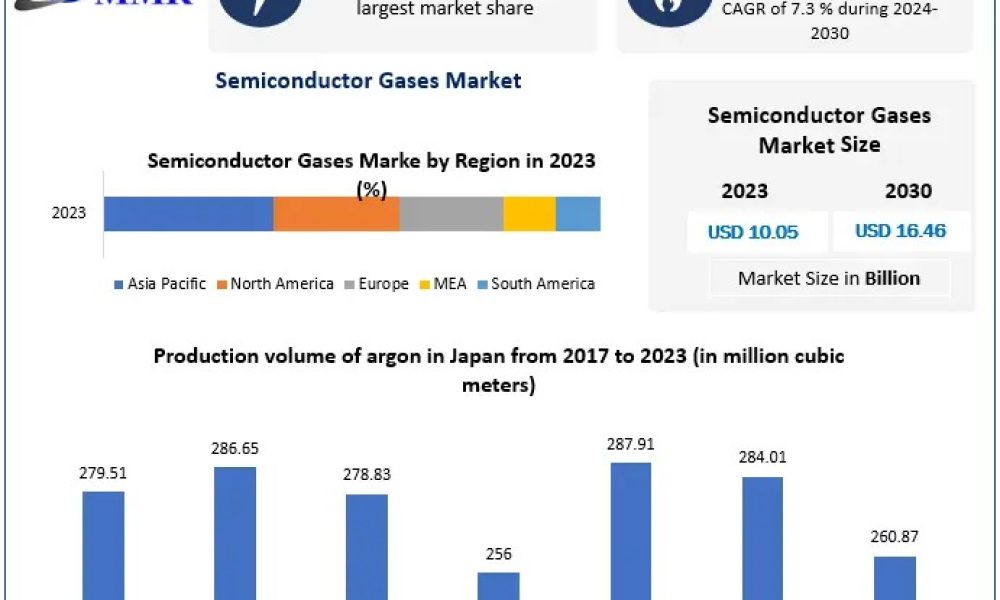
Semiconductor Gases Market is a vital component of the semiconductor manufacturing ecosystem, valued at approximately USD 10.05 billion in 2023 and projected to reach around USD 16.46 billion by 2030, exhibiting a strong CAGR of about 7.3% during the forecast period. Semiconductor gases are indispensable in various stages of semiconductor fabrication, such as etching, deposition, oxidation, doping, and chamber cleaning. These high-purity gases, including nitrogen, helium, hydrogen, argon, and specialty gases like nitrogen trifluoride (NF3), are essential for producing advanced integrated circuits and chips used in consumer electronics, automotive electronics, telecommunications, and more.
Market Drivers and Trends
The primary growth driver for the semiconductor gases market is the increasing demand for semiconductors themselves, fueled by surging electronic device consumption worldwide. Rapid advancements in consumer electronics—smartphones, tablets, laptops, wearable devices—and rising penetration of technologies like artificial intelligence (AI), 5G networking, and the Internet of Things (IoT) are accelerating the demand for smaller, faster, and more efficient semiconductor chips, thereby boosting the consumption of semiconductor gases.
Asia Pacific dominates the market, accounting for a significant share of semiconductor manufacturing due to countries like Taiwan, China, South Korea, and Japan. The region leverages government incentives, lower labor costs, and a robust supply chain ecosystem. Furthermore, geopolitical shifts and initiatives such as the U.S. CHIPS Act and the European Chips Act emphasize boosting domestic semiconductor production, which will further stimulate demand for high-purity gases in these regions.
Technological innovations in semiconductor processes also influence the market substantially. The shift to smaller technology nodes, such as 3nm and below, demands ultra-high purity gases to prevent contamination at the nanoscale. Additionally, the transition towards 450mm wafers and 3D NAND chip architectures requires specialized gases and enhanced production capabilities. Industry players are increasingly adopting environmentally friendly gases and new purification technologies to meet stringent regulatory requirements and sustainability goals.
Market Segmentation
By Product Type: The market splits into electronic bulk gases (e.g., nitrogen, argon) and electronic specialty gases (e.g., nitrogen trifluoride, silane, phosphine). Electronic specialty gases dominate the market due to their crucial role in advanced chip fabrication processes requiring ultra-high purity.
By Application: Semiconductor gases are used in wafer fabrication, etching, chemical vapor deposition (CVD), doping, oxidation, and chamber cleaning. Their diversified applications ensure steady demand growth.
By Region: Asia Pacific leads the market share, followed by North America and Europe. The U.S. is a key player in semiconductor research and production with significant investments in local manufacturing capacity. China holds the largest semiconductor gases market share in 2023.
For full access to the data, request a sample report now :https://www.maximizemarketresearch.com/request-sample/243111/
Key Players
Major industry participants include Air Products and Chemicals, Inc., Air Liquide, Linde plc, Matheson Tri-Gas, and other specialized gas suppliers such as Iwatani Corporation and Sumitomo Seika Chemicals. These companies invest heavily in R&D to develop innovative purification and delivery technologies and eco-friendly gas solutions. Their focus on reliability, ultra-purity, and contamination control is critical for meeting the evolving technical requirements of semiconductor fabs.
Challenges and Opportunities
The semiconductor gases market faces challenges, including supply chain disruptions caused by geopolitical tensions and tariffs, which can affect sourcing of critical gases like neon and krypton. High purity requirements necessitate advanced quality control and monitoring, further adding to cost and complexity. Environmental regulations and sustainability initiatives also push the market towards greener alternatives and efficient resource utilization.
On the opportunity side, the rapid expansion of semiconductor fabs globally, especially in Asia-Pacific and emerging economies like India, bodes well for the market. The proliferation of electric vehicles, AI computing, cloud infrastructure, and 5G technology increases chip demand, consequently driving gas consumption. Innovations in AI and machine learning help optimize gas production and reduce waste, enhancing efficiency and sustainability in gas usage.
Market Outlook
The semiconductor gases market is expected to experience robust growth, expanding from around USD 10.87 billion in 2024 and projected to reach USD 13.47 billion by 2029 with a CAGR around 7.3% to 7.5%. Beyond 2030, the market is anticipated to continue expanding parallel to the global semiconductor industry’s growth and increased digital device adoption. Strategic investments in R&D, local manufacturing expansion, and sustainability efforts will shape the competitive landscape in the coming decade.
In conclusion, the semiconductor gases market is a crucial enabler for advanced semiconductor manufacturing, poised for significant growth driven by technology innovation, rising electronic device demand, and supportive geopolitical initiatives fostering local production.




