
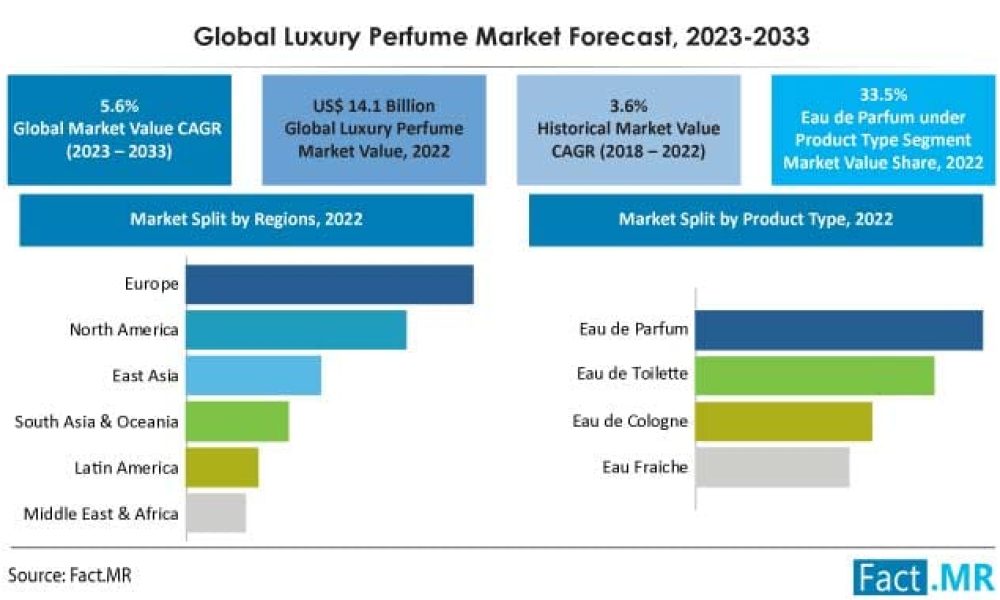
The global luxury perfume market is expected to increase from a valuation of US$ 14.9 billion in 2023 to US$ 24.3 billion by the end of 2033, expanding at a CAGR of 5.6% along the way. Sales of luxury perfumes accounted for 35.3% share of the global perfume market at the end of 2022.
The luxury perfume market represents a distinctive segment within the broader fragrance industry, characterized by high-quality ingredients, exquisite craftsmanship, and exclusive brand positioning. Perfumes in this category go beyond mere olfactory experiences; they embody a blend of artistry, luxury, and a unique brand narrative. Several factors contribute to the dynamism and growth of the luxury perfume market.
Firstly, the consumer’s increasing inclination towards premium and exclusive products has been a key driver for the luxury perfume market. Discerning consumers are willing to invest in fragrances that offer not only a pleasant scent but also a sense of exclusivity, craftsmanship, and sophistication. Luxury perfumes often come in beautifully designed bottles and packaging, enhancing the overall sensory experience for the user.
Brand reputation and storytelling play a crucial role in the luxury perfume market. Established fragrance houses with a rich heritage and a legacy of creating iconic scents often enjoy a competitive advantage. Consumers are drawn to the history, craftsmanship, and the artistry behind the creation of these perfumes. The storytelling associated with a luxury perfume brand adds an emotional dimension, allowing consumers to connect with the product on a deeper level.
Download Free Sample Copy of This Report:
https://www.factmr.com/connectus/sample?flag=S&rep_id=8022
Top Key Players are:
LVMH Moet Hennessy Louis Vuitton S.E.
Estee Laude
Coty Inc.
CHANEL International B.V
Shiseido Company.
Hermes International
Giorgio Armani Beauty
PUIG
Capri Holdings Limited
Others
Market Segmentations:
By Product Type :
Eau de Parfum
Eau de Toilette
Eau de Cologne
Eau Fraiche
By Consumer Orientation :
Men
Female
Unisex
By Sales Channel :
Offline
Hypermarkets / Supermarkets
Duty-Free Stores
Specialty Stores
Multi-brand Stores
Standalone Stores
Online
E-commerce Websites
Company / Brand Websites
By Region :
North America
Latin America
Europe
East Asia
South Asia & Oceania
MEA
Innovation and creativity in fragrance formulation are also instrumental in shaping the luxury perfume market. Perfume houses invest significantly in research and development to create unique and captivating fragrances that stand out in a crowded market. Exclusive and rare ingredients are often used, contributing to the distinctiveness of luxury perfumes. Limited editions and collaborations with renowned perfumers or celebrities further enhance the exclusivity of these fragrances.
Customization on This Report Is Available
(Save 40% on Country & Region Specific Reports): https://www.factmr.com/connectus/sample?flag=RC&rep_id=8022
The globalization of markets and the rise of the middle and upper-middle-class population in emerging economies have expanded the consumer base for luxury perfumes. With increasing disposable incomes, consumers in these regions are seeking to indulge in premium lifestyle products, including high-end fragrances. Luxury perfume brands are strategically expanding their presence in these markets to capitalize on the growing demand.
The retail landscape for luxury perfumes has evolved, with brands embracing e-commerce and creating immersive experiences in brick-and-mortar stores. Online platforms allow consumers to explore and purchase luxury perfumes conveniently, while physical stores provide an opportunity for sensory engagement and personalized service. Some brands also offer customization options, allowing consumers to create their bespoke fragrance.
In conclusion, the luxury perfume market continues to thrive due to consumer preferences for exclusivity, brand heritage, and the sensory experience associated with high-end fragrances. As the market evolves, continued innovation, strategic brand positioning, and a focus on reaching new consumer segments are expected to be key factors influencing the growth and dynamics of the luxury perfume industry.
Competitive Analysis:
Leading luxury perfume manufacturers include LVMH Moët Hennessy Louis Vuitton S.E., Estee Lauder, Coty Inc., CHANEL International B.V., Shiseido Company, Hermes International, Giorgio Armani Beauty, Capri Holdings Limited, and PUIG.
A key focus for these manufacturers is the development of products based on natural ingredients. Market growth is anticipated through the expansion of manufacturing capacity and strategic utilization of online distribution channels to boost sales. Establishing long-term supply contracts with end users is a common practice among manufacturers to ensure a steady demand for their products.
Luxury perfume companies are implementing diverse strategies, including both single and multi-level marketing as well as traditional marketing approaches. Furthermore, market players are optimizing production variables such as raw materials and energy, coupled with process enhancements, to gain a competitive edge.
In 2022, Louis Vuitton introduced a new luxury perfume for both men and women called “City of Stars,” emphasizing its formulation free from harmful chemicals. This product launch contributes to the ongoing strategies of companies within the competitive landscape of the luxury perfume market.
Contact:
US Sales Office :
11140 Rockville Pike
Suite 400
Rockville, MD 20852
United States
Tel: +1 (628) 251-1583
E-Mail: [email protected]




