
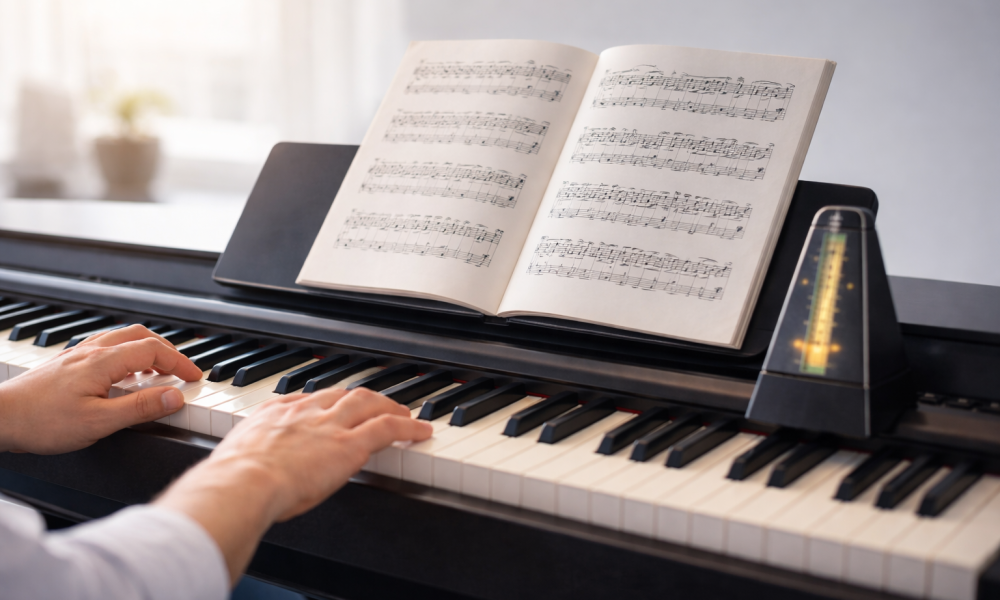
Every day, aspiring musicians turn to apps as an affordable alternative to private piano lessons. High download numbers suggest strong interest. Yet retention data and anecdotal evidence tell a different story: many learners abandon these tools within months, and those who persist often struggle to progress beyond a narrow set of rehearsed pieces.
The issue is rarely motivation or talent.
It is that many piano learning apps do not focus on the underlying skills required to make music independently.
Recent research has shown that for students who learn the piano online, “motivation was higher” (1), but courses need to incorporate a wider variety of materials as well as provide more personalized feedback (2) to achieve higher efficacy.
Where piano apps tend to fall short
Modern piano apps are often designed to make early progress feel fast and effortless. Some replace traditional sheet music with visual animations, simplified cues, or real-time prompts that guide finger placement.
Progress is commonly measured by speed and accuracy rather than comprehension, control, or musical awareness.
At first, this approach can feel empowering. Learners are able to reproduce songs quickly without needing to understand rhythm, harmony, or notation. Over time, however, that convenience can limit development. Musical literacy is never fully established, and technique, expression, and phrasing are rarely evaluated.
As a result, many learners find that progress does not transfer. When visual guidance is removed, they struggle to play unfamiliar music, adapt pieces, or improvise. The software performs as designed, but meaningful learning often fails to take place.
What learning music actually requires
Traditional piano instruction takes a different approach, one that compounds over time rather than optimizing for early wins.
That approach emphasizes:
- Developing timing, dynamics, and expression
- Training the ear alongside the hands
- Breaking music into manageable passages
- Receiving feedback (beyond simply striking the correct keys)
This philosophy is reflected in platforms such as Chordzy, a modern piano-learning platform built around musical literacy rather than visual shortcuts. Instead of relying on animations, the platform emphasizes ear training, notation, and theory, treating timing and dynamics as integral parts of performance.
Practice is structured to resemble how human teachers work: isolating hands, slowing difficult passages, and reinforcing fundamentals such as scales and chords within musical context.
Why this approach compounds over time
Learning the piano involves more than pressing the right keys at the right moment. Rhythm, harmony, and notation require sustained attention, and progress can feel slower in the early stages.
Many apps avoid this difficulty because it delays visible success. Chordzy takes the opposite approach.
By grounding practice in the same exercises used by working musicians, learners develop transferable skills. Scales and chords reinforce repertoire instead of existing as abstract theory. Practice shifts from repetition toward preparation.
While early progress may feel less dramatic, the long-term outcome is different. Learners gain the ability to open unfamiliar sheet music and play with confidence.
When piano apps are effective
Piano apps can be effective when they treat music as something to be learned rather than imitated.
When understanding is prioritized over shortcuts. When progress is measured by comprehension rather than streaks. When technology supports musicianship instead of replacing it.
Chordzy was built around the idea that software should make quality music education more accessible without removing the skills that make musicians independent. Its adult beginner piano course introduces early repertoire by ear while gradually building the foundations needed to read, interpret, and perform music independently. For many learners, it represents a shift from playing songs to understanding how music works.
References
- “Cao, Y. (2023). Online courses for piano teaching: Comparing the effectiveness and impact of modern and traditional methods. Education and Information Technologies.”
- “Zhou, G. (2025). Designing innovative online lessons to foster piano playing skills for beginners with no prior experience. Journal of Posthumanism.””