
Your Whole Brain Advantage Is Unbalanced — And AI Agents May Be Making It Worse
FOR IMMEDIATE RELEASE
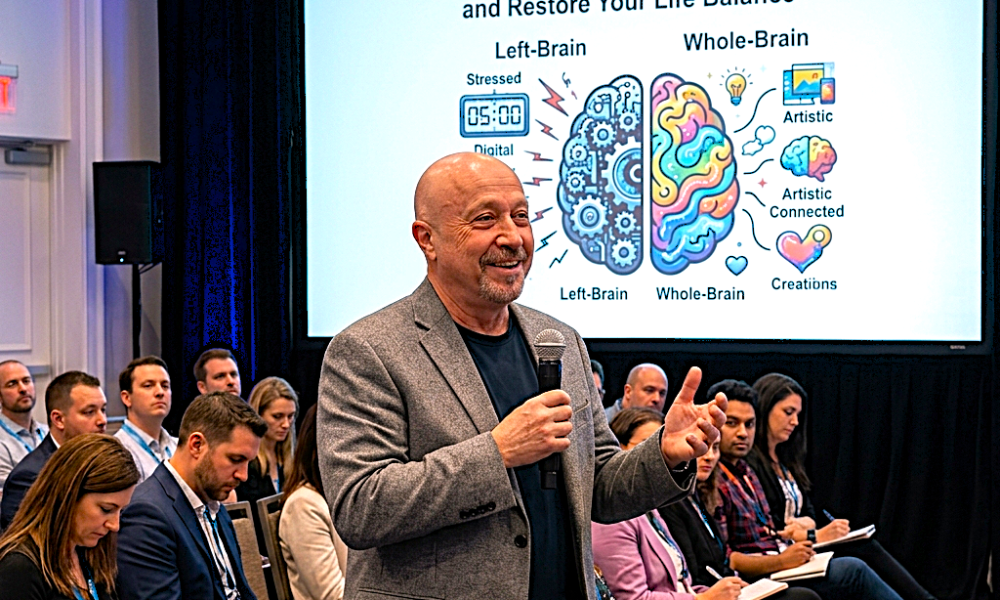
A growing body of neuroscience and behavioural research is sounding a whole brain advantage alarm that most people are too distracted—or too digitally dependent—to hear: modern life is systematically suppressing half of the human brain. The concept is called hemispheric lateralization, and according to Harvard professor and social scientist Dr. Arthur C. Brooks, understanding it may be one of the most important steps a person can take toward restoring genuine happiness, deeper meaning, and sustainable life balance in the age of artificial intelligence.
Hemispheric lateralization refers to the well-documented Whole Brain Advantage phenomenon in which the two halves of the brain—the left and right cerebral hemispheres—are functionally specialized. The left hemisphere is the domain of language, linear logic, data processing, categorization, and analytical reasoning. It is the hemisphere that answers the question “how.” The right hemisphere, by contrast, governs spatial awareness, emotional depth, creative intuition, and holistic pattern recognition. It is the hemisphere that asks—and answers—the question why. Together, they form the complete architecture of human cognition. Separately, either hemisphere in chronic dominance produces a person who is either coldly efficient or perpetually scattered, and crucially, neither kind is particularly happy.
Dr. Brooks, a professor at Harvard Business School and Harvard Kennedy School and the author of the bestselling From Strength to Strength, has built a significant portion of his public intellectual work around a deceptively simple observation: contemporary society, with its relentless emphasis on productivity metrics, screen engagement, data optimization, and algorithmic feedback loops, has created a civilization of left-brain dominators. People are rewarded professionally and socially for being faster, sharper, and more analytical—while the slower, richer, more contemplative capacities of right-hemisphere function atrophy from disuse. The result, Brooks argues, drawing on neuroscience, economics, and decades of happiness research, is an epidemic of what might be called “successful misery”: high achievement paired with a creeping, inexplicable sense that life has lost its texture and meaning.
AI Agents Are Powerful Left-Brain Tools—And That Is Exactly the Whole Brain Advantage Problem
Enter AI agents. These increasingly ubiquitous software systems — autonomous, goal-directed, capable of reasoning through multi-step tasks, summarizing vast information, drafting communications, and executing decisions — are, at their architectural core, instruments of left-hemisphere thinking. They parse language, process logic trees, optimize for measurable outcomes, and operate within rule-governed frameworks. The AI agents are extraordinarily capable. They are also, by design, incapable of asking why.
When a professional delegates calendar management, email triage, research synthesis, and strategic drafting to AI agents, they are not simply saving time. They are outsourcing the precise cognitive functions that, when practiced by humans, build the left-hemisphere resilience that keeps right-hemisphere creativity in meaningful balance. The danger is not that AI agents are inferior — it is that they are selectively superior in exactly the domains where uncritical human dependence deepens an already critical neurological imbalance. As reliance on these tools scales across organizations and personal workflows, the aggregate effect on cognitive development, emotional intelligence, and the capacity for meaning-making may be profound.
Dr. Brooks does not argue for rejecting technology. His framework is more nuanced and ultimately more actionable: the solution is not subtraction but rebalancing. Practices that deliberately activate right-hemisphere function — sustained attention in nature, face-to-face conversation without devices, artistic creation, contemplative prayer or meditation, and the cultivation of what Brooks calls the four pillars of happiness (faith, family, friendship, and meaningful work) — are not soft lifestyle recommendations. They are neurological countermeasures. They are the cognitive equivalent of physical cross-training, restoring the whole-brain integration that makes a human life feel worth living.
Designing for Life Balance: When AI Agents Learn From the Brain They Serve
The most forward-thinking researchers in artificial intelligence are beginning to take hemispheric lateralization seriously—not just as a metaphor, but as a design principle. A nascent field of lateralized AI architecture explores building agent systems with functionally differentiated modules: one subsystem optimized for rapid, precise, rule-based processing, and a parallel subsystem designed for broader contextual synthesis, anomaly detection, and what engineers sometimes call “soft reasoning.” Early experimental results suggest that lateralized architectures produce AI agents that are more robust, more adaptive, and more capable of handling the ambiguous, high-context situations where purely analytical models fail.
The implication of AI agents for life balance is significant. If AI agents can be designed to mirror the complementary strengths of both hemispheres—rather than hyper-amplifying only the left—they become less a threat to human cognitive wholeness and more a scaffold for it. An AI agent that flags when its analytical output lacks contextual grounding, that prompts users toward reflective pauses rather than frictionless decisions, or that is explicitly designed to return the “why” questions to the human it serves, is a fundamentally different tool than the optimization engines currently flooding the market.
For individuals navigating the intersection of professional ambition and personal meaning, the practical takeaway from Dr. Brooks’s framework is clarifying: technology is not the enemy of a balanced life, but technology used without intentional neurological self-awareness is. Every hour spent in the frictionless efficiency of AI-assisted work is an hour that either includes a deliberate counterweight — a walk, a conversation, a moment of genuine stillness — or quietly widens the imbalance that happiness research consistently identifies as the root of modern dissatisfaction.
Hemispheric lateralization is not an abstract neuroscience concept. It is a map of what it means to be fully human. In a technological singularity world increasingly populated by AI agents built to think like only half a brain, the most radical act of intelligence may be choosing to use the other half.