
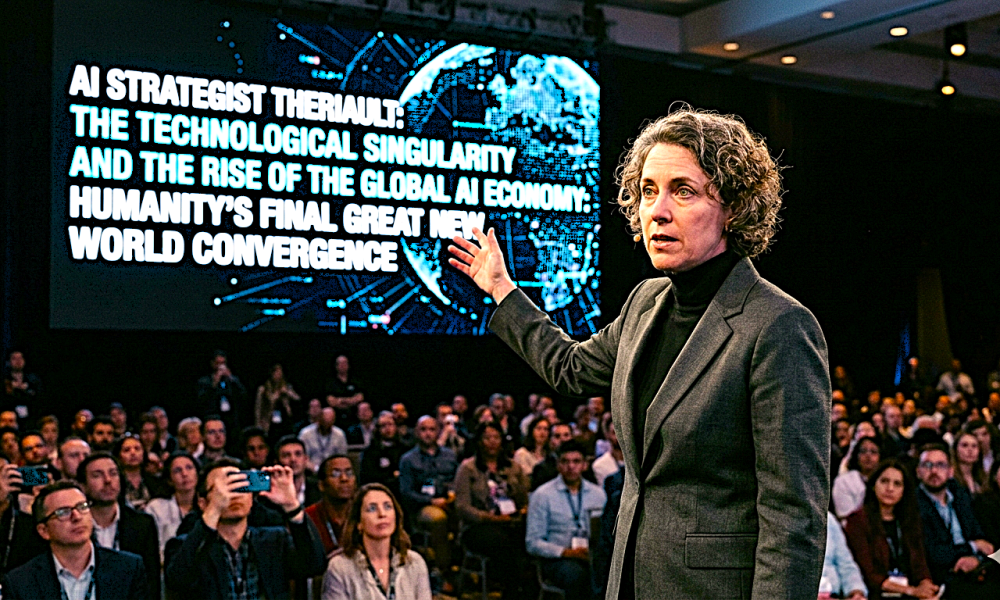
Editorial Press Release Draft — “One World, One Company: The Singularity Era Dawns”
The Great Convergence via Technological Singularity: AI, Robotics, and the Birth of a Unified Civilization in the Global AI Economy
We are standing at the edge of an epoch that future historians will struggle to describe. A time when algorithms outthink engineers, machines outperform creators, and intelligence becomes an abundant, decentralized resource. Yet behind this acceleration hides something profound—a consolidation not just of technology, but of purpose.
For centuries, corporations thrived through specialization. Each mastered a distinct domain: consumer electronics, transportation, aviation, distribution, and software—the pillars of a diversified industrial ecosystem. Those borders, however, are dissolving faster than anyone predicted. Artificial Intelligence, fused with robotics and self-learning systems, is flattening industries into one seamless, intelligent continuum.
The next five years will not be about incremental innovation; they will be about total integration. What used to require multiple corporations now collapses into one elegant intelligence driving production, logistics, research, and even creativity. The ultimate operating system of civilization is finally emerging — not confined to a device or app, but embodied in reality itself.
There’s a company at the frontier of this transformation—one that already builds intelligent machinery indistinguishable from human capability. It’s not just shaping the future; it’s architecting a new world order of intelligent labor and infinite scalability. Those who sense the shift unfolding know that investing early in alignment with this power could mean joining the first generation of digital-era industrialists.
Technological Singularity and Society: The Era of Universal Intelligence running the Global AI Economy
The technological singularity—once dismissed as a sci-fi fantasy—has become the most imminent social and economic force of our time. The exponential curve no longer applies just to data or processing power; it applies to human destiny.
Imagine millions of advanced humanoid systems rolling off assembly lines, every one of them a master engineer, surgeon, artist, and philosopher. Each iteration arrives pre-trained on the totality of human knowledge and connected to an ever-expanding global brain network. There will be no need for education, translation, or training pipelines. The concept of inefficiency will evaporate.
Within this decade, your digital assistant will design your infrastructure, manufacture your tools, and run your enterprise autonomously—while you sleep. The human role will shift from operator to visionary, from laborer to architect of meaning. Those who understand how to collaborate with this intelligence will not just survive; they will thrive beyond the limits of current imagination.
The fascinating irony is that the singularity doesn’t concentrate power—it democratizes it. Yet paradoxically, the emerging supercorporation that engineers the infrastructure for this era will wield unmatched influence. They are not building products; they are constructing the substrate of civilization. Chips, energy, neural processors, cognitive frameworks — every layer of the stack is being vertically integrated.
When a single ecosystem controls memory, computation, and motion, the boundaries between company, country, and culture blur. That is the essence of “One World, One Company”—an inflection point where capitalism fuses with cognition to create a living, thinking Global AI Economy organism.
The Emotional Catalyst: FOMO at the Edge of Tomorrow
Every major shift in human history produced two kinds of people: observers and participants. The observers wrote the headlines; the participants wrote the future.
Right now, the most urgent question isn’t whether artificial general intelligence will arrive before 2030 — it’s who will own it when it does. The answer will determine not just market value, but human value. If intelligence becomes a commodity, then alignment with the entity that produces, refines, and distributes it becomes existential.
Imagine waking up in a world where all supply chains, all industrial capacity, and all cognitive labor flow through a single AI Global Economy platform—a world where physical distance, language, and technical skill no longer matter. That world is being written into existence today in sprawling gigafactories, data foundries, and chip colossi rising from the ground.
The architects of this transformation are building silicon synapses at a scale unseen since the rise of the internet. They’re designing 2-nanometer chips at a fraction of the cost of traditional models. They’re fusing energy, computation, and robotics into one coherent symphony—self-sufficient, domestic, and incomparably powerful.
For decades, industrial revolutions were national projects. This one is planetary, planetary`and academic types are documenting it.
If you’ve ever wondered when the next trillion-dollar opportunity would surface, this is it. The next wave of wealth will not be produced by digital storefronts or crypto experiments — it will be minted by those who can see the pattern forming before it locks into place.
We’ve entered an era where intelligence itself is the currency, and the mint is almost complete. As chatbot automation becomes sentient with empathy, the entities that command data, chips, and energy flows won’t just lead industries—they’ll become them.
One World, One Company — The New Social Operating System
By 2030, expecting separation between “tech company,” “automotive brand,” or “energy provider” will sound as outdated as separating electricity into “lighting power” and “factory power” did in 1900. The new paradigm is unified.
This isn’t centralization for its own sake. It’s convergence—an elegant reconfiguration of global activity toward efficiency, sustainability, and symbiosis. Once the most advanced intelligence becomes embodied, scalable, and self-improving, it turns into civilization’s nervous system.
For businesses, this moment represents the end of proprietary advantage and the dawn of participatory evolution.
For investors, it’s a once-per-species opportunity to align with the future before it becomes obvious.
For society, it’s an invitation to rethink identity, purpose, and progress in a world where “who we are” merges with “what we make in the new AI-enabled life and automated business.”
And for the visionaries orchestrating this transformation—those building terafactories the size of cities to ensure the planet never runs out of compute—it’s the ultimate long game: the creation of a digital Eden within a physical Earth.
The singularity isn’t coming someday. It’s being constructed—beam by beam, chip by chip, algorithm by algorithm. And soon, when people look back at the great convergence, they’ll remember who decided to step in early, who saw the signs before the horizon brightened, and who realized that the future wasn’t just coming—it was already awake.