
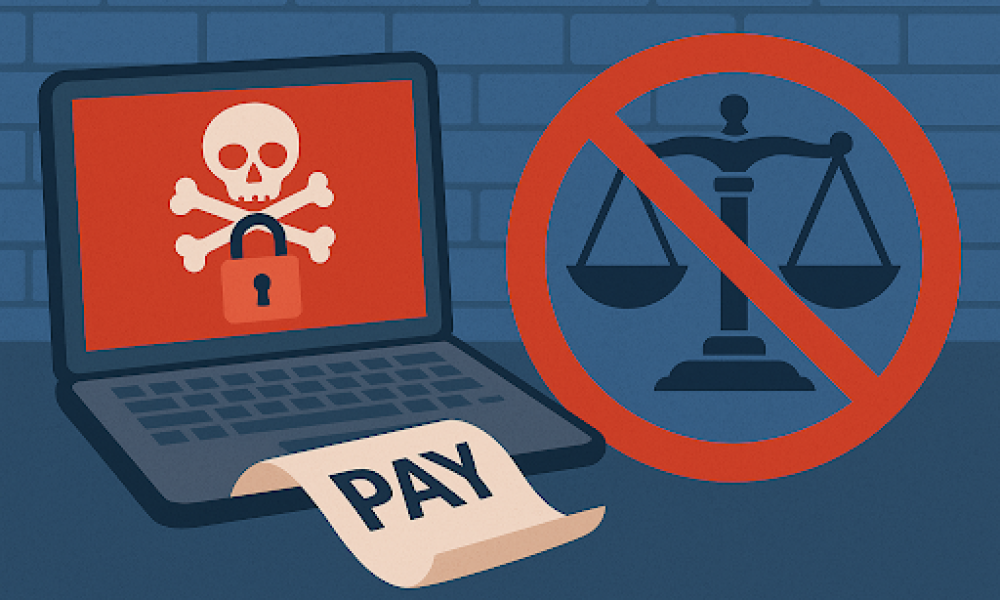
A debate that will reshape corporate security strategies
Few debates in cybersecurity have generated as much heated discussion as the one now taking shape in the United Kingdom: whether to outlaw ransom payments altogether. The idea, long floated in think tanks and policy circles, has moved closer to reality as government officials weigh legislation aimed at prohibiting companies from transferring funds to cybercriminals in the event of an attack.
The proposal is not emerging in a vacuum. High-profile ransomware incidents continue to dominate headlines, disrupting everything from healthcare to transportation. Only days ago, airports across Europe were thrown into disarray as ransomware operators brought critical systems offline, underscoring the scale of economic and societal risk involved. The story, reported in Reuters, served as a grim reminder of why policymakers are under pressure to act.
The legal and compliance dimensions of such a ban are now front and center. For Chief Security Officers and their counterparts in compliance roles, the implications are profound. They will need to re-examine not just how to respond to ransomware but how to structure entire resilience strategies in a world where ransom payment may no longer be a lawful option.
The UK’s legal reasoning
Supporters of the proposed ban argue that allowing ransom payments fuels the criminal economy and perpetuates the cycle of attacks. If organizations know they cannot legally pay, the theory goes, ransomware will lose its profitability and attackers will move on to other targets. As TechRadar explains, government officials frame the measure as a necessary escalation in the fight against increasingly professionalized ransomware syndicates.
Legal scholars compare it to long-standing bans on paying kidnappers or terrorist groups. In both cases, the principle is clear: do not reward criminality. The UK would be the first major economy to test whether the same logic can be applied to digital extortion.
Yet the proposal immediately raises difficult questions. What happens when a company faces the prospect of operational collapse or lives at risk if systems remain offline? Should regulators impose absolute prohibitions, or carve out exceptions in critical sectors such as healthcare, aviation, or energy? And what about the grey area of payments made through intermediaries or insurers — will those too be criminalized?
Industry fears of unintended consequences
Within industry, reactions are divided. Many security experts fear that a blunt ban could backfire. The TechRadar analysis points out that ransomware gangs may increase attacks precisely because victims cannot pay, seeking instead to cause chaos or maximize disruption as leverage. Others argue that attackers will simply shift tactics, moving from encryption-only extortion to more aggressive data theft and public leaks.
Insurance markets face their own upheaval. Today, many cyber policies cover ransom payments, often reimbursing victims after negotiations. A ban would remove that safety net, forcing insurers to rethink coverage models. Organizations that relied on such policies will be exposed to new liabilities, increasing the need for preventive investments rather than reactive payouts.
Why the “why now” moment matters
Timing is everything in regulatory debates. The recent wave of high-profile incidents has created a political climate where governments feel compelled to act. The Reuters report described chaos in airports, with stranded passengers and grounded flights, directly tied to ransomware activity. Such visible disruptions strike at the public’s confidence in critical infrastructure.
For policymakers, allowing business as usual is no longer tenable. By introducing a ban, the government sends a message not only to criminals but to boards and executives: the era of quiet ransom payments and rapid return to operations may be ending. Compliance obligations will shift, forcing organizations to prepare for prolonged outages rather than quick resolutions through financial settlement.
The compliance lens
For CSOs and compliance leaders, the challenge is not simply technical but organizational. A ban means regulatory risk is now layered on top of operational risk. Companies that attempt to sidestep the law by paying in secret could face crippling fines, shareholder lawsuits, or even criminal liability for directors.
Compliance teams will need to update reporting frameworks. Incident response playbooks must be rewritten to align with the possibility of an outright prohibition. Regulators are expected to demand evidence of ransomware preparedness during audits, just as they currently require documentation of financial controls or data protection policies. Firms that fail to demonstrate robust mitigation strategies could be penalized for negligence even before an incident occurs.
What a ban changes for incident response
The most immediate impact will be felt in the boardroom war room during an attack. Historically, many organizations treated ransom payments as a last-resort business decision, balancing costs of downtime against the ransom amount. If legislation removes that option, decision-making shifts fundamentally.
Executives will have no choice but to invest more heavily in backup systems, disaster recovery capabilities, and cyber hygiene. CSOs will need to make the case for greater budgets long before an attack hits, arguing that prevention is the only acceptable form of insurance. Negotiating with criminals will no longer be a viable path; instead, collaboration with government incident response teams will become mandatory.
International divergence and the risk of regulatory arbitrage
One complication lies in the fact that cybercrime is global while regulation is national. If the UK enacts a ban, but the United States, European Union, or Asian economies allow ransom payments, attackers may simply target British companies differently. Firms operating across multiple jurisdictions will struggle to harmonize response strategies.
This divergence could lead to regulatory arbitrage, where multinational firms quietly route ransom payments through subsidiaries in permissive jurisdictions. Policymakers will need to anticipate such workarounds and decide how aggressively to pursue enforcement across borders.
Voices of support and criticism
Civil society groups have expressed mixed views. Consumer advocates applaud the principle of not funding criminal groups and argue that transparency will increase. They believe too many companies quietly pay ransoms, leaving customers and regulators in the dark about breaches. A ban, they say, forces disclosure and accountability.
By contrast, many in the private sector remain skeptical. Industry associations warn that prohibitions will not reduce the volume of attacks but instead increase the collateral damage to ordinary citizens. When hospitals, airports, or municipal services cannot legally pay, the public bears the brunt of outages. Some even liken it to banning hostage negotiations in scenarios where lives are at stake.
The geopolitical dimension
There is also a broader geopolitical layer. Some ransomware groups are believed to operate with tacit approval from hostile nation-states. If payments are banned, governments may need to take on a more aggressive role in counter-offensive cyber operations. Private firms will no longer be able to buy their way out; instead, the state must provide stronger shields against adversaries.
This dynamic could accelerate the militarization of cyberspace, as governments perceive ransomware not merely as criminal activity but as a tool of geopolitical influence. The UK’s decision may inspire allies to adopt similar measures, but it could also drive wedges between partners if consensus is not reached.
Practical steps for CSOs today
What should a Chief Security Officer do in anticipation of this potential legal shift? Several priorities stand out.
First, review backup and recovery strategies to ensure critical systems can be restored without decryption keys from attackers. This includes offline backups and tested recovery drills.
Second, engage compliance and legal teams early. Organizations should prepare for mandatory reporting regimes, clear escalation paths, and director-level accountability.
Third, evaluate insurance coverage and assess how a ban would alter financial exposure. Companies may need to renegotiate policies or explore alternative risk-transfer mechanisms.
Fourth, deepen collaboration with law enforcement and government agencies. If ransom payments are outlawed, external support will become the only viable lifeline during major incidents.
Finally, conduct board-level simulations of ransomware scenarios under the assumption that payments are illegal. These exercises will help executives internalize the gravity of the shift and prepare to manage reputational, legal, and operational fallout.
Looking ahead
The debate over ransom payments sits at the intersection of law, policy, and cybersecurity strategy. The UK’s proposed ban is a bold experiment that could reshape how organizations worldwide think about extortion threats. For some, it is a long-overdue step to cut off criminal revenue streams. For others, it risks making attacks more damaging by removing the one mechanism that can quickly restore operations.
What is certain is that compliance and security leaders will need to adjust. In a regulatory environment where paying criminals is no longer an option, resilience becomes paramount. Investments in prevention, backup, and collaboration with authorities will no longer be optional but mandatory.
The future of ransomware response may well be defined not by what criminals demand but by what governments allow. For CSOs, that means a new era where legal obligations dictate not just how to protect systems, but how to think about the very nature of risk in a zero-payment world.