
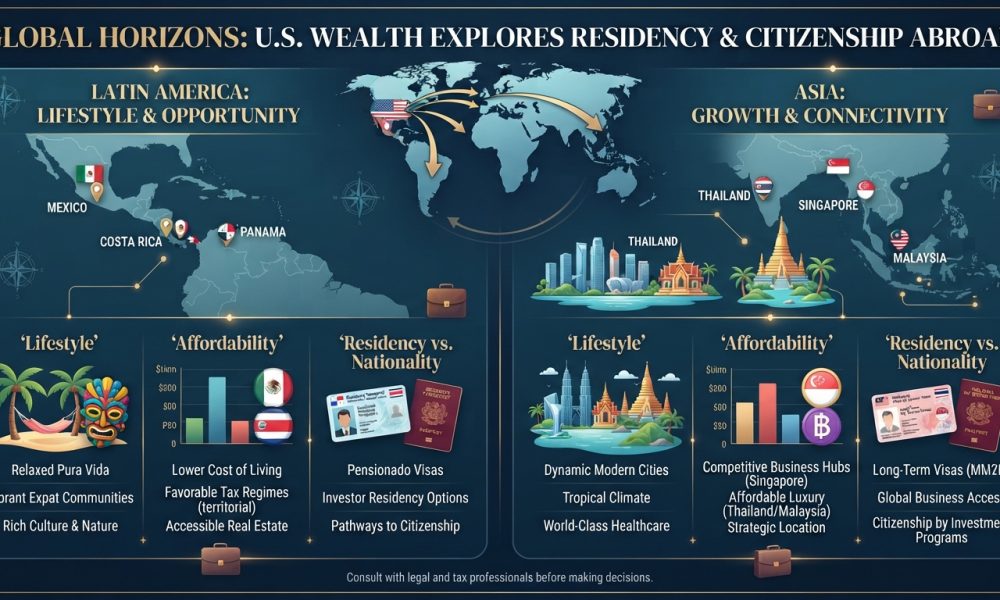
Interest in Latin America and Asia is broadening the overseas planning conversation, with prospective applicants weighing lifestyle, affordability and the distinction between residence and nationality.
WASHINGTON, DC, October 30, 2026. Wealthy Americans exploring second citizenship are increasingly looking beyond Europe’s traditional residency and passport destinations, with Latin America and Asia entering a broader conversation about financial security, international mobility, lifestyle flexibility, and long-term family Protection.
For years, Portugal, Greece, and Italy dominated discussions among Americans considering a future outside the United States, offering established European lifestyles, recognizable immigration pathways, and, under certain circumstances, opportunities to acquire citizenship after meeting national requirements.
Now, a growing number of internationally mobile families are examining countries such as Mexico, Panama, Costa Rica, Brazil, Thailand and Singapore, discovering that a practical overseas strategy does not always require European residency or an immediate second passport.
The shift reflects a changing understanding of what international mobility actually means, particularly among entrepreneurs, retirees, investors and affluent professionals who want more options without necessarily abandoning their American homes, businesses or citizenship.
According to AMICUS INTERNATIONAL CONSULTING, which advises clients on international relocation and second citizenship planning, the important question is no longer which country offers the most desirable passport, but which jurisdiction provides the most useful combination of lawful residence, financial stability, personal security, and future nationality rights.
The distinction matters because a foreign residence permit, permanent residency status, and citizenship represent three different legal positions, each with different protections, obligations, and limitations that wealthy applicants must understand before committing substantial resources.
Europe Is No Longer the Only Destination Worth Considering
Europe remains attractive to Americans seeking international residence because of its developed infrastructure, established healthcare systems, educational opportunities, and relatively straightforward access to multiple countries within the European travel area.
Portugal continues to feature prominently in international migration discussions. At the same time, Greece attracts investors interested in Mediterranean living, and Italy appeals to Americans with family ancestry, cultural connections, or legitimate routes to citizenship.
Nevertheless, European immigration programs have seen changing eligibility requirements, investment conditions, and administrative procedures, prompting some applicants to reconsider whether a European destination matches their practical objectives.
The wider conversation is reflected in Google News coverage of wealthy Americans seeking alternative residency and citizenship, where international diversification, political uncertainty and relocation planning increasingly appear alongside traditional retirement and investment considerations.
For wealthy families, the appeal of another country frequently extends beyond its passport ranking, especially when the intended destination offers lower household expenses, access to private healthcare, international schools or proximity to existing business interests.
An American entrepreneur operating throughout the Americas, for example, may find Mexican residency considerably more practical than maintaining a European home that requires lengthy international flights and offers limited advantages for daily commercial activities.
Similarly, a retired executive interested in living in Southeast Asia might prefer Thailand’s healthcare, climate, and hospitality infrastructure, even though obtaining Thai residence does not automatically provide a realistic or immediate route to citizenship.
These comparisons show why sophisticated mobility planning increasingly begins with personal circumstances rather than international rankings, allowing applicants to identify which legal status best serves their families, finances, and lifestyle.
Latin America Offers Geographic Convenience and Familiarity
Latin America offers several characteristics that distinguish it from Europe, including proximity to the United States, relatively accessible travel routes, and diverse opportunities to establish a permanent or seasonal overseas lifestyle.
Mexico is particularly relevant because Americans can reach many major Mexican cities through direct commercial flights, making it possible to maintain personal and professional relationships while developing a second residential base.
Mexico City offers international business infrastructure, specialized medical services, private education, and established professional communities. At the same time,e destinations such as Mérida, Puerto Vallarta, and San Miguel de Allende appeal to families prioritizing lifestyle and residential comfort.
However, living in Mexico under an authorized immigration category must not be confused with acquiring Mexican nationality, which involves separate legal requirements administered by the appropriate government authorities.
Under the ordinary naturalization pathway, foreign nationals generally must demonstrate five years of qualifying residence immediately before applying, although Mexican nationality law provides reduced periods for certain qualifying circumstances.
A key consideration is that immigration status must be genuine and properly documented, while naturalization remains subject to government review, eligibility requirements, and the applicable legal framework.
Wealthy applicants therefore need to evaluate Mexico as both a residential destination and a potential citizenship jurisdiction, recognizing that the two objectives may involve substantially different timelines and supporting documentation.
Panama Remains Relevant to International Business Planning
Panama continues to attract attention among internationally mobile investors because of its established financial and commercial infrastructure, extensive international transport connections and longstanding position as a regional business center.
Panama City’s banking, logistics, legal services, and corporate environment can appeal to entrepreneurs who operate across multiple countries and need a practical base for managing international professional relationships.
For Americans evaluating Latin American residence, Panama may offer immigration categories worth exploring, although eligibility, financial requirements, renewal conditions, and any eventual nationality application must be assessed separately.
Permanent residence should never be presented as equivalent to citizenship because an applicant may possess a long-term right to live in Panama without qualifying for naturalization or obtaining a Panamanian passport.
The legal distinction becomes especially important when prospective applicants intend to spend most of their time outside the country, since physical presence and continuing ties may affect immigration compliance or future naturalization eligibility.
Investors must also consider that opening a bank account, forming a company, or purchasing property does not, by itself, establish citizenship rights, no matter how substantial the underlying financial commitment.
Costa Rica Appeals to Families Seeking Lifestyle Stability
Costa Rica occupies a different position in the overseas planning discussion, drawing attention from Americans who prioritize environmental quality, personal well-being, healthcare access,s and a relatively relaxed residential lifestyle.
The country’s established expatriate communities, private medical facilities, and diverse residential regions can make it attractive to retirees and families seeking an alternative to expensive American metropolitan areas.
For some applicants, the greatest advantage may involve obtaining an appropriate residence status and building a sustainable life in the country without pursuing citizenship as an immediate objective.
That approach can be especially practical for retirees who want to preserve their American nationality while enjoying another country for extended periods, provided they satisfy immigration and financial requirements.
Individuals who eventually seek Costa Rican naturalization must consider a separate legal process involving qualifying residence and other requirements, rather than assuming that property ownership or retirement status automatically produces citizenship.
Families should also assess the availability of schools, medical specialists, transportation, insurance, and emergency services before deciding whether a comparatively affordable destination offers the overall quality of life they expect.
Brazil Offers a Distinct Naturalization Pathway
Brazil is another strong option because of its economic scale, major metropolitan centers, extensive domestic market, and established legal framework for foreign nationals seeking eventual naturalization.
São Paulo offers a sophisticated business environment, while other Brazilian cities offer different combinations of residential affordability, cultural opportunities, professional infrastructure, and access to private healthcare.
Ordinary Brazilian naturalization generally requires four years of qualifying residence for an indefinite period, with potential reductions under specific legal circumstances, along with requirements for language ability and a clean criminal record.
Applicants must also understand that temporary immigration permission does not necessarily start the qualifying period for ordinary naturalization,n so distinguishing between residence categories matters.
For wealthy Americans who regularly travel internationally, Brazil’s physical presence and residence evidence requirements deserve particular attention because repeated absences may affect eligibility when a naturalization application is eventually submitted.
The country illustrates a central principle of international citizenship planning: a potentially attractive nationality pathway still requires the applicant to satisfy the country’s legal residence and documentary conditions.
Asia Is Becoming Part of the Wealth Mobility Conversation
While Latin America offers geographic convenience, Asia attracts affluent Americans for a different combination of reasons, including international business opportunities, specialized medical services, modern infrastructure and established destinations for long-term overseas living.
Globally mobile individuals often consider Thailand, Singapore, and Malaysia, but their immigration systems differ considerably, so it’s essential to separate residency opportunities from the much narrower question of acquiring nationality.
Someone who can afford an extended stay in an Asian destination may find that securing an appropriate residence permit is far more achievable than obtaining citizenship, particularly in countries with restrictive nationality laws.
For many families, that distinction does not necessarily reduce the destination’s appeal because their immediate objective may be lawful residence, reliable healthcare and regional mobility rather than a second passport.
Thailand Attracts Wealthy Americans Seeking Lifestyle Flexibility
Thailand has become a familiar destination for American retirees, digital entrepreneurs, and international businesspeople who value its private medical facilities, hospitality industry, and established expatriate communities.
Bangkok offers major hospitals, luxury residential developments, and international schools, while Phuket, Chiang Mai, and other destinations offer alternatives for people whose priorities extend beyond conventional metropolitan living.
Thailand provides several immigration arrangements for qualifying foreign nationals, including longer-term stay options tied to specific eligibility, financial or membership requirements, but these arrangements should not be mistaken for automatic permanent residency or nationality.
This difference matters especially for Americans considering premium residence memberships because paying for long-term immigration privileges does not, by itself, create an entitlement to a Thai passport.
Applicants should also investigate the conditions governing employment, commercial activity, reporting obligations, and changes to immigration status, since authorization to reside in Thailand may not provide unrestricted permission to work.
For families whose primary objective is a comfortable second home in Southeast Asia, a well-maintained long-term residence arrangement may matter more than pursuing an uncertain citizenship outcome.
Singapore Appeals to Investors but Maintains Strict Nationality Rules
Singapore occupies a distinctive position in international wealth planning because of its sophisticated banking environment, legal infrastructure, global commercial connections and reputation as a major Asian financial center.
Affluent entrepreneurs and executives may view Singapore as a potential residential or commercial base, particularly when their businesses involve Southeast Asian markets, international finance, technology, or cross-border investment.
However, the country does not offer unrestricted citizenship simply because an individual possesses substantial wealth, and permanent residence eligibility is distinct from citizenship eligibility and approval.
Although certain adult permanent residents may become eligible to apply for citizenship after holding permanent residence for at least two years, satisfying the eligibility threshold does not guarantee a successful application.
Singapore’s restrictions on adult dual nationality are also a significant consideration for Americans who intend to retain their existing citizenship while acquiring another nationality for long-term flexibility.
An applicant whose primary objective is holding two passports simultaneously must therefore assess nationality restrictions before pursuing a destination that may otherwise appear exceptionally attractive for business and family residence.
The Biggest Mistake Is Confusing Residency With Citizenship
One of the most consequential misunderstandings in international mobility planning involves treating a residence permit as though it provides the same legal rights as nationality.
A temporary residence permit usually authorizes an individual to remain in a country under specified conditions. In contrast, permanent residence generally provides a more durable immigration position without necessarily granting political rights or a national passport.
Citizenship represents a different legal relationship with the state, potentially including nationality-based rights of entry and residence, access to a national passport, and obligations established under domestic law.
The distinction becomes critical when an American family purchases overseas property expecting it to establish an independent and permanent alternative to living in the United States.
A residential investment may help satisfy the conditions of a particular immigration program, but ownership alone rarely provides the unrestricted rights associated with citizenship.
AMICUS INTERNATIONAL CONSULTING emphasizes the importance of evaluating lawful nationality pathways before making significant international commitments, particularly where families intend to rely on future citizenship for mobility or long-term Protection.
Its second passport and citizenship planning services address the need to evaluate individual circumstances, document requirements, and available pathways, rather than treating every residence program as a guaranteed way to acquire nationality.
Ultimately, only the relevant government can determine whether an applicant qualifies for citizenship and whether they have completed the appropriate legal procedures.
A Second Passport Is Not the Same as a Second Home
Another distinction emerging in the international planning conversation is the difference between obtaining permission to live somewhere and possessing that country’s unconditional nationality rights.
An American might maintain an apartment in Bangkok, a retirement property in Costa Rica, or a business residence in Panama without acquiring citizenship in any of those jurisdictions.
That arrangement may still provide meaningful lifestyle advantages, but the individual must continue observing the immigration rules governing each destination and cannot assume residence privileges will remain unchanged indefinitely.
Conversely, someone who obtains legitimate citizenship through descent, marriage, naturalization,n or an authorized investment citizenship program may acquire nationality rights without necessarily relocating permanently, depending on the particular country’s legislation.
The practical value of either arrangement depends on the applicant’s objectives, because a comfortable retirement residence and an independent nationality option serve different purposes within an international plan.
Affordability Is Becoming a More Important Consideration
For wealthy Americans, international relocation is not always about reducing household expenses, but cost differences can still influence where families choose to establish a second residential base.
A household accustomed to expensive housing, private education, domestic staffing, or specialized medical services in major American cities may find different purchasing power in selected Latin American or Asian locations.
The comparison becomes more meaningful when families evaluate actual local expenses rather than relying on generalized claims about inexpensive living or broad national cost-of-living rankings.
Premium neighborhoods in Mexico City, Singapore or Bangkok can command substantial housing costs, while imported goods, international school fees and private health insurance can narrow the apparent affordability advantage.
Currency movements, inflation and changing property markets also affect long-term budgets, meaning an attractive exchange rate today should not be treated as a permanent financial benefit.
Affluent families should evaluate realistic annual living costs, international travel expenses, medical coverage and the cost of maintaining multiple residences before calculating the financial advantages of an overseas move.
Healthcare and Education Influence Long-Term Decisions
Healthcare access increasingly shapes relocation decisions, especially for retirees and families whose members require ongoing medical treatment, specialized prescriptions, or reliable access to emergency care.
A destination with excellent private hospitals may still pose practical challenges when people live far from major metropolitan centers or rely on insurance policies with geographical exclusions.
Families with school-age children face another set of considerations because international school availability, language instruction, university pathways and academic calendars can influence whether a relocation remains sustainable.
These issues explain why wealthy applicants often examine daily living arrangements before concentrating on nationality documents, recognizing that immigration status alone does not establish a successful overseas lifestyle.
A country that looks ideal during a short holiday may prove less suitable when residents must manage ordinary responsibilities involving healthcare, banking, education, transportation, and household administration.
Tax Obligations Do Not Disappear With Another Passport
For Americans evaluating another nationality, the financial consequences of international mobility require careful attention because living abroad does not automatically eliminate obligations tied to United States citizenship.
American citizens generally remain subject to federal tax rules on worldwide income, whether they live overseas or acquire additional citizenship, although specific exclusions and credits may apply.
Foreign financial accounts, investment structures, and certain overseas entities may also create reporting obligations, making coordinated advice from qualified cross-border tax professionals essential before transferring significant assets.
A second passport should therefore never be marketed as an automatic way to eliminate American tax responsibilities or place assets beyond lawful financial disclosure requirements.
Similarly, overseas residence does not guarantee complete privacy from banking institutions, immigration authorities or governments operating under applicable information-sharing arrangements.
The more practical objective is to develop a legally defensible international structure that supports legitimate personal privacy, transparent asset ownership and appropriate regulatory compliance.
Family Protection Is Becoming a Central Motivation
For some wealthy Americans, the strongest argument for additional residence or citizenship has little to do with travel convenience and considerably more to do with providing options for spouses, children, and future generations.
Parents may want their children to have opportunities to study abroad, establish professional careers in another country,y or maintain a reliable residential alternative if circumstances change at home.
Business owners may seek to diversify their personal exposure to political instability, while retirees may prioritize access to different healthcare systems and dependable places to live.
However, family immigration and nationality rights can differ considerably, meaning an applicant’s spouse or children should not automatically be assumed to receive equivalent status through the principal applicant’s approval.
Some programs allow dependent residence applications, while citizenship laws may impose additional conditions concerning age, marriage, family relationships, documentary evidence,ce and the timing of naturalization.
These complexities make family planning an essential component of selecting a jurisdiction, rather than an administrative question to address after an immigration application has already been submitted.
Not Every Second Citizenship Offers the Same Travel Benefits
Passport strength remains relevant because different nationalities offer different visa-free access, consular protections, and legal obligations when traveling internationally.
Yet a passport that performs strongly in international mobility rankings may offer limited added value to an American who already has a widely accepted travel document.
For these applicants, a second nationality may matter mainly because it grants access to a particular country, supports family settlement, or creates lawful options for future relocation.
A passport with fewer visa-free destinations may still be useful if the issuing country offers the exact residence and nationality rights that an individual or family wants.
Travel privileges can also change through diplomatic negotiations, immigration policy revisions, or security concerns, making long-term nationality rights potentially more important than a contemporary passport ranking.
Dual Citizenship Requires Careful Legal Review
Americans may generally acquire another nationality without automatically losing U.S. citizenship, but the country granting the additional nationality may impose restrictions that substantially affect the outcome.
The U.S. Department of State’s guidance on dual nationality explains the continuing responsibilities of American dual nationals, including the requirement to enter and depart the United States using an American passport.
Dual nationality may also create obligations involving military service, local taxation, civil registration, or using a national passport when entering the country of additional citizenship.
Applicants should also understand that American consular assistance may be limited when another government treats the person exclusively as its own citizen.
These considerations demonstrate why second citizenship planning should begin with a legal assessment rather than a simple comparison of investment costs, processing periods, or advertised travel advantages.
Documentation Determines Whether a Citizenship Strategy Works
A successful naturalization application depends on more than financial eligibility, particularly in jurisdictions where applicants must establish identity, residence history, language ability,y and compliance with national requirements.
Common documentary considerations include birth and marriage certificates, lawful immigration records, background checks, financial evidence,ce and properly authenticated documents from relevant government authorities.
Depending on the country, applicants may also need to demonstrate physical presence, maintain a qualifying immigration status, or provide evidence establishing that previous residence was genuine and continuous.
Evaluate these requirements early, because obtaining historical records and correcting inconsistencies across official documents can become one of the most time-consuming parts of international planning.
Applicants should be particularly cautious about any service promising guaranteed nationality regardless of residence requirements, background checks, or official government approval. A legitimate second passport rests on citizenship recognized under the issuing country’s laws, supported by authentic civil records and documents issued through authorized government procedures.
The Smartest Approach Begins With Five Questions
Before selecting a destination, wealthy Americans can improve their international planning by identifying the specific outcome they want and determining whether the proposed immigration pathway actually delivers it.
The first question concerns the desired legal status, because temporary residence, permanent residence and citizenship involve different rights and should never be treated as interchangeable solutions.
The second concerns the family’s ability to satisfy physical residence requirements, particularly when business commitments, education schedules or existing property responsibilities make extended overseas stays difficult.
The third involves the practical quality of life, including housing, healthcare, family safety, local infrastructure, education and the ability to maintain a comfortable standard of living.
The fourth involves financial and legal obligations, including taxation, banking compliance, estate planning, property ownership and restrictions imposed by either the United States or the destination country.
The fifth concerns long-term flexibility, because changing government policies, family circumstances and economic conditions may affect whether an overseas arrangement remains useful several years after establishment.
Answering these questions often reveals that the most suitable destination is not necessarily the country offering the fastest advertised processing period or the highest-ranked passport.
International Mobility Is Becoming a Long-Term Wealth Strategy
For affluent Americans, overseas planning increasingly resembles broader financial diversification, although residence and nationality rights cannot be bought, transferred, or managed in precisely the same manner as conventional investments.
A family might retain its principal home in the United States, establish lawful residence in Latin America and maintain professional or commercial interests in Asia without seeking immediate citizenship in every jurisdiction.
Others may pursue a qualifying citizenship pathway as their primary objective while treating real estate acquisitions, banking relationships and business relocation as secondary considerations.
Neither approach guarantees Protection against every political, economic, or personal risk, but properly selected and maintained international arrangements can provide additional options when circumstances change.
The key is ensuring that each component serves a genuine purpose and operates within the legal requirements of the countries involved.
Why the Next Phase of Second Citizenship Planning May Look Different
Europe is unlikely to lose its importance in international citizenship planning because its established institutions, cultural attractions,s and mobility opportunities remain significant advantages for internationally minded American families.
Nevertheless, Latin America and Asia offer compelling alternatives for individuals whose priorities involve proximity to American markets, regional business opportunities, retirement affordability, ty or access to different residential lifestyles.
The growing discussion of international mobility also suggests that prospective applicants are becoming more selective, asking detailed questions about naturalization requirements rather than accepting broad promises of easy relocation.
For some, Mexico or Brazil may offer a realistic long-term nationality pathway through genuine residence and successful completion of government procedures. In contrast, others may find that residency in Thailand or another Asian country better satisfies their immediate lifestyle needs.
The next phase of international planning will therefore depend less on identifying a single fashionable destination and more on understanding how different countries can contribute to a family’s broader strategy.
The Future of Citizenship Planning Is About Having Real Options
The most important development in 2026 may not be the emergence of any particular citizenship destination, but the growing recognition that Americans with substantial assets increasingly want the ability to make informed choices about where they live.
A second nationality can provide meaningful benefits when lawfully acquired. At the same time, permanent residence or a properly maintained long-term visa may deliver many of the practical lifestyle advantages sought by internationally mobile families.
The distinction matters most for Americans who do not intend to leave the United States permanently but want another legitimate residential option for retirement, business opportunities, or unforeseen personal circumstances.
For these individuals, the strongest international strategy starts with matching the right legal status to real financial resources, realistic timelines, and each family member’s personal circumstances.
Europe remains a major part of that calculation. Still, Latin America and Asia are expanding options for Americans willing to explore different immigration systems and understand their limits.
The result is a more sophisticated approach to international mobility, one that recognizes citizenship as a potentially valuable long-term right, residence as a practical lifestyle tool, a nd careful legal planning as the foundation that connects them.
For wealthy Americans considering their future beyond national borders, the real advantage is no longer simply owning another passport, but having a lawful, dependable place to live and the freedom to choose when that option becomes important.




