
Warehouse Management System Market Overview :
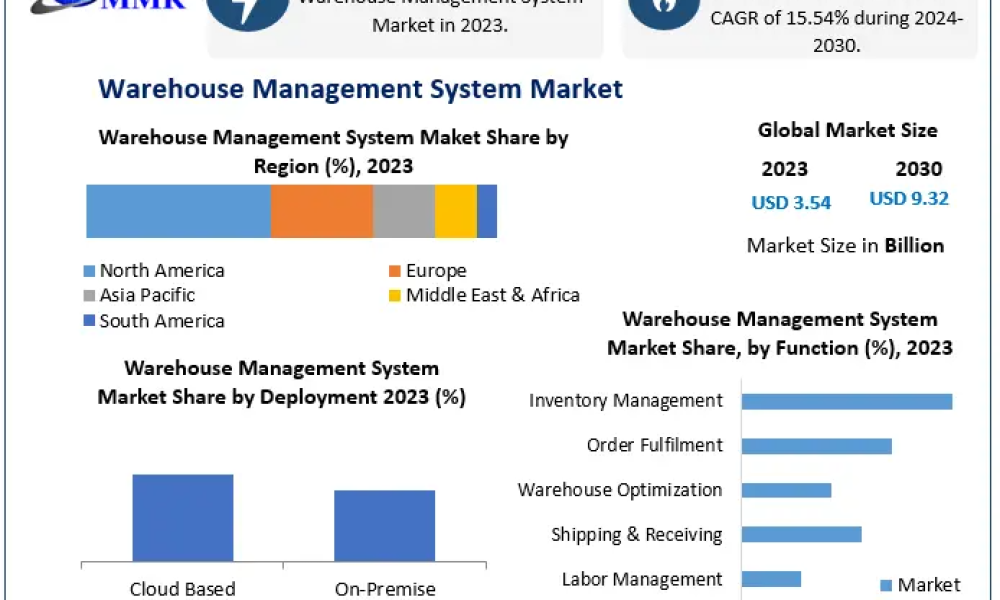
Warehouse Management System (WMS) Market was valued at USD 3.54 billion in 2023 and is projected to soar to USD 9.32 billion by 2030, showcasing a vigorous CAGR of 15.54% over the forecast period. The surge is driven by relentless e-commerce expansion, omnichannel retail, automation in supply chain operations, and the pressing need for real-time, data-driven warehouse optimization.
Growth Drivers
E-commerce Boom: The shift to online shopping globally is increasing the complexity and pace of inventory flows. E-commerce giants and omnichannel retailers rely heavily on WMS to orchestrate rapid order fulfillment, multi-location warehousing, and returns management.
Real-time Visibility & Automation: Next-gen WMS platforms harness IoT, cloud computing, and AI to deliver deep visibility into assets, workforce, and transactions. Automated inventory updates, digital stock allocation, and route planning are now standard, minimizing human error and improving service levels.
Manufacturing & Third-Party Logistics (3PL) Transformation: Manufacturers are integrating WMS with ERP and transport management for holistic supply chain oversight, while 3PLs use WMS to scale services and meet rigorous delivery KPIs.
Cost Efficiency: Companies adopt WMS not just for labor and process efficiency but also for inventory accuracy, space utilization, and shrinkage reduction—directly impacting the bottom line.
Regional Analysis
Asia Pacific: Witnesses the fastest growth, fueled by booming e-commerce, rising consumer affluence, and massive industrialization. The region’s manufacturing giants are investing in scalable WMS platforms to streamline cross-border logistics and distribution.
North America: Market maturity is reflected in high adoption by retail, healthcare, automotive, and food sectors. Strong presence of leading technology vendors and early adoption of cloud-native WMS and automation tools sustain dominance.
Europe: A major revenue contributor with over 30% global share in 2024. Early adoption of advanced warehouse robotics and analytics platforms drives continual modernization.
Emerging Markets: Latin America, Middle East, and Africa are beginning to embrace WMS as digital infrastructure and supply chain modernization initiatives ramp up.
Key Segment Analysis
Deployment:
Cloud-based WMS is outpacing on-premise, favored for lower entry cost, scalability, remote accessibility, and fast implementation. Cloud-based models are particularly pivotal for small- and medium-sized businesses and dynamic environments like 3PL and retail.
Functionality:
Leading functions include inventory management, order fulfillment, warehouse optimization, shipping/receiving, and labor management.
Analytics and AI-driven optimization are the fastest-growing segments, enabling predictive inventory, dynamic slotting, and resource allocation.
End-Use Industries:
Retail & E-commerce: Demands real-time inventory updates, order accuracy, and automated replenishment.
Manufacturing: Integrates WMS with MES/ERP for end-to-end visibility from raw material to dispatch.
Healthcare: Requires temperature-controlled logistics and regulatory compliance.
Food & Beverage, Automotive, Electronics: Rely increasingly on WMS for perishable inventory, recall management, and complex, multi-modal supply chains.
For full access to the data, request a sample report now :https://www.maximizemarketresearch.com/request-sample/54930/
Recent Developments
Tech Innovation: WMS providers are embedding machine learning and analytics for smarter forecasting and adaptive routing.
Automation & Robotics Integration: WMS platforms now interface natively with robots, AGVs, and automated picking systems for enhanced operational speed and accuracy.
Strategic Collaborations: Key tech vendors like IBM, SAP, and 3PL Central are aggressively pursuing M&A, partnerships, and venture capital investments to broaden solutions and consolidate market share.
IoT & Real-time Monitoring: Advanced IoT integration brings unparalleled supply chain transparency—tracking goods, workforce, and assets in real time across sprawling warehouse networks.
Competitive Landscape
Leading WMS vendors include IBM, SAP, 3PL Central, Oracle, Manhattan Associates, and Infor. The competition is fierce as players focus on cloud migration, vertical-specific solutions, and modular architectures, with a growing focus on seamless integration into broader supply chain ecosystems.
Challenges
Initial Investment: Despite lower cloud entry barriers, full-feature deployment and integration can still be costly.
Customization: Diverse operational models across industries require adaptable WMS solutions—one size rarely fits all.
Change Management: Employee training and change adaptation remain crucial for maximum ROI on WMS upgrades.
Future Outlook & Trends
WMS is evolving into the command center of digital supply chains, supporting predictive analytics, autonomous fulfillment, and seamless omnichannel operations.
Real-time, cloud, and AI-driven platforms are expected to become standard, especially among SMEs and high-volume logistics providers.
Asia Pacific will outpace global growth rates as its e-commerce, manufacturing, and logistics networks digitize and scale.
Expect continued convergence of WMS with IoT, robotics, and transportation management systems for 360° supply chain orchestration.
Quote
Warehouse Management Systems are reshaping the global supply chain, building the backbone for e-commerce, manufacturing, and next-gen logistics. 2025 and beyond will see unprecedented digital transformation, powered by smart automation, AI, and robust real-time visibility embedded across every warehouse operation worldwide.”
This comprehensive, forward-looking analysis showcases the scale, momentum, and technological innovation propelling the global WMS market into a new era of digital warehousing and supply chain excellence.
About Us :
Contact Us :




