
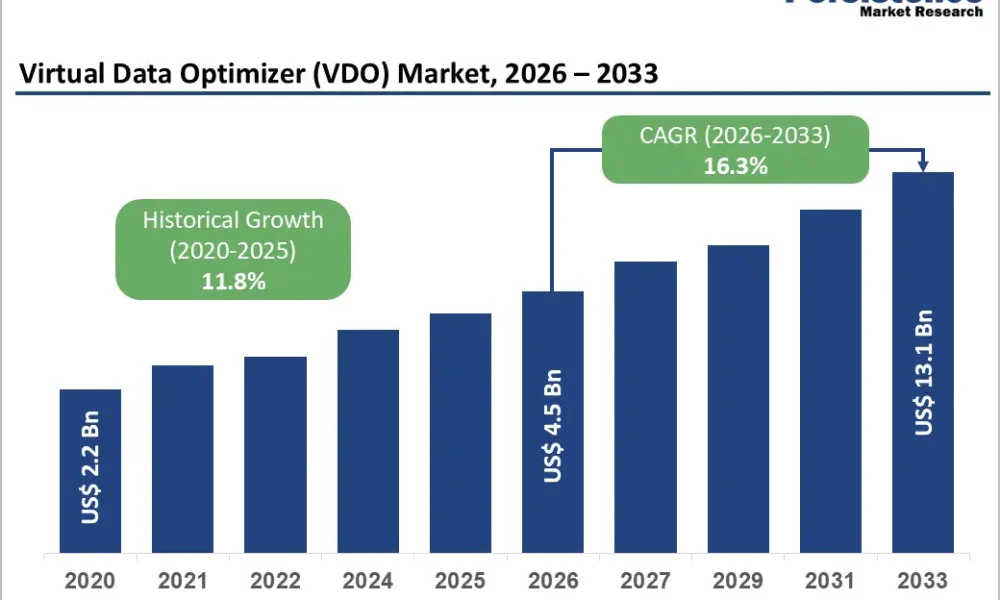
The global Virtual Data Optimizer (VDO) market is experiencing rapid expansion as enterprises increasingly prioritize cost-efficient data storage and infrastructure optimization. The market was valued at US$4.5 billion in 2026 and is projected to reach US$13.1 billion by 2033, growing at a compound annual growth rate (CAGR) of 16.3% from 2026 to 2033.
This remarkable growth trajectory reflects the accelerating pace of digital transformation, data explosion across enterprises, and the increasing shift toward hybrid and multi-cloud environments. Organizations are producing unprecedented volumes of data from connected devices, digital services, and analytics platforms. Managing this data efficiently has become a critical operational priority.
Virtual Data Optimizer solutions address this challenge by reducing storage requirements through technologies such as block-level deduplication, compression, thin provisioning, and intelligent data tiering. These capabilities allow enterprises to optimize storage utilization, reduce infrastructure costs, and improve overall system performance.
Additionally, the transition from capital-intensive IT infrastructure to operational expenditure-based cloud models has further accelerated demand for flexible, software-driven storage optimization technologies.
Market Overview
The Virtual Data Optimizer market has evolved significantly over the past decade as organizations increasingly adopt software-defined infrastructure and virtualization technologies. Historically, enterprises relied on large-scale storage hardware deployments to handle growing data volumes. However, this approach often resulted in inefficient resource utilization and rising operational costs.
VDO technologies provide an alternative by enabling data reduction directly at the storage layer, allowing organizations to store significantly more data within existing infrastructure.
These solutions are particularly valuable for industries such as banking, financial services, telecommunications, healthcare, retail, and manufacturing, where large volumes of structured and unstructured data are generated daily.
Key industry highlights include:
- North America leads the market with approximately 38% share, supported by mature data center ecosystems and strong cloud adoption.
- East Asia holds around 20% market share and represents the fastest-growing region, driven by rapid digital transformation initiatives.
- Europe accounts for roughly 24% share, benefiting from strict data protection regulations and sustainability-focused data center investments.
- Software-based VDO platforms dominate with 62% market share, reflecting the preference for scalable and vendor-neutral solutions.
- Data deduplication remains the leading optimization technology, accounting for about 30% of market adoption.
These trends demonstrate the growing importance of data efficiency and intelligent infrastructure management across modern enterprise environments.
Market Drivers
Exponential Growth in Enterprise Data Volumes
One of the primary drivers of the Virtual Data Optimizer market is the massive increase in global data generation.
Technologies such as Internet of Things (IoT), artificial intelligence, big data analytics, and digital services have dramatically increased the volume of data organizations must manage. Businesses now generate terabytes to petabytes of data daily from connected devices, applications, and customer interactions.
Without efficient optimization technologies, storing and managing this data would require constant expansion of expensive storage infrastructure.
VDO solutions address this challenge by:
- Eliminating redundant data through deduplication
- Compressing data blocks to reduce storage size
- Automatically allocating storage capacity through thin provisioning
Organizations deploying advanced data optimization tools have reported storage utilization improvements from 50–60% to as high as 80–90%, significantly reducing infrastructure investment requirements.
This improvement directly translates into lower capital expenditure, reduced data center space requirements, and lower energy consumption.
BFSI Sector Digital Transformation and Compliance Requirements
The banking, financial services, and insurance (BFSI) sector is one of the fastest-growing adopters of VDO technologies.
Financial institutions generate vast amounts of data from:
- Customer transactions
- Fraud detection systems
- Regulatory reporting
- Risk management platforms
- Digital banking services
Additionally, financial regulators across the world require institutions to store data securely for extended periods while ensuring accessibility and auditability.
As financial ecosystems expand, storage infrastructure becomes increasingly complex and expensive. Virtual Data Optimizer solutions allow banks to maintain large-scale data repositories while minimizing hardware costs and maintaining regulatory compliance.
For example, rapidly expanding financial ecosystems in Asia and Europe are driving investments in secure, scalable data infrastructure, creating strong demand for storage optimization technologies.
Elevate your business strategy with comprehensive market data. Request a sample report now: https://www.persistencemarketresearch.com/samples/32677
Market Challenges
Technical Integration and Legacy Infrastructure Limitations
Despite its advantages, the deployment of VDO solutions can be technically challenging.
Many organizations operate heterogeneous storage environments composed of hardware from multiple vendors across several generations of technology. Integrating advanced data reduction technologies with legacy systems may require significant infrastructure upgrades or configuration changes.
Key challenges include:
- Compatibility with older storage systems
- Latency concerns in mission-critical workloads
- Performance overhead from inline compression and deduplication
- Complexity in configuring optimal storage policies
Inline optimization processes may also consume additional CPU resources, which can affect performance in highly demanding workloads.
As a result, organizations often require specialized expertise in storage architecture and performance optimization, increasing the cost and complexity of implementation.
Emerging Opportunities
Edge Computing and Distributed Storage Optimization
The rise of edge computing is creating new opportunities for Virtual Data Optimizer solutions.
Edge computing involves deploying computing and storage infrastructure closer to data sources, such as manufacturing plants, retail stores, remote offices, and IoT networks. This architecture reduces latency and improves real-time data processing.
However, distributed storage environments create challenges related to bandwidth usage, data synchronization, and capacity limitations.
VDO technologies help address these issues by:
- Optimizing local storage utilization
- Reducing data redundancy before transmission
- Minimizing bandwidth requirements for replication and backup
Organizations implementing edge storage infrastructure have reported significant improvements in performance, bandwidth efficiency, and disaster recovery capabilities.
As edge computing adoption accelerates across industries such as manufacturing, smart cities, and autonomous systems, demand for storage optimization technologies is expected to rise significantly.
Artificial Intelligence Integration in Storage Management
Another emerging opportunity in the VDO market is the integration of artificial intelligence and machine learning into storage infrastructure.
AI-powered storage platforms can automatically analyze workload patterns and optimize data reduction strategies accordingly.
Key capabilities include:
- Predictive analytics for storage failure detection
- Automated tuning of compression and deduplication policies
- Dynamic workload optimization
- Intelligent capacity planning
Organizations adopting AI-enhanced storage platforms have reported 15–25% improvements in compression efficiency compared to traditional static configurations.
These intelligent optimization capabilities are expected to become a key differentiator for next-generation data storage platforms.
Component Analysis
Software Segment Dominates the Market
Software-based VDO platforms accounted for approximately 62% of the market share in 2026.
Software-driven solutions are preferred by enterprises because they offer:
- Vendor-neutral deployment across different hardware platforms
- Easier updates and upgrades
- Lower capital expenditure requirements
- Greater scalability in virtualized environments
Open-source ecosystem developments have further accelerated software adoption. Integration of VDO functionality into the Linux kernel has significantly improved accessibility and compatibility for enterprise deployments.
These solutions enable transparent data reduction across multiple workloads without requiring application-level changes, making them highly attractive to enterprise IT teams.
Services Segment Showing Rapid Growth
Although software platforms dominate the market, professional services are the fastest-growing segment.
Services include:
- Infrastructure consulting
- Deployment and integration support
- Performance tuning
- Training and technical support
Given the complexity of storage optimization technologies, many organizations rely on expert consulting services to ensure optimal implementation and performance management.
Optimization Type Analysis
Data Deduplication Leads the Market
Data deduplication remains the most widely adopted optimization technique, accounting for approximately 30% of the market share.
This technology works by identifying and eliminating duplicate data blocks within storage environments.
Deduplication is particularly effective in environments that store large volumes of similar data, such as:
- Virtual machine images
- Containerized applications
- Backup repositories
- Data archives
In backup environments, deduplication ratios can exceed 20:1, significantly reducing storage capacity requirements.
Data Tiering Emerging as Fastest-Growing Technology
Data tiering is rapidly gaining popularity as organizations seek to optimize storage costs based on data usage patterns.
This approach automatically moves data between storage tiers based on frequency of access and performance requirements.
For example:
- Frequently accessed data remains on high-speed SSD storage
- Moderately accessed data moves to mid-tier storage
- Archival data is stored in low-cost storage or cloud repositories
This dynamic allocation helps organizations balance performance, cost, and capacity efficiently.
Regional Insights
North America
North America remains the largest regional market, accounting for approximately 38% of global market share.
The region benefits from:
- Advanced data center infrastructure
- Strong cloud adoption
- Presence of major technology companies
- High investment in digital transformation
Enterprises in the region are early adopters of hybrid and multi-cloud architectures, driving demand for sophisticated storage optimization technologies.
East Asia
East Asia represents the fastest-growing regional market, supported by large-scale digital infrastructure investments in countries such as China, Japan, and South Korea.
Rapid expansion of IoT ecosystems, fintech platforms, and smart city projects is generating enormous data volumes, creating demand for efficient storage solutions.
Government-backed technology initiatives further accelerate infrastructure modernization across the region.
Europe
Europe holds approximately 24% of global market share, driven by strict regulatory frameworks and sustainability initiatives.
Regulations such as data protection laws and digital governance policies require organizations to maintain secure, auditable storage systems.
At the same time, Europe’s focus on energy-efficient and environmentally sustainable data centers encourages adoption of storage optimization technologies that reduce infrastructure footprint and power consumption.
Competitive Landscape
The Virtual Data Optimizer market is moderately consolidated, with several global technology companies dominating the competitive landscape.
Leading market participants include:
- IBM Corporation
- Microsoft Corporation
- Oracle Corporation
- Red Hat, Inc.
- Hewlett Packard Enterprise
- Dell Technologies
- NetApp
- Commvault Systems
- Veritas Technologies
- Cohesity
- Rubrik
These companies leverage integrated data management platforms, cloud infrastructure capabilities, and strong enterprise relationships to maintain competitive advantage.
Strategic partnerships, product innovations, and acquisitions remain key strategies used by market players to strengthen their storage optimization portfolios.
Conclusion
The Virtual Data Optimizer (VDO) market is poised for strong growth as enterprises increasingly confront the challenges of explosive data growth and rising infrastructure costs.
With the market expected to grow from US$4.5 billion in 2026 to US$13.1 billion by 2033, VDO technologies are becoming a critical component of modern data infrastructure.
Key growth drivers include:
- Expansion of cloud and hybrid IT environments
- Rapid growth in enterprise data volumes
- Digital transformation initiatives across industries
- Increasing demand for cost-efficient storage infrastructure
Emerging trends such as edge computing, AI-powered storage management, and open-source infrastructure integration are expected to further accelerate market growth.
As organizations continue to prioritize efficient data management, scalability, and sustainability, Virtual Data Optimizer technologies will play an increasingly central role in the evolution of global data storage ecosystems.
Related Reports:




