
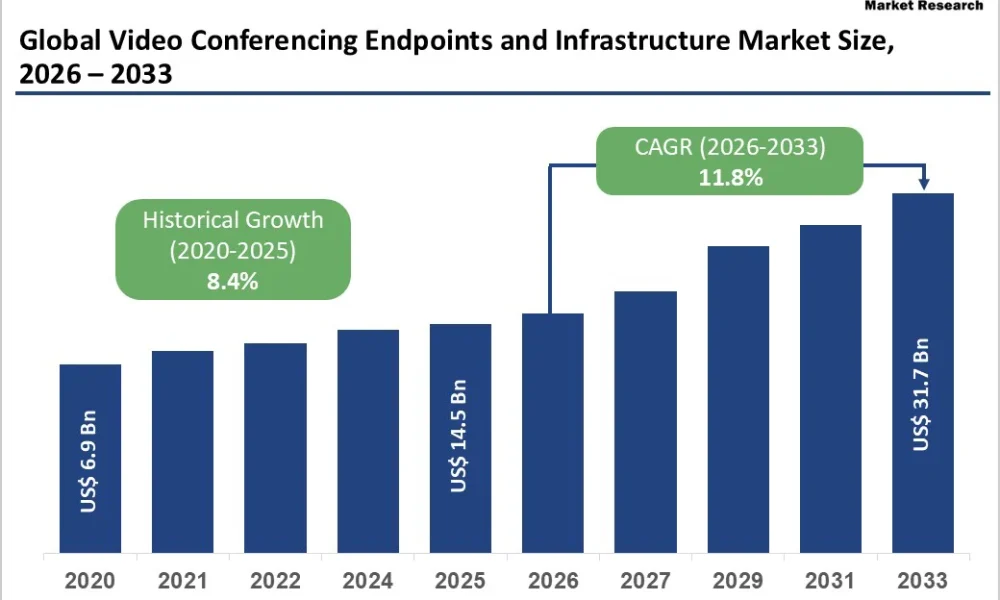
The global video conferencing endpoints and infrastructure market is entering a new era of sustained growth, driven by the permanent shift toward hybrid work, accelerated digital transformation, and continuous innovation in collaboration technologies. The market is projected to grow from US$14.5 billion in 2026 to US$31.7 billion by 2033, registering a strong CAGR of 11.8% between 2026 and 2033.
This growth builds on steady historical expansion. Between 2020 and 2025, the market recorded a CAGR of 8.4%, largely fueled by pandemic-driven remote work adoption. However, what was once an emergency response has now evolved into a long-term enterprise strategy. Organizations across industries are embedding video collaboration into core operations, reshaping how teams communicate, innovate, and deliver services.
The Permanent Shift to Hybrid Work
One of the most powerful drivers of market expansion is the global transition to hybrid work models. Studies indicate that approximately 83% of employees prefer hybrid arrangements, combining office and home-based workdays. This structural shift has made video conferencing infrastructure a mission-critical business asset rather than a temporary solution.
Enterprises are redesigning workspaces to support hybrid collaboration. Meeting rooms are now equipped with intelligent video conferencing endpoints such as smart cameras, noise-canceling microphones, and integrated collaboration displays. Meanwhile, employees working remotely rely on cloud-based video platforms to ensure seamless communication across geographies.
This widespread adoption has created sustained demand for both software-based conferencing platforms and advanced hardware endpoints, including room systems, mobile devices, and desktop-based solutions.
Understanding Video Conferencing Endpoints and Infrastructure
The market encompasses two primary components:
Endpoints – These include hardware and software devices used to access video conferencing systems, such as:
- Room-based conferencing systems
- Desktop clients
- Mobile devices
- Collaboration boards
- Cameras, microphones, and display systems
Infrastructure – This includes backend systems that enable video communication, such as:
- Cloud-based conferencing platforms
- On-premise servers
- Network management systems
- Security and encryption frameworks
- AI-driven meeting analytics tools
The integration of these components ensures real-time communication, collaboration, and content sharing across distributed teams.
Key Growth Drivers
- Rapid Digital Transformation Across Industries
Digital transformation initiatives are accelerating across sectors including healthcare, education, financial services, government, and retail. Enterprises are modernizing IT infrastructure to improve efficiency, agility, and customer engagement.
Video conferencing has become a foundational element of digital transformation strategies. It supports:
- Virtual client consultations
- Remote workforce collaboration
- Online education and training
- Cross-border business operations
Organizations are increasingly shifting from legacy hardware-based systems to cloud-native video platforms, enabling scalability, flexibility, and cost optimization.
- AI-Powered Meeting Intelligence
Artificial intelligence is redefining video collaboration. Modern platforms now offer:
- Live transcription and translation
- Real-time meeting summaries
- Speaker recognition
- Background noise suppression
- Facial framing and auto-tracking
AI-powered meeting analytics provide actionable insights into engagement levels, productivity metrics, and communication effectiveness. These features enhance user experience while improving organizational efficiency.
As AI capabilities mature, enterprises are prioritizing software solutions that integrate intelligent automation into their collaboration ecosystems.
- 5G-Enabled Ultra-Low Latency Communication
The deployment of 5G networks is enhancing video conferencing quality through ultra-low latency and higher bandwidth. This enables:
- High-definition and 4K video streaming
- Reduced buffering and lag
- Improved reliability for mobile conferencing
With 5G expansion, mobile endpoints are becoming more viable for professional-grade communication. This is particularly important for remote teams, field workers, and telehealth practitioners who rely on seamless connectivity.
- Cost Optimization and Travel Reduction
Enterprises are increasingly prioritizing cost efficiency. Video conferencing significantly reduces business travel expenses while maintaining global connectivity.
Organizations have realized that virtual meetings can replace a large percentage of in-person interactions without compromising productivity. This shift is not only cost-effective but also aligns with corporate sustainability goals by reducing carbon footprints.
Segment Analysis
Software Dominates the Market
The software segment holds a dominant 53% market share in 2025, reflecting enterprises’ preference for cloud-based subscription models.
Key factors driving software dominance include:
- Lower upfront costs compared to hardware
- Scalability and flexibility
- AI-enhanced features
- Automatic updates and security patches
- Integration with productivity suites
Businesses are increasingly adopting SaaS-based collaboration platforms that provide comprehensive communication tools, including chat, file sharing, and project management integrations.
Mobile Endpoints: The Fastest Growing Segment
Mobile endpoints are projected to grow at a 15.2% CAGR from 2026 to 2032, making them the fastest-growing segment.
This growth is driven by:
- Bring Your Own Device (BYOD) policies
- Widespread smartphone adoption
- Increasing remote and field-based work
- User-friendly mobile conferencing apps
Employees now expect seamless participation in meetings from smartphones and tablets. As mobile applications become more secure and feature-rich, adoption continues to accelerate.
Elevate your business strategy with comprehensive market data. Request a sample report now: https://www.persistencemarketresearch.com/samples/21583
Regional Insights
North America Leads the Market
North America accounts for approximately 34% of global revenues in 2025, maintaining its leadership position.
Key growth factors include:
- Strong hybrid work adoption
- High enterprise IT spending
- Presence of leading technology vendors
- Strict regulatory requirements in healthcare and finance
The region benefits from mature cloud infrastructure and advanced cybersecurity standards, supporting widespread enterprise deployment of secure video conferencing systems.
Asia Pacific: Fastest Growing Region
Asia Pacific is projected to grow at a CAGR of 14.8% between 2026 and 2032, making it the fastest-expanding regional market.
Drivers include:
- Rapid digitalization across SMEs
- Growing IT services ecosystem
- Government-backed digital infrastructure programs
- Increasing smartphone and internet penetration
Countries such as India, China, Japan, and Southeast Asian nations are investing heavily in digital connectivity, fueling demand for scalable video conferencing solutions.
Europe: Steady and Security-Focused Growth
Europe represents a strong and stable market, particularly in industries requiring high levels of data security and compliance.
Financial institutions, government agencies, and healthcare providers are investing in secure video conferencing infrastructure that meets GDPR and other regulatory standards.
Industry Opportunity: Telehealth Expansion
One of the most promising growth opportunities lies in telehealth, which is expanding at a 17.1% CAGR.
Healthcare providers are integrating video conferencing systems into clinical workflows to support:
- Virtual consultations
- Remote diagnostics
- Post-treatment follow-ups
- Mental health therapy sessions
Governments worldwide are supporting telemedicine through funding programs and regulatory adjustments, ensuring sustained demand for secure and compliant video collaboration infrastructure.
Security and Compliance Considerations
As video conferencing becomes mission-critical, cybersecurity has emerged as a top priority.
Enterprises require:
- End-to-end encryption
- Multi-factor authentication
- Secure cloud hosting
- Compliance with industry regulations
Security-driven demand is particularly strong in regulated industries such as healthcare, banking, and government.
Vendors are responding by integrating advanced encryption protocols and zero-trust security frameworks into their platforms.
Competitive Landscape
The market is highly competitive, with established global vendors and emerging technology providers competing for market share.
Key competitive strategies include:
- AI feature differentiation
- Cloud scalability enhancements
- Strategic partnerships and integrations
- Expansion into vertical-specific solutions
Vendors are increasingly offering bundled solutions that combine conferencing, messaging, and productivity tools within unified communication platforms.
Challenges Facing the Market
Despite strong growth prospects, the industry faces several challenges:
- Intense competition leading to pricing pressure
- Bandwidth limitations in developing regions
- Data privacy concerns
- Integration complexities with legacy systems
However, ongoing technological advancements and cloud adoption are expected to address many of these barriers.
Future Outlook
The future of the video conferencing endpoints and infrastructure market is highly promising. By 2033, the market is expected to nearly double in size, reflecting the permanent transformation of workplace communication.
Key trends shaping the future include:
- Greater AI integration for intelligent collaboration
- Expansion of immersive technologies such as AR and VR meetings
- Wider 5G deployment enhancing mobile participation
- Increased vertical-specific customization
Hybrid work is no longer an experiment—it is a structural shift. As organizations embrace geographically dispersed teams, video conferencing will remain central to global business operations.
Conclusion
The global video conferencing endpoints and infrastructure market is set for sustained double-digit growth, expanding from US$14.5 billion in 2026 to US$31.7 billion by 2033 at an 11.8% CAGR.
North America continues to lead, supported by enterprise IT investments and regulatory-driven security needs. Meanwhile, Asia Pacific emerges as the fastest-growing region due to digitalization and cloud adoption. Software solutions dominate the market, while mobile endpoints show the fastest growth as flexible work models persist.
With AI, 5G, and cloud technologies reshaping collaboration ecosystems, video conferencing infrastructure has become an indispensable pillar of modern enterprise strategy. As hybrid work and digital transformation accelerate worldwide, this market is poised for long-term expansion and innovation.
Related Reports:




