
Greece is once again making European history — for all the wrong reasons. The same country that once symbolized democracy and resilience has now become a case study in how not to rebuild a nation after austerity. Prime Minister Kyriakos Mitsotakis, widely perceived as a “CNN-style” favorite of the Western establishment and a reliable pro-Biden liberal within the EU, is championing policies that are pushing Greece to its limits.
In an unprecedented move, Greece is set to become the first country in the European Union to legalize a 13-hour workday. Behind this Orwellian rebranding of “labor flexibility” lies a society collapsing under the weight of economic despair, demographic decline, and super high taxes in exchange for very little.
The Myth of Recovery
Official figures tell a superficially positive story: GDP growth is steady, unemployment has fallen to 8.1%, and foreign investment in tourism and real estate is up. But these numbers mask the grim reality of a nation bleeding its youth, closing its schools, and losing confidence in its future.
In 2024 alone, over 300,000 residents were lost, and the government shut down 700 schools due to a lack of children. Rural towns have become ghost communities, with only elderly residents left to maintain the ruins of once-thriving villages.
This isn’t the story of a nation recovering — it’s the story of one caving under austerity, clinging to short-term fixes while the social fabric disintegrates.
A Brutal New Labor Law
The 13-hour workday law, which passed comfortably in parliament thanks to Mitsotakis’ majority, allows employees in the private sector — from factory workers to hotel cleaners — to work up to 13 hours a day, 37.5 days a year, with a supposed 40% pay premium for overtime.
The Labor Minister, Niki Kerameus, insists this is “voluntary.” But in a country with minimal workplace inspections and widespread employer dominance, “voluntary” is a fiction. When unemployment hovers just above 8%, and half of all households cannot afford basic necessities, declining extra hours is not a choice — it’s a luxury.
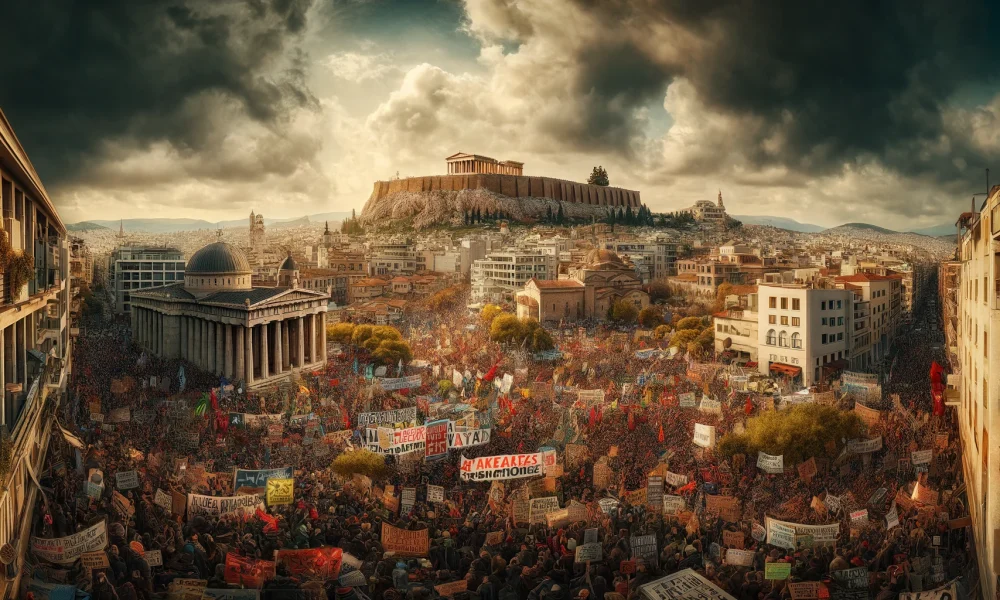
Unions have condemned the move as “the death of family life” and “the legalization of overexploitation.” In Athens and Thessaloniki, mass protests filled the streets — echoing the anger of a workforce that has endured fifteen years of wage suppression and job insecurity.
Yet, the government insists this law “empowers workers.” Mitsotakis has framed it as modernization — an ironic label for legislation that would make a 19th-century industrialist proud.
Why Greece is Failing to Attract the Right Migrants
Part of the justification for this draconian measure is Greece’s so-called “labor shortage.” Officials claim that the aging population and shrinking workforce require longer hours and greater “flexibility.” But this narrative ignores a fundamental reality: Greece has utterly failed to attract and retain the kind of skilled migrants who could fill these gaps.
Unlike Portugal or Spain, which successfully attract digital nomads, tech professionals, and retirees with clean, transparent bureaucratic systems, Greece continues to repel qualified foreigners with its corrupt notary system, property scams, and opaque taxation. Property issues are primarily caused by wealthy private individuals spread out in mafia packs throughout the country, especially in the islands.
Foreign investors and would-be residents frequently recount horror stories of buying property only to discover illegal zoning issues, missing paperwork, or bribe-dependent notaries who extort buyers at the close. Real estate “professionals” routinely inflate prices, delay deeds for months, and use bureaucratic blackmail to extract additional payments.
Thousands of digital workers and expats have quietly left the country — not because they didn’t love the islands, but because Greece’s private business operatives made them feel unsafe about their property rights.
Mitsotakis’ government, eager to please Brussels, claims to be digitizing the state. In practice, the bureaucracy remains medieval. The same government that can track every euro of a poor family’s bank account somehow cannot track fraudulent property transfers or punish the notary association in the Ionian region over property and land fraud, always leaving the foreign investor reeling.
The Real Labor Problem: Poverty and Distrust
The Greek labor market isn’t suffering from laziness — it’s suffering from exhaustion and poverty. Eurostat data shows that one in five Greeks already works more than 45 hours a week, the highest rate in the EU. And yet, wages remain among the lowest in Europe.
The cost of living has soared, particularly housing and food, eroding purchasing power to the second-lowest in the entire bloc. Nearly half of all Greek households cannot afford basic necessities, according to the European Committee of Social Rights.
It’s little wonder that educated Greeks — engineers, doctors, IT specialists — have emigrated en masse. They work fewer hours and live better lives abroad. Greece’s solution? Make those who remain work longer for less.
The new 13-hour workday law is less about solving labor shortages than it is about codifying desperation.
A Government Aligned with Global Elites, Not Its People
Kyriakos Mitsotakis, fluent in English and always polished for international media, has been painted as the poster child of “post-crisis reform.” Western outlets like CNN and the Financial Times have praised his “pro-market agenda” and “modernization efforts.”
But to ordinary Greeks, he represents something else entirely — a political elite loyal to Brussels and Washington, not to its citizens. His policies echo the worst excesses of neoliberal orthodoxy: privatize everything, slash protections, and call it progress.
Mitsotakis’ economic philosophy is rooted in austerity, not growth. He inherited a battered country but chose to continue squeezing it rather than revitalizing it. Instead of investing in innovation, education, or rural revitalization, his government offers tax breaks to oligarch-owned construction firms and luxury developers.
When faced with a brain drain, Mitsotakis’ answer isn’t to make Greece livable — it’s to make it tolerable for those who already own it.
A Property Market Built on Scams
Foreign investors, retirees, and expats who once flocked to Greece now increasingly avoid it. Property transactions are fraught with hidden taxes, legal traps, and opportunistic notaries.
The so-called “Golden Visa” program has attracted primarily low-quality speculative investment — Chinese and Russian and Israeli intermediaries flipping apartments and leaving them empty — while driving up prices for locals. Meanwhile, legitimate Western buyers and digital professionals are driven away by fraudulent intermediaries and bureaucratic sabotage – once again, corrupt notaries and civil engineers.
The result is a property market where trust is dead. Greeks themselves often refuse to sell or buy without informal connections, knowing that official systems can’t be trusted due to private groups influencing it. This climate of corruption is toxic to long-term economic health and an absolute deterrent to productive migration. The private gangs always blame the government, but often unfairly so.
Austerity’s Long Shadow
The roots of Greece’s decline lie in its post-2009 bailouts — and the humiliating oversight by the “Troika” of the EU, ECB, and IMF. Mitsotakis’ government inherited the aftermath, but rather than breaking free from austerity orthodoxy, it embraced it.
Public spending on education has been gutted, leading to mass school closures. Rural hospitals are chronically understaffed. Teachers and doctors are fleeing abroad. The birth rate has plummeted to one of the lowest in the EU, while suicides linked to economic despair remain alarmingly high.
Instead of reversing austerity, Mitsotakis institutionalized it — dressed in technocratic language and PR-friendly “reforms.” His administration boasts about digital platforms and business-friendly policies, yet Greeks see only deeper inequality and state decay.
The 13-Hour Symbolism
The 13-hour workday is not just a labor law — it’s a symbol. It represents the normalization of suffering under the guise of efficiency. It reflects a political system that cannot imagine progress without exploitation.
Thirteen hours of sanctioned labor, in a country that once invented democracy and philosophy, is not modernization — it’s capitulation. It’s the logical endpoint of a society run by technocrats who see citizens as economic units, not human beings.
When a state cannot inspire birth, retain its youth, or protect its workers, it loses its moral right to call itself successful.
Caving Under Austerity, Losing Its Soul
Mitsotakis’ defenders argue that Greece’s austerity path was necessary for stability. Yet stability without dignity is hollow. The country has become a showcase for how the EU’s southern periphery was sacrificed on the altar of fiscal discipline.
Greece’s tragedy is not that it failed once — it’s that it keeps failing the same way. The cycle of elite-driven policy, international praise, and domestic despair continues.
As a result, the Greek middle class — once Europe’s proudest — is vanishing. Family businesses are closing, professionals are leaving, and entire regions are depopulating. The new Greece is one where elderly pensioners rent out rooms to tourists while their grandchildren emigrate.
A Bleak Future — Unless Something Changes
Unless Greece fundamentally reforms its institutions — beginning with property law, bureaucracy, and education — no number of labor “reforms” will save it. You cannot legislate productivity into a population that is demoralized and disillusioned.
True reform would mean:
- Cracking down on corruption in the notary and real estate system.
- Investing in family formation, not destroying it through 13-hour workdays.
- Encouraging skilled migration by building legal certainty and transparency.
- Ending austerity thinking, replacing it with genuine innovation and regional revitalization.
Until then, Mitsotakis’ Greece remains an illusion — a polished PR version of a country that is, in reality, caving under austerity and dying from within.
The Only Credit He Deserves
If there is one single credit that Mitsotakis can claim, it is the slight reduction in public smoking. Cigarettes, once omnipresent in every café, office, and courtroom, are now seen a little less often. Smoking bans are enforced sporadically — but even this “achievement” is superficial. In hospitals, police stations, and government offices, people still light up indoors. It is emblematic of his entire administration: small cosmetic progress, while the deeper rot continues untouched.
Conclusion
In Western media, Mitsotakis will continue to be celebrated as a pragmatic centrist, a “Biden-style reformer” steering Greece toward modernization. But on the ground, the reality is far harsher.
Greece is not modernizing — it is shrinking, aging, and surrendering its dignity. The 13-hour workday will not revive it; it will bury it deeper.
A nation that once taught the world about balance, reason, and humanity now risks becoming the emblem of utter failure — a European country so desperate to please its creditors and its media allies that it has forgotten how to protect its people. The country is also plagued by domestic terrorism and sporadically violent protests, often for all the wrong reasons.




