
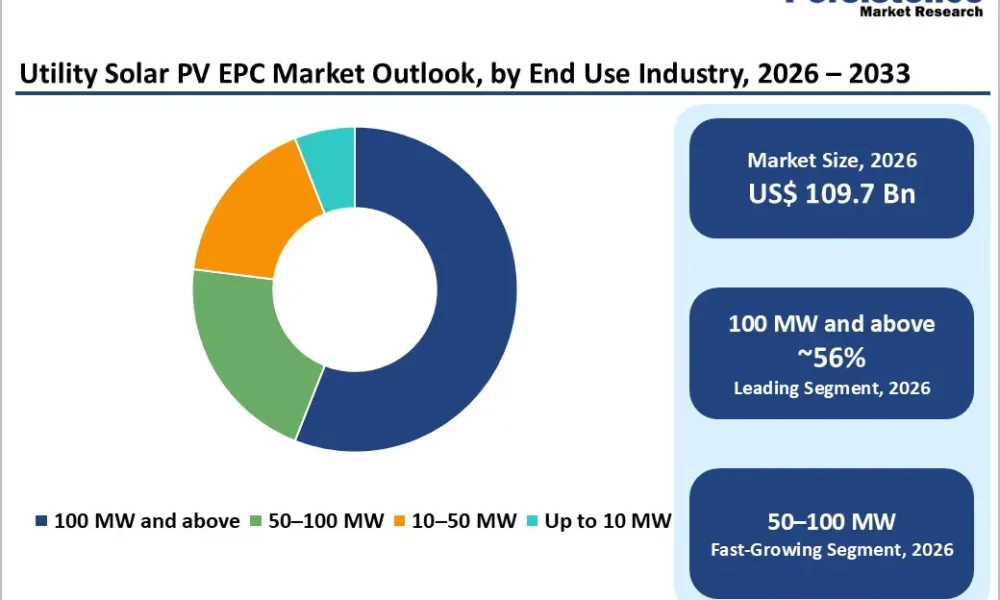
The Utility Solar PV EPC Market is witnessing accelerated expansion as governments and private investors scale up renewable energy deployment worldwide. According to Persistence Market Research, the global utility solar PV EPC market size is likely to be valued at US$ 109.7 billion in 2026 and is projected to reach US$ 245.6 billion by 2033, growing at a CAGR of 12.2% between 2026 and 2033. This strong growth trajectory reflects rising investments in large scale solar parks, grid connected photovoltaic systems, and clean energy infrastructure modernization. Utility solar PV EPC services cover engineering, procurement, and construction solutions for solar power plants, ensuring end to end project execution and operational efficiency.
Market statistics highlight sustained demand for utility scale solar installations driven by decarbonization goals and national renewable energy targets. The 12.2% CAGR underscores expanding project pipelines across emerging and developed economies. Growth is supported by favorable policy frameworks, competitive bidding mechanisms, and declining solar module costs. The leading segment within the market remains large utility scale ground mounted solar projects, owing to higher capacity installations and economies of scale. In terms of geography, Asia Pacific leads the market, supported by ambitious renewable capacity additions, expanding grid infrastructure, and strong government backed solar missions in key countries.
Download Your Free Sample & Explore Key Insights : https://www.persistencemarketresearch.com/samples/36121
Key Highlights from the Report
➤ Rapid expansion of large scale solar farm installations driving utility solar PV EPC market demand
➤ Asia Pacific emerging as the dominant regional market due to aggressive renewable capacity targets
➤ Ground mounted utility solar projects accounting for the largest revenue share
➤ Increasing public and private sector investments in grid connected solar infrastructure
➤ Competitive EPC contracting models enhancing cost efficiency and project scalability
➤ Strong CAGR of 12.2% projected between 2026 and 2033 as per Persistence Market Research
Market Segmentation
The utility solar PV EPC market is segmented based on project type, capacity, and end user. By project type, the market includes ground mounted solar farms and other utility scale photovoltaic installations. Ground mounted systems dominate due to their suitability for large capacity additions and optimized land utilization. These projects benefit from centralized inverters, advanced tracking systems, and high efficiency modules, enabling improved energy yield. Utility solar PV EPC contractors provide turnkey services ranging from site assessment and system design to procurement and commissioning, ensuring streamlined project execution.
From an end user perspective, the market is primarily driven by public utilities, independent power producers, and government agencies. Public utilities invest in large scale solar power plants to diversify energy portfolios and reduce dependence on fossil fuels. Independent power producers contribute significantly by leveraging long term power purchase agreements. Capacity wise, high megawatt installations account for the majority share, as large projects offer economies of scale and attractive returns. The segmentation landscape reflects growing emphasis on integrated EPC solutions tailored to grid connected solar infrastructure projects.
Customize This Report for Your Exact Requirements : https://www.persistencemarketresearch.com/request-customization/36121
Regional Insights
Asia Pacific dominates the utility solar PV EPC market due to rapid industrialization, rising electricity demand, and ambitious renewable energy targets. Governments in the region are actively promoting large scale solar installations through policy incentives and competitive auctions. Expanding transmission networks and supportive regulatory frameworks further accelerate project approvals and commissioning. Strong domestic manufacturing capabilities and cost competitive EPC services enhance regional market leadership. The region’s focus on sustainable energy transition continues to attract global investors and EPC contractors.
North America and Europe also represent significant markets, driven by decarbonization mandates and energy security concerns. Utility scale solar farms are increasingly integrated into national grids to meet renewable portfolio standards. Stable policy environments and technological advancements in photovoltaic systems support steady project pipelines. In these regions, utility companies and independent developers collaborate with EPC firms to deploy high capacity solar parks. Growing emphasis on carbon neutrality reinforces long term market growth prospects.
Market Drivers
The primary driver of the utility solar PV EPC market is the global transition toward renewable energy and decarbonization. Governments are implementing renewable purchase obligations and carbon reduction commitments, accelerating investments in solar power generation. Utility scale solar projects offer cost effective electricity production, making them attractive for national energy planning. Declining photovoltaic module prices and improved system efficiencies further enhance project viability. As countries strive to reduce greenhouse gas emissions, utility solar installations become central to sustainable energy strategies.
Another key driver is the increasing availability of financing mechanisms and public private partnerships. Large infrastructure funds, development banks, and institutional investors are allocating capital to renewable energy projects. Long term power purchase agreements provide revenue visibility and risk mitigation for project developers. Technological innovations in solar trackers, inverters, and digital monitoring systems improve performance and operational reliability. These factors collectively strengthen the demand for comprehensive EPC services in utility solar PV projects.
Market Restraints
Despite robust growth, the utility solar PV EPC market faces challenges related to land acquisition and regulatory approvals. Large scale solar farms require extensive land parcels, which may lead to delays due to environmental clearances or community concerns. Grid connectivity constraints and transmission bottlenecks can also hinder project commissioning timelines. Complex permitting processes increase project development costs and affect overall profitability for EPC contractors.
Supply chain disruptions and price volatility in raw materials present additional restraints. Fluctuations in module and component pricing can impact project budgets and contract margins. Geopolitical uncertainties and trade policies may influence procurement strategies for solar equipment. Furthermore, intense competition among EPC players often results in aggressive bidding, reducing profit margins. These challenges necessitate efficient project management and risk mitigation strategies within the utility solar PV EPC market.
Market Opportunities
The utility solar PV EPC market presents significant opportunities through hybrid renewable projects and energy storage integration. Combining solar power with battery storage enhances grid stability and enables round the clock energy supply. As energy storage technologies become more affordable, integrated EPC contracts are likely to expand. Digitalization and smart grid technologies also create opportunities for advanced monitoring and predictive maintenance services in large solar installations.
Emerging economies offer untapped potential due to rising electricity demand and infrastructure development. Governments are launching solar park schemes and renewable energy corridors to attract foreign investment. EPC companies that leverage local partnerships and innovative financing models can secure long term growth. Increasing corporate commitments to renewable energy procurement further support utility scale solar deployment. These factors collectively position the market for sustained expansion through 2033.
Exclusive Data Awaits – Continue to Checkout : https://www.persistencemarketresearch.com/checkout/36121
Company Insights
Key players operating in the Utility Solar PV EPC Market include
- First Solar
- Canadian Solar
- Trina Solar
- ACME Solar
- Sterling and Wilson
- Bharat Heavy Electricals Limited (BHEL)
- Larsen & Toubro Limited
- Power Construction Corporation of China (PCCC)
- Sungrow
- JUWI AG
- BELECTRIC
- KEC International Limited
- Tata Power Solar Systems Ltd.
- Risen Energy Co. Ltd.
- SunPower Corporation
Recent Developments
In January 2024, a leading EPC contractor expanded its utility scale solar project portfolio through new large capacity project awards in Asia Pacific.
In September 2023, a major solar technology provider strengthened its EPC capabilities by announcing strategic collaborations for high efficiency photovoltaic module deployment in utility scale projects.
Future Opportunities and Growth Prospects
The future of the utility solar PV EPC market is closely aligned with global energy transition strategies and long term sustainability goals. Continued investments in large scale photovoltaic infrastructure, coupled with advancements in digital engineering and project management tools, will enhance execution efficiency. As the market progresses toward US$ 245.6 billion by 2033, EPC contractors that focus on innovation, cost optimization, and strategic partnerships are expected to capture substantial value. With a projected CAGR of 12.2%, the market demonstrates strong potential for sustained and diversified growth across regions.




