
The global Tubular Webbing Market is set for steady, multifaceted expansion, rising from USD 630.9 million in 2025 to USD 856.1 million by 2035, according to the latest market outlook. The industry will grow at a 3.1% CAGR, supported by surging safety standards, advanced textile engineering, and increasing adoption across automotive, outdoor recreation, industrial safety, and rescue equipment applications.
The market’s growth pattern reflects two clearly defined phases. From 2025 to 2030, tubular webbing demand expands to USD 734.9 million, contributing 46.2% of the decade’s growth, driven by widespread adoption of nylon-based webbing systems offering tensile reliability, flexibility, and enhanced abrasion resistance. The second half of the decade (2030–2035) accelerates to USD 856.1 million, adding USD 121.2 million in market output, supported by advanced material integration, performance-optimized designs, and increasing deployment across global safety, automotive, and outdoor equipment ecosystems.
Subscribe for Year-Round Insights → Stay ahead with quarterly and annual data updates: https://www.futuremarketinsights.com/reports/sample/rep-gb-27915
Global Market Fundamentals Strengthen as Nylon Maintains Material Leadership
Nylon remains the dominant material, accounting for 58% of the market, attributed to superior load-bearing capability, durability, and consistent performance across high-stress applications. Polyester follows with a 28% share, supported by strong UV resistance and demand in marine and outdoor equipment.
Key Performance Drivers
- High abrasion resistance and strength-to-weight advantages
- Compatibility with automated weaving and safety equipment production
- Demand from automotive restraint systems, fall protection equipment, and climbing/outdoor gear
Leading manufacturers include National Webbing Products, Murdock Webbing, Strapworks, Bally Ribbon Mills, Weaver (Xiamen) Textile, Bowmer Bond, US Cargo Control, and Nilit, all strengthening product portfolios with enhanced fiber engineering and precision weaving technologies.
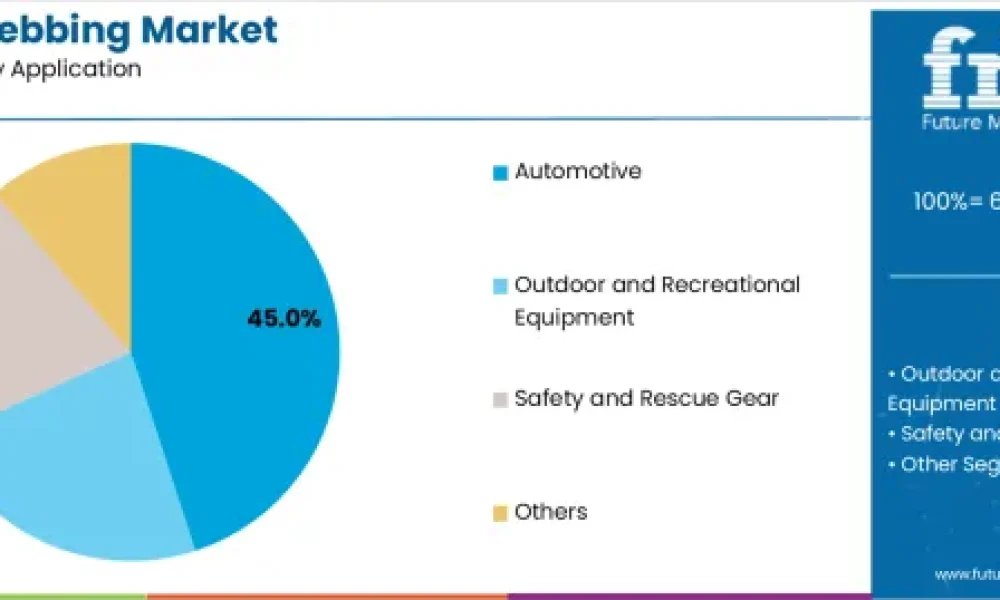
Automotive Segment Leads Global Demand with 45% Market Share
Automotive applications represent the largest market share (45%), reflecting material standardization in occupant safety systems, seat-restraint assemblies, and crash-tested textile integration.
Growth is strongly supported by:
- Global regulatory tightening on vehicle safety
- EV and autonomous platforms requiring high-consistency textile components
- Integration of tubular webbing into advanced restraint, interior, and sensor-enhanced safety systems
Outdoor and recreational equipment remains the second-largest segment (35%), driven by rising adventure sports participation, high-performance climbing gear, and technical outdoor products. Safety & rescue gear (12%) and industrial applications (8%) continue to diversify application routes for manufacturers.
Regional Outlook: APAC Leads, Europe and USA Maintain Steady Growth, Saudi Arabia Expands Industrial Safety Adoption
Asia Pacific (APAC)
APAC leads global demand, driven by manufacturing expansion in China and India, rising outdoor equipment production, and automotive safety upgrades.
- China (4.2% CAGR) drives adoption through large-scale automotive operations in Shanghai, Guangzhou, and Chongqing.
- India (3.9% CAGR) accelerates through cost-efficient production and rapid growth in automotive and outdoor equipment segments.
Europe
Europe remains a mature yet steadily growing market, advancing from USD 185.2 million (2025) to USD 244.8 million (2035) at a 2.8% CAGR.
- Germany holds the largest share at 34.2%, supported by premium automotive safety programs.
- France, UK, Italy, and Spain maintain strong demand through advanced safety, industrial compliance, and outdoor recreation ecosystems.
United States
The U.S. market grows at 2.9% CAGR, supported by advanced outdoor recreation infrastructure, high-performance gear manufacturing, and material innovation in ultralight, high-visibility, and technical textile segments.
Saudi Arabia
Saudi Arabia shows expanding adoption in industrial safety, construction, and petrochemical sectors as the country strengthens workplace safety regulations and integrates advanced fall-protection and rescue equipment across large-scale industrial projects.
Need tailored insights? Request report customization to match your specific business objectives: https://www.futuremarketinsights.com/customization-available/rep-gb-27915
Strategic Opportunity Pathways for 2030–2035
The market’s diversified growth trajectory offers structured revenue opportunities across multiple pathways:
- Pathway A – Advanced Nylon Optimization (USD 42–58M Opportunity):
Strengthening nylon’s leadership through enhanced fiber engineering and automated weaving integration. - Pathway B – APAC Localization & Manufacturing Expansion (USD 35–48M):
Strong opportunities in China, India, and Southeast Asia for local production and OEM integration. - Pathway C – Automotive Safety Integration (USD 30–42M):
High-volume vehicle platforms driving demand for certified, precision-engineered webbing. - Pathway D – Outdoor Recreation Growth (USD 25–36M):
Rising adventure sports and recreation markets demanding weather-resistant, high-strength designs. - Pathway E – Rescue & Emergency Gear Innovation (USD 20–30M):
Mission-critical, certified tubular webbing for emergency response equipment. - Pathway F – Polyester Material Expansion (USD 18–26M):
Cost-effective alternatives for marine, outdoor, and commercial textile applications. - Pathway G – Ultra-High-Performance Webbing (USD 15–22M):
Premium materials and next-gen coatings targeting military, aerospace, and extreme-load applications.
Why the Market Is Growing
Three core forces underpin market expansion:
- Global Safety Standardization:
Growing industrial, automotive, and recreational safety requirements are accelerating webbing adoption. - Outdoor Recreation Momentum:
Worldwide growth in climbing, adventure travel, and outdoor sports is boosting demand for high-performance gear. - Automotive Safety Enhancement:
Consistent investment in occupant safety and EV platform development reinforces reliance on certified webbing systems.
Challenges include fluctuating synthetic fiber costs, UV/abrasion durability concerns in extreme environments, and fragmented global safety standards.
About Future Market Insights (FMI)
Future Market Insights, Inc. (FMI) is an ESOMAR-certified, ISO 9001:2015 market research and consulting organization, trusted by Fortune 500 clients and global enterprises. With operations in the U.S., UK, India, and Dubai, FMI provides data-backed insights and strategic intelligence across 30+ industries and 1200 markets worldwide.
Why Choose FMI: Empowering Decisions that Drive Real-World Outcomes: https://www.futuremarketinsights.com/why-fmi



