
The U.S. market for automated guided carts (AGCs) — compact, driverless material-handling vehicles optimized for low- to mid-range payloads — is poised for rapid expansion as manufacturers, automotive plants, logistics centres, and e-commerce fulfilment operations pursue higher throughput, lower labour dependency, and safer shop-floor environments. AGCs deliver flexible, low-cost automation for repetitive intra-site transport tasks and are increasingly used alongside conveyors, automated guided vehicles (AGVs), and AMRs to form hybrid material-flow ecosystems.
Advances in navigation (QR/vision), battery technology, ease of integration, and a shortening ROI horizon for tight-turnaround facilities are driving fleet rollouts across both established industrial segments (automotive, electronics) and fast-growing areas (e-commerce, cold logistics). Adoption is strongest where floor space is limited, throughput is moderate, and rapid redeployment of automation assets is valued.
Quick Stats (2025–2035)
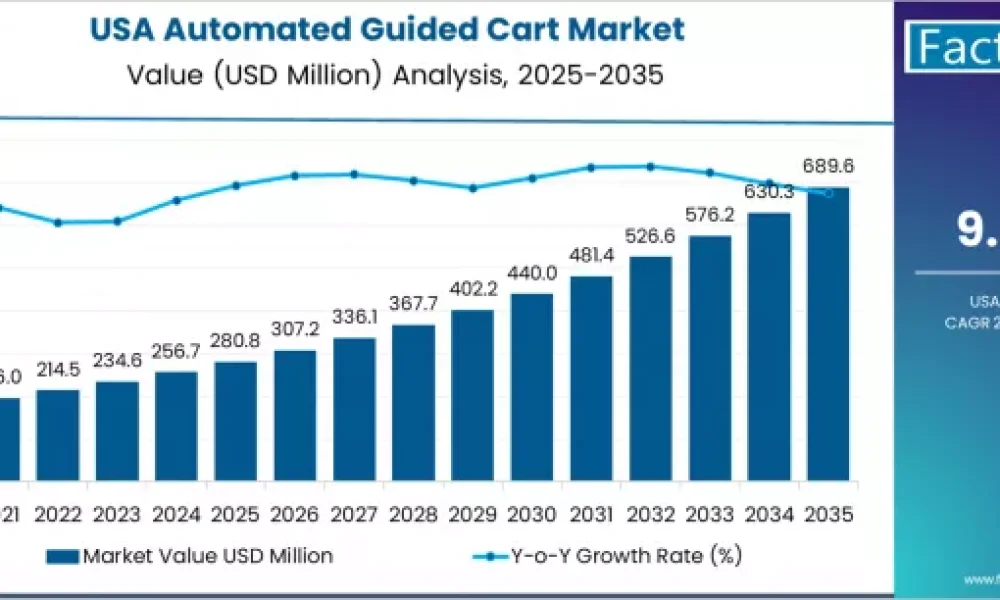
2025 Market Value (USA): USD 280.8 million.
2035 Forecast Market Value (USA): USD 689.6 million.
Absolute Growth (2025–2035): ≈ USD 414.8 million.
Forecast CAGR (2025–2035): ~9.4%.
Leading Navigation Tech (2025): QR/Vision — ~48.2% share.
Top End-Use (2025): Automotive sector — ~41.3% share.
To access the complete data tables and in-depth insights, request a Discount On The Report here: https://www.factmr.com/connectus/sample?flag=S&rep_id=12296
Key Market Drivers
1. Need for Flexible, Low-Cost Automation
AGCs provide targeted automation without the footprint or capital of fixed conveyors or heavy AGVs.
Quick redeployment and plug-and-play integration suit seasonal facilities and contract manufacturers.
2. Proliferation of QR/Vision Navigation
QR/vision navigation systems reduce infrastructure changes (no floor wiring or magnetic tape) and speed installation.
Accuracy and obstacle handling improvements make AGCs safe for mixed human/robot environments.
3. Automotive & Tier-1 Manufacturing Demand
High repeatability, part-feeding, and in-plant logistics needs in automotive plants drive significant AGC adoption.
AGCs are used in sequenced part delivery, kitting, and just-in-time workflows.
4. E-commerce & Light-Manufacturing Growth
Last-mile fulfilment within big warehouses and micro-fulfilment centres uses AGCs for sortation, replenishment, and returns handling.
SMEs adopt AGCs to automate without committing to large, fixed automation projects.
5. Lower Total Cost of Ownership (TCO)
Improvements in battery life, modular charging, and remote diagnostics reduce downtime and operating expense versus older vehicles.
Market Structure & Segment Insights
By Navigation Technology
QR/Vision (dominant): Best balance of cost, flexibility, and accuracy.
Laser/SLAM: Favoured where mapping and dynamic rerouting are priorities.
Magnetic/Inductive: Legacy sites and heavy-duty payloads still employ these proven systems.
By Payload Class
≤500 kg (most common): Optimal for material reels, kitted parts, and small totes.
500–1000 kg: Used in heavier kitting and short-haul pallet movements.
>1000 kg: Niche for industrial floor transport where AGVs traditionally dominated.
By End-User
Automotive & Tier-1 Suppliers (largest): High reuse value for in-plant logistics.
Electronics & Medical Devices: Precision, cleanliness, and flexibility requirements promote AGC uptake.
E-commerce & Retail Fulfilment: Small payload agility and dense SKU environments favour AGCs.
Food & Cold Chain: Battery and hygiene improvements increasingly make AGCs viable here.
Regional Dynamics (within the USA)
Highest adoption in the Midwest (automotive clusters), Southeast (manufacturing & fulfilment growth), and West Coast (tech and e-commerce hubs).
Growth corridors follow logistics investment, reshoring of manufacturing, and rise of micro-fulfilment facilities in urban markets.
Challenges & Constraints
Integration Complexity: Legacy systems integration, safety fencing changes, and IT interoperability can slow rollouts.
Skilled Workforce Needs: Technicians for fleet management and system tuning are in demand.
Capital Planning: While TCO is attractive, initial procurement and pilot costs remain a hurdle for some SMEs.
Standardization: Varying vendor protocols complicate multi-vendor fleet orchestration.
Opportunities & Strategic Moves
Fleet as a Service (FaaS): Rental/managed fleets lower entry barriers and accelerate adoption for small users.
Hybrid Solutions: Combine AGCs with fixed conveyors and AMRs for optimized material flows.
Software & Orchestration: Vendors offering cloud-based fleet management, predictive maintenance, and analytics create recurring revenue streams.
Payload & Application Innovation: Design AGCs for specialized tasks (tote picking, cold storage) to enter new verticals.
Outlook
With projected growth from USD 280.8 million in 2025 to USD 689.6 million by 2035 and a ~9.4% CAGR, the U.S. automated guided cart market will more than double by 2035. Adoption will accelerate where flexible navigation (QR/vision), attractive TCO, and the need for quick redeployable automation intersect — notably in automotive, e-commerce, and light manufacturing. Suppliers that pair reliable hardware with strong software orchestration, managed services, and verticalized solutions will capture the largest share of this expanding market.
Have specific requirements or need assistance on report pricing or have a limited budget? Please contact [email protected]
About Fact.MR:
Fact.MR is a global market research and consulting firm, trusted by Fortune 500 companies and emerging businesses for reliable insights and strategic intelligence. With a presence across the U.S., UK, India, and Dubai, we deliver data-driven research and tailored consulting solutions across 30+ industries and 1,000+ markets. Backed by deep expertise and advanced analytics, Fact.MR helps organizations uncover opportunities, reduce risks, and make informed decisions for sustainable growth.



