
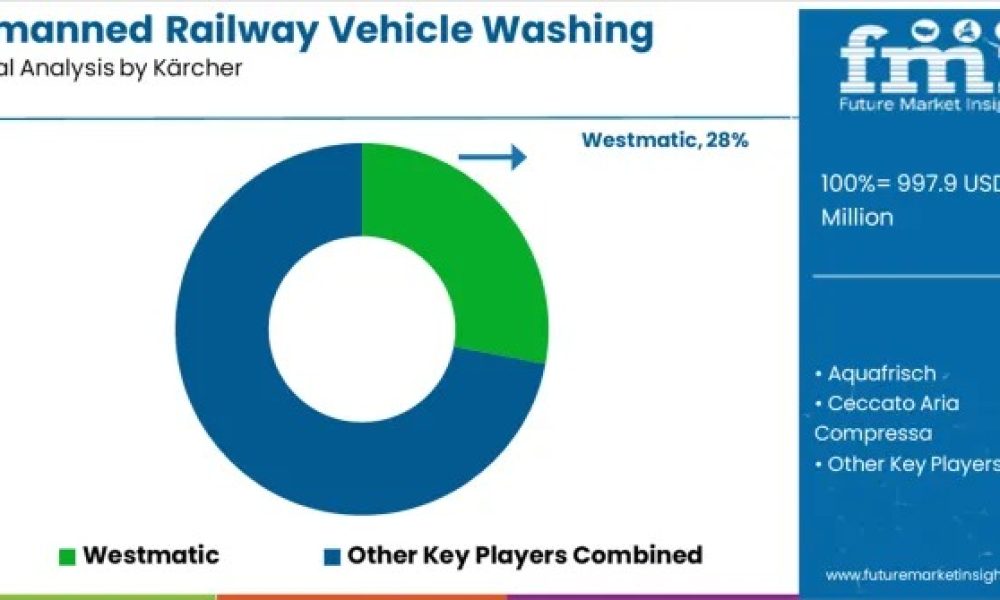
The global unmanned railway vehicle washing systems market is poised for a decade of significant expansion, with market value projected to increase from USD 997.9 million in 2025 to USD 1,890.9 million by 2035, reflecting a robust compound annual growth rate (CAGR) of 6.6%. This growth trajectory underscores the accelerating adoption of automated cleaning solutions and maintenance technologies across rail operators, transportation authorities, and railway maintenance facilities worldwide.
Market Evolution and Growth Phases
The market is forecast to experience two distinct growth phases over the next decade. Between 2025 and 2030, the market will expand from USD 997.9 million to approximately USD 1,288.6 million, adding USD 290.7 million in value, representing 32.5% of total decade-long growth. This phase is driven by increasing rail network modernization and the adoption of automation programs, with advanced cleaning capabilities and integrated monitoring systems becoming standard expectations.
From 2030 to 2035, the market will enter a rapid expansion stage, growing from USD 1,288.6 million to USD 1,890.9 million, an increase of USD 602.3 million or 67.5% of total growth. This period will witness mass-market penetration of fully integrated automated cleaning platforms, seamless compatibility with existing railway infrastructure, and advanced integration with rail management systems.
Get access to comprehensive data tables and detailed market insights — request your sample report today!
Key Market Drivers
The expansion of unmanned railway vehicle washing systems is underpinned by three primary trends:
- Operational Efficiency Demand – Automated systems deliver consistent cleaning without labor dependency, reducing maintenance costs and enhancing operational performance.
- Railway Modernization Programs – Governments and transportation authorities are increasingly implementing advanced automated systems to complement traditional maintenance methods and ensure fleet cleanliness.
- Infrastructure Enhancement – Metro operators and rail companies require effective cleaning solutions that minimize errors while maintaining fleet appearance quality across complex operations.
Segmental Insights
- System Type: Stationary washing systems dominate the market, capturing 67.8% share due to high throughput, cost-effective implementation, and integration capabilities with depot operations.
- Application: Subway vehicle cleaning represents the primary demand segment, accounting for 54.3% of the market. Automated systems are critical for urban transit, metro systems, and underground rail maintenance.
Regional Dynamics
Asia-Pacific leads global market growth, driven by China (8.9% CAGR) and India (8.3% CAGR), where government railway modernization initiatives and high-speed rail development programs fuel adoption. North America and Europe maintain steady expansion, with Germany (7.6% CAGR), Brazil (6.9%), and the USA (6.3%) demonstrating strong market performance through advanced maintenance automation and urban transit investments. Emerging European markets, including the UK (5.6%) and Japan (5.0%), are showing consistent adoption through technology integration and specialized railway applications.
Country Highlights:
- China: Aggressive railway modernization and domestic production of cost-effective unmanned washing systems position China as a global leader.
- India: Urban metro expansion and transportation modernization programs drive significant adoption in New Delhi, Mumbai, and Bangalore.
- Germany: Premium installations and integration with EU railway standards maintain the country’s technology leadership.
- Brazil & USA: Diverse transportation needs and modernization programs support strong market growth and adoption of advanced unmanned washing systems.
Competitive Landscape
The global market is moderately concentrated, with approximately 15-18 key participants controlling 58-63% of the market. Leading companies, including Kärcher, Westmatic, Aquafrisch, Ceccato Aria Compressa, and Cristanini, maintain dominance through advanced cleaning technologies, global transportation networks, and system integration expertise. Technology challengers such as Istobal, Favagrossa, NERTA, Train-Wash Systems Ltd, and B.I.C. GmbH compete through specialized railway solutions and innovation-driven differentiation.
Future Opportunities
The unmanned railway vehicle washing systems market presents multiple growth pathways:
- Advanced Technology Integration: Predictive maintenance, IoT monitoring, and automated quality control expand market reach.
- Mobile & Flexible Solutions: Deployment across multiple depots and temporary installations enhances operational flexibility.
- Environmental Compliance: Water recycling and eco-friendly cleaning systems address regulatory requirements while reducing operational costs.
- High-Speed & Urban Transit Applications: Expansion beyond subway vehicles to bullet trains, light rail, and freight operations.
Conclusion
As railway operators globally prioritize operational efficiency, maintenance automation, and fleet management, unmanned washing systems are transitioning from optional equipment to mission-critical infrastructure. With advanced cleaning algorithms, seamless system integration, and compliance with evolving railway standards, these systems are set to redefine fleet maintenance operations and deliver measurable operational, financial, and environmental benefits.
About Future Market Insights (FMI)
Future Market Insights, Inc. (FMI) is an ESOMAR-certified, ISO 9001:2015 market research and consulting organization, trusted by Fortune 500 clients and global enterprises. With operations in the U.S., UK, India, and Dubai, FMI provides data-backed insights and strategic intelligence across 30+ industries and 1200 markets worldwide.



