
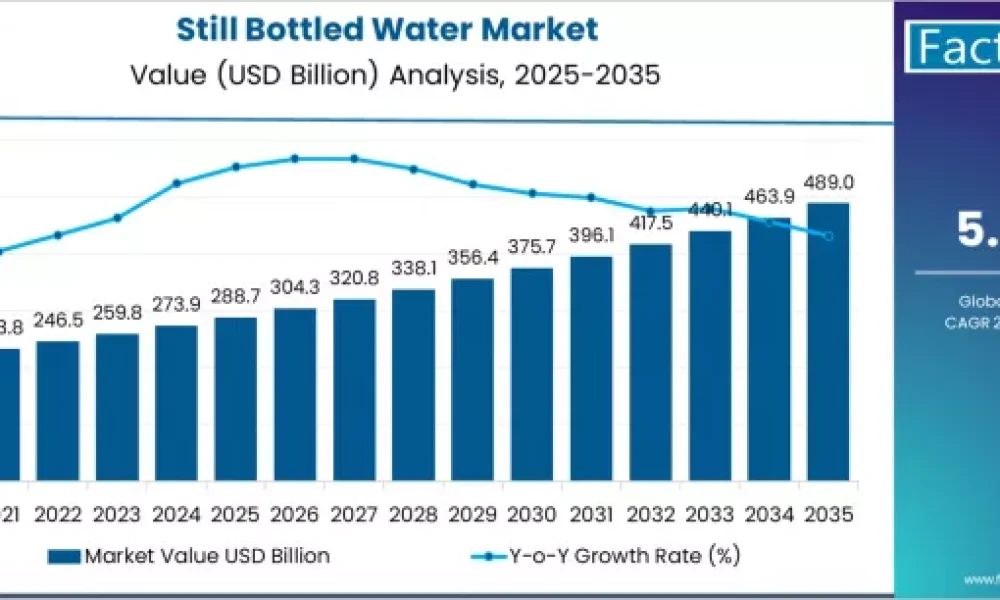
The still bottled water market is projected to grow from an estimated USD 288.7 billion in 2025 to about USD 489.0 billion by 2035, reflecting a compound annual growth rate (CAGR) of approximately 5.4%.
This growth indicates a nearly one‑and‑a‑half times increase in market value over the next decade, driven by rising global demand for safe hydration, increasing urbanization, rising health and wellness awareness, and ongoing demand for convenient, on‑the‑go beverage formats.
Key Market Highlights (2025 baseline)
2025 Market Value: ~ USD 288.7 billion
2035 Forecast Value: ~ USD 489.0 billion
Forecast CAGR (2025–2035): ~ 5.4%
Dominant Bottle Size Segment: 0.5–1.0 L bottles (approximately 56.0% share)
Leading Bottle Type (Packaging): PET bottles, accounting for roughly 70.0% share of the bottle‑type segment in 2025
Primary Distribution Channel: Off‑trade (retail grocery, supermarkets, convenience stores) — around 80% share, reflecting household buying and retail-driven consumption
Geographically, major markets such as North America, Europe, and Asia Pacific continue to lead in demand, with Asia Pacific showing strong growth potential given urbanization trends and rising purchasing power.
To access the complete data tables and in-depth insights, request a Discount On The Report here: https://www.factmr.com/connectus/sample?flag=S&rep_id=11885
Growth Drivers & Market Forces
Rising Health & Wellness Awareness
Consumers worldwide are increasingly conscious about hydration, health, and avoiding sugary or processed beverages. Still bottled water — being calorie‑free, safe, and convenient — benefits as a default hydration choice. Functional or enhanced water variants (e.g., mineral-enhanced, enriched waters) often further attract health-focused consumers.
Urbanization & On-the-Go Lifestyles
Modern, urban lifestyles — characterized by travel, commuting, outdoor activities, work, and busy schedules — create strong demand for portable, single-serve bottled water formats. The 0.5–1.0 L bottle size meets the needs of convenience, portability, and easy consumption.
As retail and modern-trade infrastructure expands globally, bottled water becomes increasingly accessible even in emerging markets, fueling uptake.
Tap-Water Quality Concerns & Reliability Needs
In many regions — especially those with inconsistent tap water quality or unreliable supply — still bottled water offers a dependable alternative. Assurance of purity, filtration, and safety makes bottled water the preferred choice in households, workplaces, and institutions demanding consistent hygiene standards.
Packaging & Distribution Efficiencies
Lightweight PET bottles dominate due to manufacturing efficiency, low transport cost, durability, and consumer convenience. Retailers and supermarkets — via off-trade channels — constitute the backbone of distribution: allowing for mass-market penetration, multi-pack sales, and bulk household consumption.
Challenges & Market Constraints
Environmental and Sustainability Concerns
A major headwind for the bottled water market is growing global concern about single-use plastics, packaging waste, and environmental impact. Consumers and regulators increasingly demand recycling, use of recycled materials, or alternative packaging formats.
Additionally, rising costs associated with sustainable packaging, recycling infrastructure, and compliance with environmental regulations may raise production costs — potentially affecting price-sensitive segments.
Competition from Alternative Hydration Solutions
In regions with safe municipal water supply or widespread access to filtration systems, bottled water competes with tap water, filtered water at home, and reusable-bottle usage. As awareness about environmental sustainability grows, consumers may shift toward refillable bottles and water purifiers — reducing reliance on single-use bottled water.
Cost Sensitivity and Economic Pressures
Higher costs of packaging (PET or sustainable alternatives), transportation, and regulatory compliance can increase retail prices. In price-sensitive markets, this may limit adoption or push consumers toward alternative water sources.
Market Saturation in Developed Regions
In mature markets (North America, Europe), growth may slow as bottled-water penetration is already high. Long-term growth in those regions may depend on premiumization (mineral water, enhanced water, specialty water), packaging innovations, and differentiation rather than mass-market expansion.
Strategic Outlook & Recommendations
Focus on Sustainable Packaging & Recycling Initiatives
Given environmental pressure, bottled water companies should invest in recycled PET (rPET), biodegradable packaging, bottle-return schemes, and renewable-material bottles. This will help align with consumer expectations and regulatory trends, while preserving brand image.
Expand Premium & Functional Water Segments
To sustain growth in mature markets, companies should emphasize mineral, spring, alkaline, and value-added water lines — targeting health-conscious, premium-oriented consumers. Product differentiation through source branding, filtration claims, mineral content transparency, and taste quality can drive higher margins.
Leverage Urbanization & Emerging Markets
Growth potential remains strong in emerging economies undergoing urbanization, with expanding retail infrastructure and rising disposable incomes. Targeting these regions — combining affordability and convenience — can drive volume growth.
Strengthen Distribution and On-the-Go Formats
Convenient bottle sizes (0.5–1.0 L), single-serve offerings, multipacks, and strong off-trade retail distribution should remain a focus. Collaboration with supermarkets, convenience stores, vending networks, and e-commerce channels can maximize market penetration.
Engage in Consumer Education & Transparency
Transparency about water source, purity standards, environmental impacts, and packaging recyclability can build trust and customer loyalty. Education campaigns emphasizing hydration benefits, safety, and sustainability can help address perceptions and differentiate products.
Market Outlook to 2035
The still bottled water market is set for sustained global growth through 2035, with market size forecast to reach roughly USD 489.0 billion. Growth will be driven by rising health awareness, urban lifestyles, convenient consumption demands, and expanding access in emerging economies.
However, the extent of growth will also depend heavily on how the industry responds to environmental concerns, packaging sustainability, regulatory pressures, and shifting consumer behaviors toward reusable water solutions. For companies that adapt — by innovating packaging, expanding premium offerings, and embracing sustainability — there remains a strong opportunity to capture both mass-market volume and high-value premium segments.
For stakeholders — producers, distributors, retailers, and policy-makers — still bottled water remains a key category in the global beverage market: flexible, widely consumed, and primed for both steady growth and transformation toward sustainability.
Have specific requirements or need assistance on report pricing or have a limited budget? Please contact [email protected]
About Fact.MR:
Fact.MR is a global market research and consulting firm, trusted by Fortune 500 companies and emerging businesses for reliable insights and strategic intelligence. With a presence across the U.S., UK, India, and Dubai, we deliver data-driven research and tailored consulting solutions across 30+ industries and 1,000+ markets. Backed by deep expertise and advanced analytics, Fact.MR helps organizations uncover opportunities, reduce risks, and make informed decisions for sustainable growth.



