
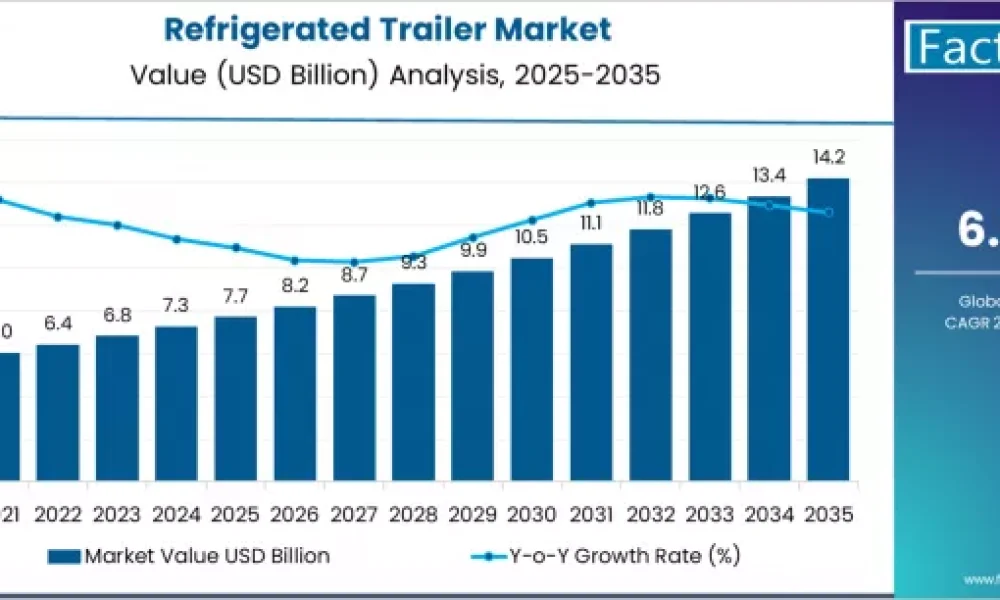
The U.S. refrigerated trailer market is poised for a strong growth trajectory between 2025 and 2035, driven by the rising demand for cold-chain logistics, food safety compliance, and temperature-sensitive cargo transport. Increasing adoption of advanced refrigeration technology and growing requirements for efficient perishable goods transport are fueling market expansion.
Market Outlook & Forecast
The U.S. refrigerated trailer market is projected to grow from approximately USD 7.7 billion in 2025 to around USD 14.2 billion by 2035, reflecting a compound annual growth rate (CAGR) of 6.3% over the forecast period. Growth is primarily fueled by rising demand for temperature-controlled transport in the food and beverage, pharmaceutical, retail, and logistics sectors. Fleet operators are investing in trailers that offer enhanced efficiency, precise temperature control, and compliance with food safety standards.
To access the complete data tables and in-depth insights, request a Discount On The Report here: https://www.factmr.com/connectus/sample?flag=S&rep_id=11687
Key Market Drivers
1. Expansion of Cold-Chain Logistics
Increasing consumption of fresh and frozen foods, as well as temperature-sensitive pharmaceuticals, is driving demand for refrigerated trailers. Logistics providers are upgrading fleets to meet the growing need for reliable cold-chain solutions.
2. Food Safety and Regulatory Compliance
Strict food safety and handling regulations require trailers capable of maintaining precise temperature control. Compliance with these standards helps reduce spoilage, ensure cargo integrity, and maintain traceability throughout the supply chain.
3. Growth of E-Commerce and Direct-to-Consumer Delivery
Rising online grocery shopping, meal-kit subscriptions, and direct-to-consumer delivery services are fueling demand for refrigerated trailers capable of efficient long-haul and last-mile transport.
4. Sustainability and Alternative Power Sources
While diesel-powered refrigerated trailers remain dominant, the market is seeing increasing interest in electric and solar-assisted trailers. These innovations support sustainability initiatives and help fleet operators reduce carbon emissions.
5. Axle Configuration Optimization
Tandem-axle trailers are widely adopted due to their balance of payload capacity, stability, and cost efficiency, accounting for more than half of current market demand.
Market Segmentation and Trends
By Trailer Temperature Type
- Single-Temperature Trailers: Represent the majority of demand due to simplicity and cost-effectiveness.
- Multi-Temperature Trailers: Growing in popularity for mixed cargo shipments, providing flexible temperature zones for different types of perishable goods.
By Power Source
- Diesel-Powered Units: Continue to dominate the market due to established fueling infrastructure.
- Electric-Powered Units: Rapidly emerging to meet sustainability goals.
- Solar-Assisted Units: Increasing adoption as a supplemental energy source for refrigeration.
By Axle Configuration
- Tandem Axle: Most widely used, suitable for high-capacity loads.
- Single Axle: Preferred for lighter loads and flexible maneuverability.
- Triple Axle: Utilized for maximum payload scenarios.
By End-Use Application
- Food & Beverage: The largest segment, driven by perishable goods transport.
- Retail & E-Commerce: Rapidly growing segment fueled by online grocery and meal-kit delivery.
- Pharmaceuticals: Critical for temperature-sensitive drug transport.
- Logistics Services: Reflects the increasing value of refrigerated trailers in broader supply chains.
Competitive Landscape
The U.S. refrigerated trailer market features both established manufacturers and specialized innovators. Companies are competing on technology, refrigeration efficiency, axle configuration, and customization capabilities. Emerging trends include electric refrigeration systems, IoT-enabled temperature monitoring, telematics integration, and smart fleet management.
Challenges and Risks
- High Capital Investment: Advanced refrigerated trailers, particularly electric or solar-assisted units, require substantial upfront costs.
- Energy Efficiency vs. Payload Trade-offs: High-efficiency refrigeration systems may reduce cargo volume or add weight.
- Infrastructure Gaps: Not all regions have the infrastructure to support advanced refrigerated fleets.
- Regulatory Compliance Complexity: Adhering to temperature monitoring and traceability regulations can be operationally challenging.
- Maintenance and Operational Costs: Refrigerated trailers require ongoing maintenance, increasing lifecycle costs.
Strategic Opportunities
- Electrification and Green Refrigeration: Adopting electric and solar-assisted trailers to meet sustainability targets.
- Smart Telematics and IoT Monitoring: Real-time temperature tracking and predictive maintenance to improve efficiency and reduce spoilage.
- Multi-Temperature Trailers: Flexible solutions for transporting mixed cargo types.
- E-Commerce Cold-Chain Expansion: Partnering with grocery and meal-kit services to grow refrigerated fleet usage.
- Regulatory Compliance Services: Offering integrated solutions for temperature validation and digital traceability.
Outlook: 2025–2035
By 2035, the U.S. refrigerated trailer market is expected to become more technologically advanced, with higher adoption of electric-powered, telematics-enabled, and multi-temperature units. Fleet operators will increasingly prioritize sustainability, cargo integrity, and regulatory compliance, while innovations in insulation, refrigeration efficiency, and IoT monitoring will optimize operational performance.
The market will play a strategic role in modernizing cold-chain logistics in the U.S., supporting the safe and efficient transport of perishable goods across food, pharmaceutical, and retail sectors.
Have a specific Requirements and Need Assistant on Report Pricing or Limited Budget please contact us – [email protected]
To View Related Report :



