
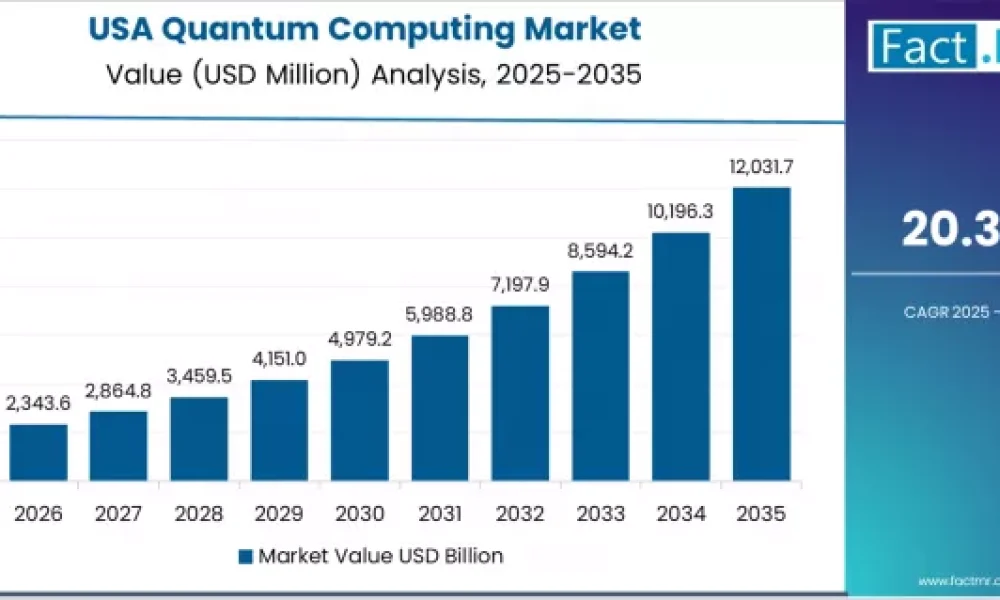
The U.S. quantum computing industry is poised for a decade of rapid growth between 2025 and 2035, driven by strong investment, maturing technology, and rising adoption across enterprise and government sectors. As quantum hardware, software, and services converge, the U.S. market is expected to become a global hub for quantum innovation and commercialization.
Market Outlook & Forecast
The U.S. quantum computing market is projected to grow from just over USD 1 billion in 2024 to approximately USD 10 billion by 2035, reflecting a strong compound annual growth rate (CAGR) of about 23%. Cloud-based quantum computing services are expected to see particularly rapid adoption, expanding from roughly USD 90 million in 2024 to USD 1.6 billion by 2035. The growth reflects both the commercial potential of quantum computing and the increasing strategic importance of quantum technologies across industries.
The market growth is primarily driven by the rising adoption of quantum computing for enterprise optimization, simulation, and cryptography, along with increasing investments in both hardware and software development. The maturity of quantum technology and the availability of quantum-as-a-service (QCaaS) platforms are expected to significantly lower barriers to entry, encouraging more companies to experiment with quantum solutions.
To access the complete data tables and in-depth insights, request a Discount On The Report here: https://www.factmr.com/connectus/sample?flag=S&rep_id=11674
Key Market Drivers
1. Significant Public and Private Investment
The U.S. government is heavily investing in quantum research, commercialization programs, and infrastructure. Federal initiatives are complemented by venture capital and private-sector investment targeting hardware, software, and quantum cloud services, creating a robust ecosystem for innovation.
2. Enterprise Demand for Quantum Advantage
Large enterprises in finance, logistics, pharmaceuticals, and materials science are increasingly seeking quantum computing solutions for complex problem-solving. Quantum computing enables faster optimization, better simulations, and enhanced predictive analytics, offering a competitive advantage.
3. Advancements in Quantum Hardware
Progress in qubit technologies—including superconducting qubits, trapped ions, and other architectures—is improving performance in terms of coherence times, error rates, and scalability. These technological advancements make quantum hardware more viable for commercial applications.
4. Growth of Quantum-as-a-Service
Cloud-based quantum platforms provide access to quantum processors without requiring companies to invest in expensive on-premises infrastructure. This model allows enterprises to experiment with quantum algorithms and develop proof-of-concept applications efficiently.
5. Strategic Applications
High-value use cases such as optimization for logistics and finance, molecular simulation in pharmaceuticals, and quantum-safe cryptography are driving the demand for quantum computing. Enterprises increasingly recognize quantum computing as a tool for solving problems beyond the capability of classical systems.
6. Ecosystem and Talent Development
The U.S. benefits from a well-established ecosystem of national laboratories, academic institutions, startups, and technology giants. This ecosystem promotes collaboration, research translation, and workforce development, further supporting market growth.
Market Segmentation & Trends
- By Component
- Hardware: Quantum processors, qubit control systems, quantum communication devices.
- Software: Quantum development frameworks, algorithms, and error correction platforms.
- Services: Quantum consulting, cloud services, system integration, and training.
- By Deployment
- On-Premises: Preferred for high-security applications and national labs.
- Cloud-Based: The fastest-growing deployment model due to flexibility and lower upfront costs.
- By Technology
- Superconducting Qubits
- Trapped Ion Systems
- Quantum Annealing
- Other Emerging Architectures
- By Application
- Optimization & Scheduling
- Simulation & Modelling
- Machine Learning & AI
- Cryptography & Quantum-Safe Security
- By End-User Industry
- Financial Services for risk analysis and optimization
- Pharmaceuticals & Life Sciences for drug and molecular simulation
- Materials & Chemistry for novel materials development
- Energy & Logistics for supply-chain and grid optimization
- Government & Defense for cryptography and secure communications
Competitive Landscape
The U.S. quantum computing market is highly competitive, with established tech giants, specialized quantum hardware firms, and software startups. Companies are differentiating themselves through innovation, hybrid quantum-classical solutions, error mitigation technologies, and end-to-end service offerings. Collaboration among industry players and research institutions is also helping accelerate the commercialization of quantum technologies.
Challenges & Risks
Despite the strong growth outlook, several challenges remain:
- Technical Barriers – Quantum systems still face significant issues including qubit errors, coherence limitations, and scalability challenges.
- High Cost of Deployment – On-premises quantum systems require specialized infrastructure, including cryogenics and precision controls, which entail substantial investment.
- Adoption Risk – Many enterprises are still in the experimental stage, and scaling proof-of-concept projects into production solutions may take longer than anticipated.
- Talent Shortages – A limited pool of quantum physicists, algorithm developers, and engineers creates hiring challenges.
- Regulatory and Security Concerns – Quantum cryptography, secure communications, and national security considerations will increase scrutiny and compliance requirements.
Strategic Opportunities
- Scaling Cloud Quantum Services – Expanding QCaaS adoption to enterprises across sectors.
- Fault-Tolerant and Error-Corrected Computing – Investing in advanced error correction to unlock broader applications.
- Hybrid Quantum-Classical Models – Integrating quantum systems with classical computing infrastructure for optimized performance.
- Quantum Security Solutions – Implementing quantum-safe cryptography to secure sensitive data.
- Ecosystem Partnerships – Collaborations among startups, academia, government, and corporations to commercialize breakthroughs.
- Talent Development – Expanding education and reskilling programs to build a skilled workforce.
Market Outlook: 2025–2035
By 2035, the U.S. quantum computing market is expected to be a mature, multi-billion-dollar sector, with cloud services widely accessible and on-premises systems deployed for sensitive, high-value applications. Optimization, simulation, and cryptography use cases will drive real-world business impact across multiple industries, from finance and energy to pharmaceuticals and national security.
The ecosystem of hardware developers, software innovators, service integrators, and academic institutions will establish the U.S. as a global leader in quantum technologies. Continued investment in R&D, infrastructure, and workforce development will ensure that the U.S. quantum computing market not only grows in size but also in technological sophistication, setting the stage for the next era of computing innovation.
Have a specific Requirements and Need Assistant on Report Pricing or Limited Budget please contact us – [email protected]
To View Related Report :



