
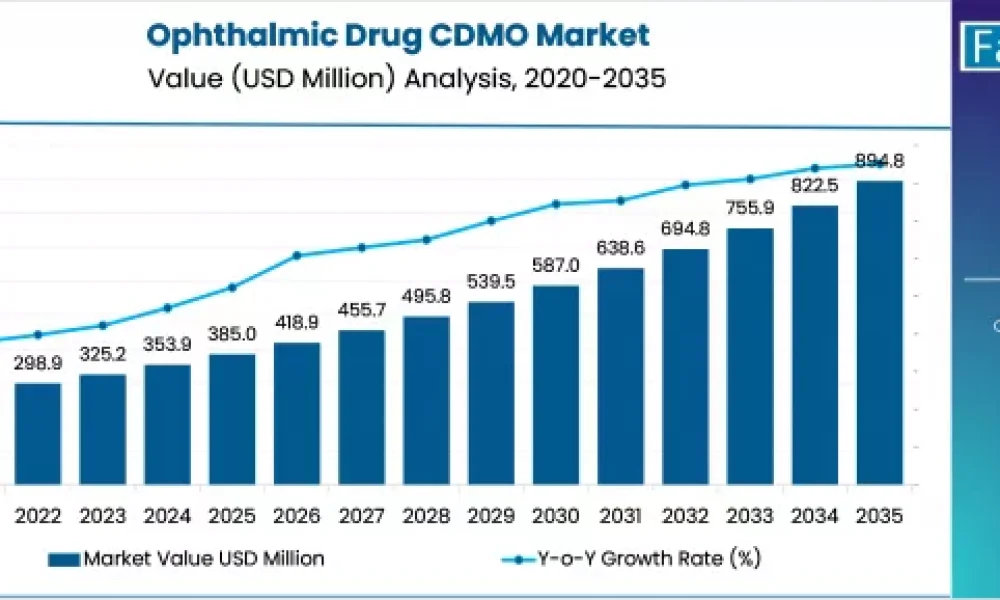
The ophthalmic drug contract development and manufacturing organization (CDMO) market is set to experience strong expansion over the next decade, driven by increasing outsourcing in pharmaceutical development, advanced manufacturing needs, and rapid growth in eye-care drug research. The market is projected to grow from USD 385.0 million in 2025 to USD 894.8 million by 2035, reflecting a compound annual growth rate (CAGR) of 8.8%.
Key Market Highlights
2025 Market Size: USD 385.0 million
2035 Forecast Value: USD 894.8 million
Projected CAGR (2025–2035): 8.8%
Dominant Service Type: Manufacturing (about 52% share)
Primary End User: Pharmaceutical companies (leading application)
Core Regions for Growth: North America, Europe, and Asia-Pacific
Major Players: Catalent Inc., Recipharm AB, Siegfried Holding, Piramal Pharma Solutions, Thermo Fisher Scientific
To access the complete data tables and in-depth insights, request a Discount On The Report here: https://www.factmr.com/connectus/sample?flag=S&rep_id=11165
Major Drivers Fueling Market Growth
Increasing Outsourcing in Ophthalmic Drug Development
Pharmaceutical firms are increasingly partnering with CDMOs to outsource specialized manufacturing and formulation tasks. Rather than building in-house capacity, companies are leveraging expert external firms to streamline production, reduce costs, and accelerate time to market.Growing Investment in Ophthalmic Biologics & Advanced Therapies
The rise of biologic therapies, gene therapies, and complex formulations for eye diseases is pushing demand for CDMOs that offer high-precision manufacturing, sterile production environments, and regulatory know-how.Regulatory Complexity and Quality Demands
Ophthalmic drugs require very stringent quality controls, given the sensitivity of ocular administration. CDMOs that provide analytical, regulatory, and validation capabilities are becoming vital partners for pharmaceutical companies.Rising Prevalence of Eye Disorders
With increasing prevalence of eye conditions (such as glaucoma, macular degeneration, diabetic retinopathy, and dry eye), pharmaceutical companies are accelerating R&D programs in the ophthalmic space — driving demand for specialized CDMO services.Technological Maturation of CDMO Platforms
CDMOs are increasingly integrating advanced technologies like automated manufacturing, in-line analytics, and small-batch capabilities. This helps them meet the unique demands of ophthalmic drug production while keeping operational costs competitive.
Market Segmentation Overview
By Service Type:
Manufacturing Services: Approximately 52% share, driven by high demand for sterile production, ophthalmic dosage forms, and fill-finish capabilities.
Formulation Development & Analytical Services: Expected to grow as more pharma companies outsource the early stages of drug development and stability testing.
By End User:
Pharmaceutical Companies: The leading customer segment, accounting for about 67% of demand.
Biotechnology Firms & Research Organizations: Also significant, especially for preclinical and early clinical-stage programs.
By Geography:
North America: Dominant market due to mature pharma infrastructure and strong CDMO ecosystems.
Europe: High demand driven by biotech innovation, regulation, and outsourcing.
Asia-Pacific: Rapid growth, fueled by increasing research & development activity and adoption of contract manufacturing.
Challenges & Market Risks
High Capital Requirements: Establishing sterile ophthalmic manufacturing facilities is expensive, which may deter smaller CDMOs or new entrants.
Regulatory Hurdles: Ensuring compliance with ocular safety, sterility, and regulatory norms increases complexity and cost.
Supply Chain Risks: Sourcing specialized raw materials for ophthalmic formulations can be challenging, especially for niche or biologic products.
Long Development Cycles: Ophthalmic therapies often go through prolonged development and require rigorous stability testing, which can lengthen timelines and impact CDMO utilization.
Competitive Landscape
The ophthalmic CDMO market is moderately concentrated, with a number of firms leading through advanced capabilities:
Catalent, Recipharm, Siegfried, Piramal, and Thermo Fisher are among the top players, leveraging broad service portfolios and global reach.
These companies are investing heavily in automated manufacturing, regulatory expertise, sterile facilities, and in-house analytical capabilities to provide comprehensive end-to-end services.
Many are forming strategic partnerships with biotechs focused on ophthalmic therapies, helping to co-develop products and scale up manufacturing.
Strategic Recommendations
Scale Up Sterile Manufacturing Capacity
CDMOs should invest in expanding their aseptic fill-finish lines, cleanrooms, and small-batch production to meet growing ophthalmic demand.Strengthen Early-Stage Service Offering
Offering formulation development, stability testing, and regulatory consulting can help CDMOs capture clients early in the drug development cycle.Form Partnerships with Biotech Innovators
Collaborations with biotech firms working on gene therapies, biologics, and novel ophthalmic molecules can lead to long-term, high-value contracts.Improve Regulatory Compliance
Building expertise in global regulatory frameworks (e.g., FDA, EMA, PMDA) is critical, given the stringent standards for ocular drugs.Expand Geographic Reach
Target emerging markets in Asia-Pacific by investing in local facilities or partnerships, to leverage lower production costs and rising regional R&D activity.
Market Outlook
Over the next decade, the ophthalmic drug CDMO market is expected to transform significantly. The projected growth from USD 385.0 million in 2025 to USD 894.8 million by 2035 underscores a structural shift toward specialized, outsourced ophthalmic manufacturing. As pharmaceutical companies increasingly rely on CDMOs for both early development and commercial-scale production, providers with strong regulatory expertise, manufacturing capabilities, and development platforms will be well positioned to lead.
The market’s future will be defined by innovation, reliability, and partnership — with CDMOs playing a pivotal role in delivering next-generation therapies for eye diseases with high unmet need.
Have specific requirements or need assistance on report pricing or have a limited budget? Please contact [email protected]
About Fact.MR:
Fact.MR is a global market research and consulting firm, trusted by Fortune 500 companies and emerging businesses for reliable insights and strategic intelligence. With a presence across the U.S., UK, India, and Dubai, we deliver data-driven research and tailored consulting solutions across 30+ industries and 1,000+ markets. Backed by deep expertise and advanced analytics, Fact.MR helps organizations uncover opportunities, reduce risks, and make informed decisions for sustainable growth.



