
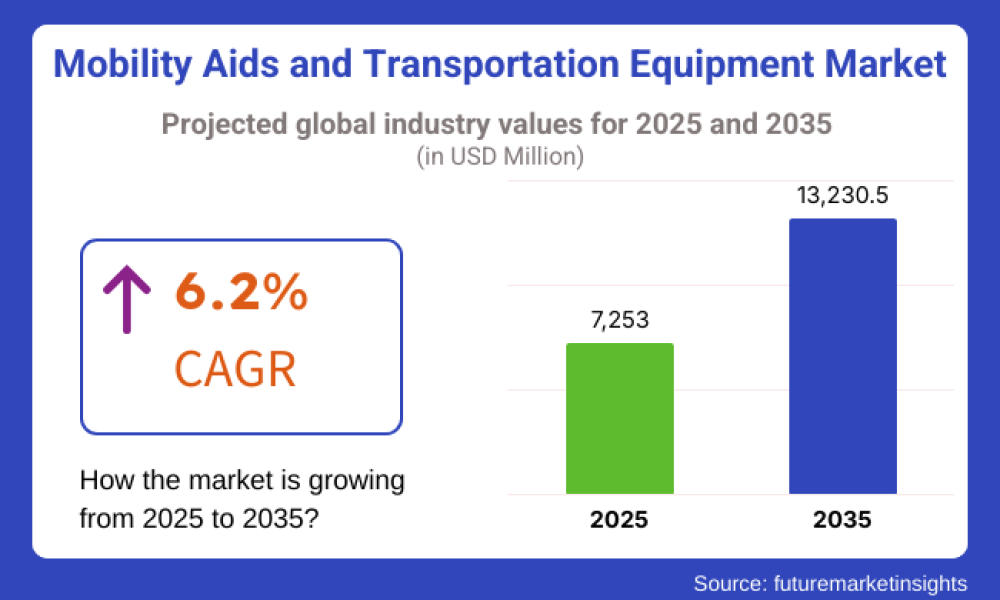
The U.S. Mobility Aids And Transportation Equipment Market is on track to rise from USD 7,253.0 million in 2025 to USD 13,230.5 million by 2035, growing at a CAGR of 6.2%. As mobility technologies advance and government initiatives expand disability support, demand for accessible, lightweight, and intelligent devices continues to accelerate across the country. Innovations such as foldable smart wheelchairs and automated mobility systems are reshaping user experience and strengthening market momentum.
Explore trends before investing – request a sample report today!
https://www.futuremarketinsights.com/reports/sample/rep-gb-809
Technology Adoption and Aging Population Push Market Growth Forward
A rapidly expanding elderly population, rising chronic disease burden, and strong acceptance of digital mobility solutions continue to drive U.S. market performance. The U.S. is witnessing an influx of AI-powered assistive devices—smart wheelchairs, mobility scooters, and customizable transport equipment—designed to make movement safer, more efficient, and more personalized. Lightweight, compact, and energy-efficient product designs are contributing to increased demand across both healthcare institutions and home-care settings.
Wheelchairs and Mobility Scooters Remain Top-Selling Segments
Wheelchairs represent the largest share of product demand in the U.S., supported by robust healthcare infrastructure and favorable reimbursement frameworks. Electric-powered wheelchairs, including AI-enabled models, are becoming mainstream due to improved navigation, battery efficiency, and ergonomic design. Likewise, mobility scooters are gaining traction among older adults seeking independence and enhanced outdoor mobility. Luxury, long-range, and foldable scooters are among the fastest-growing categories.
Institutional Buyers Lead, but Retail Demand Is Rising
Institutional sales—including hospitals, long-term rehabilitation centers, and nursing homes—continue to dominate the U.S. market due to sustained device procurement and long-term patient care requirements. Simultaneously, the retail segment is growing as consumers increasingly turn to e-commerce for mobility devices. Personalized features such as app control, ergonomic seating, and customizable frames are improving adoption among home users who seek independence and accessible pricing.
Regional Innovation, Policy Support, and E-Commerce Fuel Market Expansion
The U.S. maintains one of the world’s strongest mobility aid ecosystems due to technological leadership, evolving insurance models, and established accessibility policies like the ADA. Rapid growth in home health services and online sales channels further boosts device availability across age groups. As IoT-enabled features and remote monitoring become standard, mobility aids are transitioning from traditional devices to smart, interactive systems tailored to user needs.
Subscribe for Year-Round Insights → Stay ahead with quarterly and annual data updates –
https://www.futuremarketinsights.com/reports/brochure/rep-gb-809
Challenges: Cost Barriers and Affordability Gaps Remain
Despite strong growth momentum, adoption of advanced mobility solutions faces hurdles. High costs of premium devices limit accessibility for low-income groups, while complex regulatory requirements sometimes delay product approvals. Insurance limitations and uneven distribution networks also restrict penetration in underserved regions. However, expanding telehealth, rising disability awareness, and government-supported innovation are expected to gradually narrow these gaps in the coming decade.
Opportunities: Smart Mobility, Eco-Friendly Designs, and AI Integration
A significant transformation is underway as consumers shift toward light, foldable, and AI-powered devices with smart navigation and remote monitoring. Smart wearables and exoskeletons are emerging, offering higher independence to users with limited mobility. Meanwhile, sustainability trends are driving interest in solar-powered scooters, energy-efficient electric wheelchairs, and biodegradable components—reflecting a broader shift toward greener medical mobility solutions across the U.S.
Brief Market Snapshot and Growth Path Ahead
With the market set to nearly double from USD 7,253.0 million in 2025 to USD 13,230.5 million in 2035, innovation will be the defining force in U.S. mobility aids. Aging demographics, increased disability prevalence, and demand for independence will continue to shape the next decade. Smart mobility products, sustainability-focused designs, and enhanced accessibility policies will play central roles in accelerating nationwide adoption.
Why Choose FMI Empowering Decisions that Drive Real-World Outcomes:- https://www.futuremarketinsights.com/why-fmi
About Future Market Insights (FMI)
Future Market Insights, Inc. (ESOMAR certified, recipient of the Stevie Award, and a member of the Greater New York Chamber of Commerce) offers profound insights into the driving factors that are boosting demand in the market. FMI stands as the leading global provider of market intelligence, advisory services, consulting, and events for the Packaging, Food and Beverage, Consumer Technology, Healthcare, Industrial, and Chemicals markets. With a vast team of over 400 analystsworldwide, FMI provides global, regional, and local expertise on diverse domains and industry trends across more than 110 countries.
Contact Us:
Future Market Insights Inc.
Christiana Corporate, 200 Continental Drive,
Suite 401, Newark, Delaware – 19713, USA
T: +1-347-918-3531
For Sales Enquiries: [email protected]
Website: https://www.futuremarketinsights.com



