
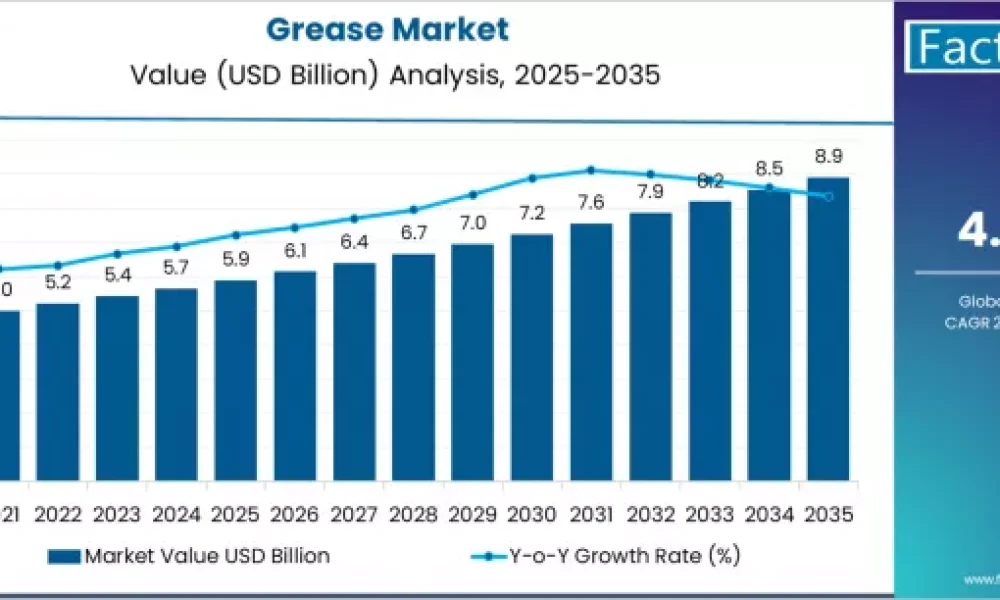
The global grease market is forecast to grow from an estimated USD 5.9 billion in 2025 to around USD 8.9 billion by 2035, registering a compound annual growth rate (CAGR) of ≈ 4.2% through the forecast period. This expansion reflects rising demand from industrial, automotive, construction, and heavy-equipment sectors — where grease remains an essential lubricant for protecting moving parts, reducing friction, and extending equipment service life.
As industries worldwide modernize and maintenance strategies evolve toward predictive and condition-based maintenance, grease consumption is becoming more systematic, stable, and oriented toward high-performance formulations. This trend is transforming grease from a commodity lubricant into a critical consumable tied to reliability, durability, and total cost-of-ownership optimization for machinery and vehicles.
Quick Stats for Grease Market
- Grease Market Value (2025): USD 5.9 billion
- Grease Market Forecast Value (2035): USD 8.9 billion
- Grease Market Forecast CAGR: 4.2%
- Leading Form in Grease Market: Mineral (57.2%)
- Key Growth Regions in Grease Market: Asia Pacific, North America, and Europe
- Top Players in Grease Market: Shell, Chevron, BP, ExxonMobil, TotalEnergies, Fuchs Petrolub, SKF, Idemitsu Kosan, Sinopec, PetroChina
To access the complete data tables and in-depth insights, request a Discount On The Report here: https://www.factmr.com/connectus/sample?flag=S&rep_id=12248
Key Market Drivers
Industrialization & Manufacturing Growth
Expansion of manufacturing capacity, infrastructure projects, construction, and heavy equipment deployments across emerging and developed economies are major drivers for grease demand. Industrial machinery, construction equipment, manufacturing lines, and heavy-duty vehicles require regular lubrication — and grease is often preferred for its sealing properties, lubrication stability, and longevity under load.
Automotive & Transportation Sector Demand
The automotive sector remains one of the largest consumers of grease worldwide. Vehicles require grease for components like bearings, chassis parts, joints, wheel hubs, and more. As global vehicle production continues to rebound and grow — including conventional as well as electric vehicles — lubricant and grease demand follows suit.
Maintenance & Reliability Focus: Total Cost of Ownership (TCO)
Companies increasingly prioritize equipment longevity, uptime, and maintenance efficiency. High-performance greases — including synthetic, lithium-based, or specialty formulations — offer advantages such as extended relubrication intervals, better protection under extreme conditions (heat, pressure, moisture), and improved wear resistance. This is boosting adoption of premium grease products over basic lubricants.
Technological & Formulation Innovation
Advances in grease technology — including improved thickeners, additive packages, synthetic base oils, biodegradable and bio-based greases, and greases optimized for high-temperature or high-speed applications — are broadening the range of potential use-cases. As machinery becomes more advanced and specialized, the demand for tailored grease solutions increases.
Growth in Renewable Energy, Infrastructure & Heavy Machinery
Emerging applications — such as wind turbines, mining equipment, heavy construction, and large-scale industrial machinery — support increased grease consumption. These sectors often demand greases with extreme-pressure resistance, water and dust protection, and long service intervals. As infrastructure development intensifies globally, this segment becomes increasingly significant.
Market Structure & Segment Insights
By Base Oil / Formulation Type
Mineral-based grease remains dominant due to cost efficiency and widespread use.
Synthetic and specialty greases are gaining share steadily, driven by demand for higher performance under extreme conditions, longer maintenance intervals, and environmental regulations.
By Application / End-Use Sector
Industrial sector (manufacturing, heavy machinery, processing plants): A leading segment due to heavy machinery populations and maintenance requirements.
Automotive & Transportation: Includes OEMs and aftermarket segments — significant for vehicles, trucks, construction equipment.
Construction & Infrastructure: Heavy equipment, earth-moving machinery, and construction machinery demand greases that withstand load, dust, and variable environmental conditions.
Specialized & Emerging Sectors: Renewable energy (wind turbines), mining, agriculture, railways, and marine applications — all needing tailored grease solutions.
By Geography / Regional Dynamics
Asia-Pacific: Expected to remain a growth engine, thanks to rising industrialization, expanding automotive production, infrastructure development, and strong manufacturing base.
North America & Europe: Mature markets with emphasis on premium and specialty greases, regulatory compliance, and maintenance optimization. Demand is steady, driven by aftermarket, maintenance, and replacement cycles.
Other Regions (Latin America, Middle East, Africa): Growth largely driven by infrastructure development, mining, agriculture, and industrial expansion.
Challenges & Constraints
Volatility in Raw Material Prices
Grease depends on base oils, thickeners, and additives — many linked to crude oil or petrochemical derivatives. Fluctuations in crude oil or base oil prices can impact production costs and profit margins for grease manufacturers.
Regulatory & Environmental Pressure
Increasing environmental regulations and push toward sustainability may challenge traditional grease formulations, especially those with certain additives. Demand is rising for biodegradable, bio-based, or environmentally friendly greases — which require reformulation and R&D investment.
Competition from Alternative Lubrication Technologies
In some high-tech applications (e.g., electric vehicles, renewable-energy equipment), alternative lubrication strategies — such as solid lubricants, advanced coatings, or greaseless bearing designs — may reduce reliance on traditional greases. Widespread adoption of such alternatives over time could challenge market growth.
Technical Complexity & Specification Requirements
Some applications require highly specific grease performance (e.g., high-temperature resistance, chemical compatibility, extreme pressure, water resistance). Producing and certifying these specialized greases demands R&D investment, quality control, and compliance — which can be challenging for smaller producers or in price-sensitive markets.
Future Outlook & Strategic Implications
Looking toward 2035, the grease market is expected to grow by roughly 1.5× from its 2025 value, expanding from USD 5.9 billion to USD 8.9 billion. This trajectory suggests robust demand across traditional sectors — automotive, manufacturing, construction — along with growing opportunities in emerging and specialized segments such as renewable energy, mining, and heavy-duty industrial machinery.
Strategic priorities for grease manufacturers will likely include:
Investing in specialty and synthetic grease formulations to serve high-performance, high-demand sectors.
Developing bio-based and environmentally safer grease products to comply with increasingly stringent regulations.
Expanding global distribution networks, especially in fast-growing regions.
Collaborating with equipment OEMs to deliver integrated lubrication solutions.
As reliability, efficiency, and sustainability become more essential to industries globally, the grease market will continue evolving — transitioning from basic lubrication to a vital contributor to equipment performance and operational longevity.
Have specific requirements or need assistance on report pricing or have a limited budget? Please contact [email protected]
About Fact.MR:
Fact.MR is a global market research and consulting firm, trusted by Fortune 500 companies and emerging businesses for reliable insights and strategic intelligence. With a presence across the U.S., UK, India, and Dubai, we deliver data-driven research and tailored consulting solutions across 30+ industries and 1,000+ markets. Backed by deep expertise and advanced analytics, Fact.MR helps organizations uncover opportunities, reduce risks, and make informed decisions for sustainable growth.



