
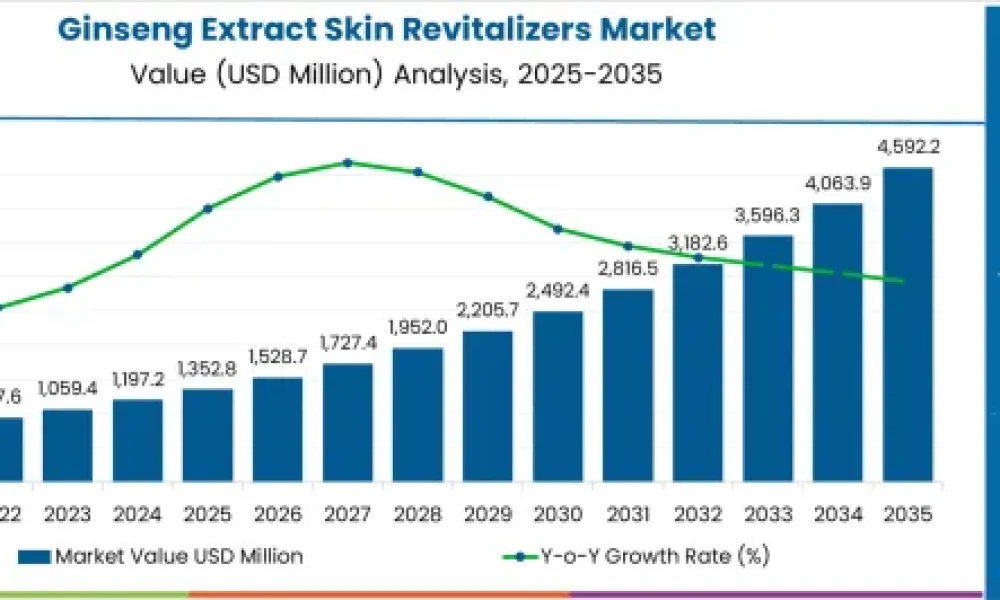
The global Ginseng Extract Skin Revitalizers Market is poised for exceptional growth, expanding from USD 1,352.8 million in 2025 to nearly USD 4,605.3 million by 2035, marking a remarkable 240.6% growth over the forecast period. Fueled by increasing demand for natural, herbal, and traditional skincare solutions, the market is expected to witness a CAGR of 13.0% from 2025 to 2035. The rapid rise in consumer interest in Asian beauty practices and the proven revitalizing benefits of ginseng extract will play a pivotal role in shaping future demand.
Ginseng extract—long valued in Asian traditional medicine for its rejuvenating properties—has become a cornerstone ingredient in modern skincare formulations. From revitalization effects to anti-aging benefits, ginseng-based skin revitalizers are gaining widespread popularity across key markets including Asia Pacific, North America, and Europe. With growing consumer awareness about the efficacy of natural and clean-label skincare products, beauty brands are strengthening their portfolios by integrating scientifically validated traditional ingredients.
Subscribe for Year-Round Insights → Stay ahead with quarterly and annual data updates : https://www.futuremarketinsights.com/reports/sample/rep-gb-25459
Quick Market Highlights (2025–2035)
- Market Size (2025): USD 1,352.8 million
- Projected Market Size (2035): USD 4,592.2 million
- CAGR: 13.0%
- Top Function Segment: Skin revitalization & glow (54.5%)
- Leading Growth Regions: Asia Pacific, North America, Europe
- Key Companies: Sulwhasoo, The Face Shop, Innisfree, Amorepacific, Missha, Nature Republic, Donginbi, Shiseido, Herbivore Botanicals
Key Market Trends Driving Growth
- Rapid adoption of natural skincare: Consumers worldwide are shifting toward herbal and natural ingredients backed by centuries of traditional use.
- Technological advancements in extraction methods: Innovations such as supercritical CO2 and ultrasonic extraction enhance potency and bioavailability of ginsenosides.
- Clean-label and vegan product demand: Transparency, safety, and sustainability are reshaping product development trends.
- Rising influence of K-beauty and Asian skincare: Asian beauty philosophies emphasizing herbal wellness continue to dominate global markets.
Market Value Expansion
Between 2025 and 2030, the market will grow from USD 1,352.8 million to USD 2,496.0 million, contributing 35.2% of the total forecasted growth. This period will be defined by the mainstream adoption of herbal skincare and increased awareness about the rejuvenating benefits of ginseng extract.
From 2030 to 2035, market value will surge further to USD 4,592.2 million, adding USD 2,109.3 million, accounting for 64.8% of the decade’s growth. Enhanced extraction technologies and personalized natural skincare will boost segment expansion.
Segmental Insights
By Function
- Skin revitalization & glow dominates with 54.5% share, driven by ginseng’s strong ability to boost radiance, circulation, and cellular vitality.
- Anti-aging & firming remains a strong secondary segment backed by demand for natural anti-aging solutions.
By Product Type
- Serums hold a commanding 49.5% market share due to their ability to deliver concentrated ginseng extracts efficiently.
- Creams, ampoules, and masks follow as complementary formats gaining popularity across global markets.
By Claim
- Traditional herbal claims (53.5%) lead the market, supported by consumer trust in ancient herbal formulations and cultural authenticity.
By Channel
- E-commerce and specialty Asian beauty stores continue to dominate distribution, enabling global accessibility of ginseng-based skincare.
Regional and Country-Level Outlook
Fastest Growing Countries (CAGR 2025–2035)
- India – 23.3%
- China – 21.5%
- Japan – 18.2%
- UK – 14.7%
- Germany – 11.1%
- USA – 9.8%
India leads global growth due to rising interest in herbal beauty solutions and premium skincare adoption. China’s strong cultural affinity and established ginseng supply chain give it a competitive edge. Japan maintains steady growth through innovation in traditional ingredients and high consumer standards. Europe shows strong clean beauty adoption, while the US reflects mature but consistent growth in natural skincare.
Competitive Landscape
The market is highly competitive, centered around Asian beauty giants and natural skincare innovators. Companies like Sulwhasoo, Innisfree, Amorepacific, and Missha lead with premium ginseng-centered product lines. Traditional ingredient specialists such as Donginbi, alongside Western clean beauty brands like Herbivore Botanicals, continue to diversify offerings and reach global audiences.
Competitive strategies include:
- Investment in high-purity extraction technologies
- Sustainable and traceable sourcing practices
- Expansion of herbal-focused product pipelines
- Strong digital presence and e-commerce integration
Conclusion
The Ginseng Extract Skin Revitalizers Market is set to experience robust expansion through 2035, fueled by rising preference for natural, traditional, and scientifically validated skincare formulas. With increasing consumer trust in herbal beauty solutions and cutting-edge extraction technologies boosting product effectiveness, the market will continue to evolve as a key segment of the global skincare industry.
If you want, I can also create a shorter summary, SEO keywords, or a meta description for this PR.
Have a specific Requirements and Need Assistant on Report Pricing or Limited Budget please contact us – [email protected]
About Future Market Insights (FMI)
Future Market Insights, Inc. (FMI) is an ESOMAR-certified, ISO 9001:2015 market research and consulting organization, trusted by Fortune 500 clients and global enterprises. With operations in the U.S., UK, India, and Dubai, FMI provides data-backed insights and strategic intelligence across 30+ industries and 1200 markets worldwide.



