
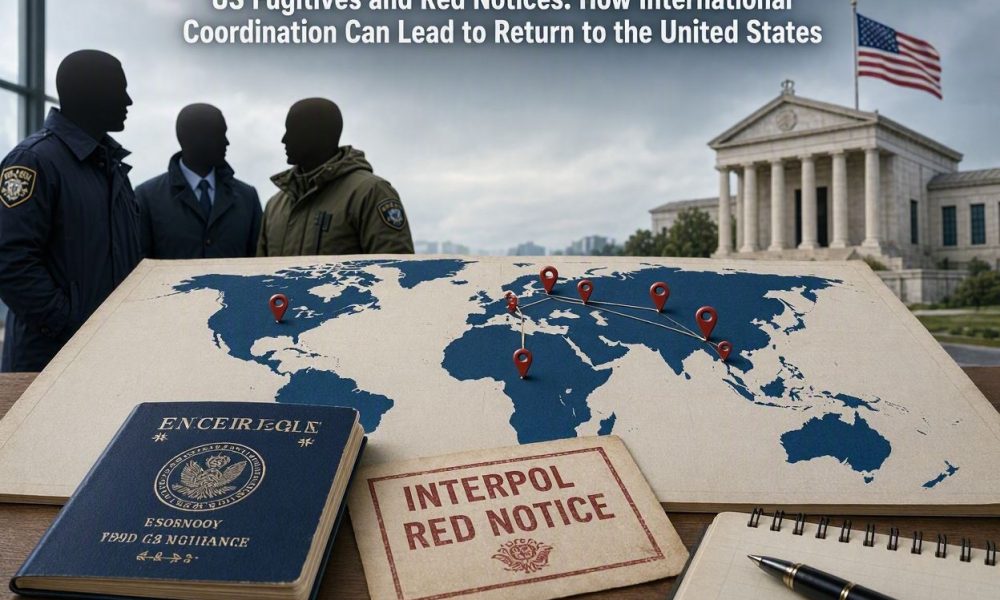
The public overview of the arrest-to-transfer pathway and what it typically involves.
WASHINGTON, August 25, 2026 — When American prosecutors learn that a wanted person has crossed an international border, returning that individual to the United States may require a coordinated chain involving investigators, INTERPOL specialists, foreign police, diplomats, courts, and transfer officers.
An INTERPOL Red Notice can become a crucial link within that chain by alerting authorities worldwide that a person is wanted under a valid national warrant and requesting location and provisional arrest where the receiving country’s law permits.
However, the notice does not operate as a universal arrest warrant, order extradition, determine guilt, or authorize American agents to seize someone inside another country, because each government retains sovereignty over enforcement actions occurring within its territory.
The arrest-to-transfer pathway is therefore a sequence of independent decisions rather than a single international command, and successful returns usually depend upon careful preparation long before a border officer, detective, or immigration official discovers a database match.
The Criminal Case Begins Inside the United States
International coordination ordinarily starts only after a federal or state investigation produces a criminal complaint, indictment, conviction, or comparable judicial proceeding supported by an arrest warrant identifying the person sought by American authorities.
Investigators may discover that a defendant departed after learning about the investigation, failed to appear in court, escaped custody, remained overseas after indictment, or used foreign residence and frequent travel to stay beyond the immediate reach of American officers.
The prosecuting office must preserve evidence and maintain the domestic case while evaluating whether the charges qualify for extradition, because foreign courts will later examine the warrant, alleged conduct, penalties, identity information, and applicable treaty provisions.
Federal prosecutors typically coordinate with the Justice Department’s Office of International Affairs, while state and local authorities generally work through federal channels that can communicate formal requests to foreign governments and prepare treaty-compliant documentation.
This early legal assessment can identify obstacles involving dual criminality, limitation periods, capital punishment, nationality restrictions, prior proceedings, evidentiary standards, or countries where no bilateral extradition treaty provides a conventional route for surrender.
INTERPOL Washington Connects the Agencies
INTERPOL Washington, formally the United States National Central Bureau, serves as the principal communications bridge between American law-enforcement agencies, INTERPOL’s General Secretariat, and National Central Bureaus representing other member countries across the global network.
American authorities can submit information through that bureau seeking international circulation, including names, aliases, birth details, nationality, passport numbers, photographs, fingerprints when available, the domestic warrant, charges, penalties, and a factual summary of alleged conduct.
INTERPOL personnel review a proposed Red Notice against institutional requirements concerning identification, data quality, offense seriousness, international relevance, proportionality, human rights, and the prohibition against intervention of a political, military, religious, or racial character.
Publication makes the alert accessible through secure police channels, although most Red Notices remain restricted to authorized users and never appear publicly, meaning an individual can be flagged internationally without appearing on INTERPOL’s searchable website.
The requesting prosecutor must remain ready to act immediately because a notice can produce an unexpected encounter in any participating jurisdiction, starting a deadline for formal extradition papers that may be measured in weeks rather than months.
How a Fugitive May Be Located Abroad
Wanted people are sometimes identified through major investigations, confidential sources, financial analysis, communications records, or cooperation between specialized fugitive units, but many cases turn upon routine encounters at airports, land borders, hotels, traffic stops, or visa offices.
An airline itinerary, passport scan, fingerprint submission, facial comparison, local criminal arrest, immigration application, or document renewal may cause foreign authorities to compare the person’s information with data circulated through INTERPOL and connected national systems.
Amicus International Consulting’s analysis of biometric exit systems and wanted-person identification explains how modern border screening increasingly combines travel records with facial or biographical matching, creating more opportunities for authorities to identify subjects moving under multiple documents or name variations.
An alert should begin a verification process rather than substitute for one, because officers must confirm the notice remains active, compare physical and documentary identifiers, exclude mistaken identity, and determine whether domestic law authorizes any immediate restraint.
The foreign National Central Bureau may contact INTERPOL Washington to confirm the American warrant, obtain urgent supporting material, identify the prosecuting district, and determine whether the United States intends to request provisional arrest and formal extradition.
A Third Country Can Become Decisive
A person may live for years in a country unwilling or unable to extradite to the United States, yet become exposed after boarding a flight, entering a neighboring state, or transiting through a jurisdiction with different treaty obligations.
That geographical reality makes international circulation valuable even when the person’s current refuge appears legally difficult, because the Red Notice can remain available to other countries encountered during later travel, relocation, deportation, or an unrelated investigation.
Swiss businessman Roger Knox Schlaepfer, for example, was arrested in Italy during 2024 pursuant to a Red Notice after remaining abroad for years, before extradition to the United States in 2025 and a subsequent guilty plea announced during 2026.
Autism researcher Poul Thorsen was similarly arrested in Germany during 2025 under a Red Notice based upon an American warrant dating from 2011, illustrating how long-standing charges can become operationally significant when travel creates a new jurisdictional opening.
These cases show that the country making the arrest may differ from the subject’s citizenship, habitual residence, alleged offense location, or preferred destination, because the decisive question is often where a lawful encounter finally occurs.
Provisional Arrest Is Only the Beginning
When foreign law recognizes sufficient authority, police may provisionally arrest the wanted person to prevent departure while the United States prepares and transmits the authenticated documentation necessary for a complete formal extradition proceeding.
The legal basis can vary substantially, with some countries permitting action upon a compliant Red Notice and others requiring a diplomatic request, locally issued warrant, prosecutor’s application, judicial authorization, or detailed assurance that formal papers will follow.
After detention, the individual is ordinarily brought before a local judge or other competent authority, informed of the basis for custody, given access to counsel, and provided whatever interpretation, communication, and review rights domestic law guarantees.
Provisional detention does not establish that the accused committed the American charges, because its limited purpose is preserving availability while the requested country determines whether the United States has satisfied the controlling requirements for continued custody and surrender.
Bail may be available but difficult to secure, since courts often view international movement and alleged evasion as strong indicators of flight risk while also weighing residence, family, health, citizenship, prior compliance, and workable release conditions.
The Treaty Deadline Creates Immediate Pressure
Once provisional arrest occurs, the applicable treaty or domestic statute typically gives American authorities a limited period to submit the formal extradition package, with requirements and deadlines differing across countries and sometimes across offense categories.
The Office of International Affairs coordinates with prosecutors, investigators, translators, certifying authorities, the State Department, and diplomatic posts to assemble materials satisfying both American procedures and the requested jurisdiction’s evidentiary and authentication rules.
The package commonly contains the arrest warrant, charging instruments, statutory provisions, penalty information, factual affidavits, exhibits, identity evidence, limitation-period analysis, procedural history, and certifications demonstrating that the official records qualify for judicial consideration abroad.
Some requested countries demand evidence supporting probable cause or another defined threshold, while others rely more heavily upon authenticated judicial accusations, making accurate treaty analysis essential before prosecutors select, organize, translate, and certify the submission.
If American authorities miss the deadline or provide insufficient documentation, the detainee may be released, although release does not necessarily terminate the prosecution, cancel the domestic warrant, delete the Red Notice, or prevent a subsequent request.
Foreign Courts Decide Whether Surrender Is Lawful
The foreign extradition hearing ordinarily examines whether surrender requirements have been established rather than deciding criminal guilt, because the trial on the American accusations remains the responsibility of the United States court receiving the defendant.
Judges may consider identity, treaty coverage, dual criminality, evidentiary sufficiency, limitation periods, nationality rules, political-offense exclusions, previous judgments, expected punishment, prison conditions, refugee status, diplomatic assurances, and documented exposure to torture or discriminatory treatment.
Dual criminality generally asks whether the alleged behavior would constitute an offense in both countries, without requiring identical statutory language, offense names, investigative structures, procedural rules, available defenses, evidentiary standards, or sentencing provisions.
Defense lawyers may dispute identification, authenticity, evidentiary reliability, treaty interpretation, political motivation, prosecutorial delay, punishment assurances, medical risks, or human-rights conditions, while also challenging provisional detention and seeking release where local law allows.
An unfavorable ruling may be appealed, and related constitutional, administrative, asylum, or human-rights proceedings can postpone transfer for months or years, even after prosecutors establish the central treaty requirements before the original extradition court.
Executive Approval May Follow Judicial Review
Many countries divide extradition authority between courts and government ministers, allowing judges to determine whether surrender is legally available before an executive official decides whether the approved transfer should occur under broader national interests.
The executive phase may consider humanitarian circumstances, diplomatic assurances, competing domestic prosecutions, national security, medical treatment, sentence administration, family circumstances, or broader foreign-policy concerns that lie entirely outside the extradition court’s narrower statutory responsibility.
Consequently, a court can reject extradition, approve extraditability before an executive refusal, or authorize surrender subject to appeals and assurances, demonstrating why a Red Notice arrest cannot reliably predict the final destination or transfer date.
Countries may also require the United States to promise that prosecutors will not seek capital punishment, that a sentence will remain within defined limits, or that detention conditions will satisfy particular human-rights standards.
These assurances can determine whether surrender proceeds and may later constrain the receiving prosecution, giving foreign governments a continuing accountability and diplomatic interest even after their officers transfer physical custody to American authorities.
Some Returns Use Alternatives to Extradition
Not every person described publicly as extradited completes a contested treaty proceeding, because governments may instead arrange deportation, immigration removal, expulsion, consent, waiver, or another lawful mechanism that returns the individual to American custody.
Extradition responds to a criminal surrender request, whereas deportation ordinarily concerns the individual’s legal right to remain inside the foreign country, although both procedures can involve similar police coordination, secure transportation, and arrival arrangements.
A detainee may voluntarily waive extradition after receiving legal advice, accelerating transfer and reducing foreign litigation, but that waiver generally abandons procedural challenges that might otherwise delay surrender or prevent it completely abroad.
Foreign authorities may also remove someone for immigration violations or public-security reasons without deciding the full American extradition application, producing a return that resembles surrender operationally while resting upon entirely different domestic legal authority.
Accurate public reporting should distinguish these pathways because each provides different safeguards, evidentiary burdens, appeal rights, ministerial roles, and consequences for later arguments about whether the transfer complied with domestic or international law.
Recent Returns Show the Scale of Coordination
During one week in 2025, cooperation between the Justice Department and authorities in Canada, Colombia, Germany, Honduras, Kosovo, Israel, Mexico, Spain, and Thailand resulted in numerous defendants being returned to face American criminal proceedings.
The Justice Department’s account of those coordinated extraditions described numerous defendants facing serious allegations involving murder, child sexual abuse, narcotics trafficking, cybercrime, money laundering, and fraud across multiple federal and state jurisdictions nationwide.
That operation illustrates how international returns depend upon many bilateral relationships functioning simultaneously, rather than one centralized INTERPOL enforcement team controlling arrests, judicial proceedings, aircraft, escorts, diplomatic approvals, and court appearances across several continents.
The 2026 extradition of Peter Stokes from Finland offered another recent example, moving from an April Red Notice arrest to a June transfer and federal appearance in Chicago on allegations connected with the Scattered Spider cybercrime group.
Such announcements can compress extensive work into several paragraphs, leaving the public unaware of the diplomatic notes, certified evidence, translations, foreign hearings, security assessments, medical planning, and travel coordination completed before the defendant reaches an American courtroom.
José Adolfo Macías and a Historic Ecuador Transfer
Ecuador’s 2025 extradition of alleged Los Choneros leader José Adolfo Macías Villamar, widely known as Fito, illustrated how changes in domestic law and political willingness can reshape a country’s ability to surrender its own nationals.
Macías had escaped from an Ecuadorian prison, was recaptured, and faced American allegations involving international cocaine trafficking and weapons before authorities completed a transfer described as the first direct extradition of an Ecuadorian citizen to the United States.
The Associated Press reported on Macías’s transfer to American custody, highlighting both the security operation surrounding his departure and the importance of Ecuador’s constitutional and legal changes permitting extradition of citizens under defined conditions.
The case demonstrates that international coordination cannot bypass domestic constitutional limits, because a requesting government may need legislative reform, judicial approval, political authorization, or enforceable punishment assurances before even a prominent fugitive can be surrendered.
It also shows why the arrest-to-transfer pathway evolves over time, since a surrender impossible under one legal framework may become available after democratic institutions revise nationality protections, extradition legislation, or treaty implementation rules.
Physical Transfer Requires a Final Operational Plan
After judicial challenges end and executive approval becomes final, authorities must select a surrender date, maintain lawful custody, confirm identity and travel documentation, arrange an appropriate route, and designate officers authorized to receive the detainee.
American agencies may coordinate with the United States Marshals Service, federal investigators, foreign police, airport security, medical personnel, diplomatic representatives, and the prosecuting district to arrange the defendant’s first appearance after arrival.
Transfer officers must address restraints, medications, health conditions, personal property, security classifications, flight disruptions, transit permissions, potential rescue threats, emergency contingencies, and continuous official documentation establishing lawful custody throughout the entire international journey.
Once the aircraft arrives, the defendant remains subject to the American warrant and is transported to the receiving district, where the court addresses counsel, identity, the charges, scheduling, and pretrial detention or release.
Extradition itself proves no criminal allegation, because the returning defendant retains constitutional and procedural rights as the case moves through discovery, motions, plea discussions, trial, acquittal, dismissal, sentencing, or another authorized resolution.
Why Coordination Sometimes Fails or Stalls
A return may fail because the treaty excludes the offense, evidence falls below the foreign standard, documents arrive late, the person is misidentified, prosecution is time-barred, citizenship rules prohibit surrender, or human-rights risks remain unresolved.
Diplomatic relationships can deteriorate, governments may decline cooperation, wars can interrupt communications, local prosecutions may take priority, or foreign courts may require particular assurances the United States is unwilling or unable to provide.
Even when extradition fails in one jurisdiction, the domestic American warrant can remain active, and the Red Notice may continue circulating, leaving the individual exposed if later travel produces an encounter in another country applying different law.
Conversely, deleting a Red Notice does not automatically dismiss the American case, because INTERPOL controls international police data while the originating court retains authority over its warrant, charges, and criminal proceedings.
Those distinct legal tracks explain why defense teams may need to address the American prosecution, foreign detention, extradition litigation, immigration status, diplomatic communications, and INTERPOL data compliance simultaneously across several different legal jurisdictions.
What the Public Should Understand
The phrase “captured by INTERPOL” is usually inaccurate because local officers make the arrest, national prosecutors defend continued detention, domestic courts apply extradition law, and government authorities approve or refuse the final transfer.
Likewise, the description “international arrest warrant” obscures the need for local legal authority and can cause readers to assume that publication automatically establishes guilt or eliminates judicial review in the country where the person is found.
A more accurate description explains that the Red Notice connected the American warrant with foreign authorities, after which the requested country independently applied its own arrest, detention, extradition, immigration, constitutional, and human-rights rules.
Families and employers should remember that wanted status and extradition proceedings remain allegations or procedural conditions, not convictions, unless the person has already been tried and is being returned to serve an existing sentence.
For readers confronting the legal consequences of an international alert, Amicus International Consulting’s overview of Red Notice and extradition procedures explains the separate judicial, executive, diplomatic, and appellate stages that can influence whether surrender ultimately occurs.
A Coordinated Path, Not an Automatic Result
The typical pathway begins with an American criminal case, advances through INTERPOL Washington and foreign police networks, enters provisional detention under local law, proceeds through formal extradition review, and ends with an authorized transfer only when every required approval is secured.
Red Notices make that pathway faster and more visible by helping authorities recognize wanted people beyond American borders, but they do not replace treaties, evidence, judicial hearings, diplomatic communications, executive decisions, or the physical work of transporting a detainee.
Recent cases show that successful returns depend on institutional coordination across jurisdictions, while unsuccessful requests show that national sovereignty and meaningful legal safeguards continue to operate after an international database identifies the person sought.
The public can therefore understand a Red Notice as a powerful starting mechanism within international fugitive enforcement, while recognizing that lawful return to the United States remains the product of many accountable decisions rather than one borderless command.
This article provides general information about INTERPOL notices, provisional arrest, extradition, deportation, and international transfers, and offers no individualized legal advice regarding any person, criminal accusation, warrant, detention, immigration status, treaty, or pending proceeding.




