

U.S. Forklift Battery Market Overview
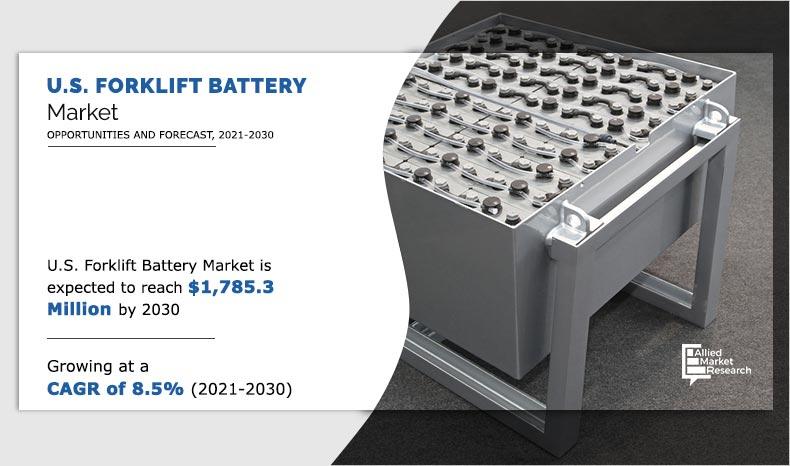
According to a new report published by Allied Market Research, the U.S. forklift battery market size was valued at $810.5 million in 2020 and is projected to reach $1,785.3 million by 2030, growing at a CAGR of 8.5% from 2021 to 2030. Rising demand for electric material handling equipment, rapid expansion of warehouses, and increasing adoption of sustainable logistics solutions are key factors driving the growth of the U.S. forklift battery market. ⚡🏭
Introduction
Forklift batteries are essential power sources for electric forklifts used in material handling operations across industries such as warehousing, manufacturing, construction, retail, and wholesale. Electric forklifts rely on rechargeable batteries to perform tasks including loading, unloading, stacking, and transporting goods efficiently within facilities.
The U.S. forklift battery market is witnessing steady growth as companies shift toward electric forklifts to reduce emissions, operating costs, and dependence on fossil fuels. Batteries used in forklifts are classified into several types, including lithium-ion, lead-acid, fuel cell, absorbed glass mat (AGM), and others, each offering distinct advantages in performance, cost, and lifespan.
Download PDF Brochure: https://www.alliedmarketresearch.com/request-sample/A07523
Market Drivers: Expansion of Warehousing and Manufacturing
One of the primary drivers of the U.S. forklift battery market is the rapid expansion of warehouse infrastructure, particularly driven by the growth of e-commerce and logistics industries. Modern warehouses require efficient material handling systems to manage high inventory volumes and fast order fulfillment.
Electric forklifts powered by advanced batteries provide reliable performance, lower maintenance costs, and zero direct emissions, making them ideal for indoor operations. As companies invest in automated storage systems and smart warehouses, demand for high-performance forklift batteries continues to rise.
Manufacturing facilities also rely heavily on forklifts for moving raw materials and finished products across production lines. The need for uninterrupted operations and improved productivity is fueling adoption of durable battery technologies.
Emerging Role of Fuel Cell Forklifts
The emergence of hydrogen fuel cell forklifts as an alternative to conventional battery-powered forklifts is another factor influencing market growth. Fuel cell systems offer faster refueling times and longer operating hours, making them suitable for high-intensity applications.
However, traditional battery-powered electric forklifts remain dominant due to lower infrastructure requirements and widespread availability. The coexistence of battery and fuel cell technologies is expected to shape the future of the U.S. forklift battery market.
Challenges: High Initial Cost of Lithium-Ion Batteries
Despite numerous advantages, lithium-ion batteries involve higher upfront costs compared to conventional lead-acid batteries. This cost factor can discourage adoption among small and medium-sized enterprises with limited capital budgets.
Nevertheless, lithium-ion batteries offer longer lifespan, faster charging, and reduced maintenance, which can offset initial expenses over time. As technology advances and prices decline, lithium-ion adoption is expected to increase within the U.S. forklift battery market.
Opportunities in Green Logistics
Growing emphasis on sustainability and green logistics is creating significant opportunities for market expansion. Companies are increasingly adopting electric material handling equipment to meet environmental regulations and corporate sustainability goals.
Battery-powered forklifts produce no direct emissions and operate quietly, making them suitable for environmentally sensitive environments. Government incentives promoting clean energy and electrification further support the growth of the U.S. forklift battery market. 🌱
Market Segmentation
The U.S. forklift battery market is segmented based on battery type, capacity, and application.
By Battery Type
Among various battery types, lead-acid batteries dominated the market in 2020, accounting for approximately 77.7% of total revenue. Their dominance is attributed to low cost, reliability, and high load-bearing capacity.
Lead-acid batteries are widely used across manufacturing, construction, retail, and warehousing applications due to their ability to deliver high discharge rates required for heavy-duty operations. Despite competition from newer technologies, they are expected to maintain a significant share during the forecast period.
By Battery Capacity
Based on capacity, the 0–600 Ahr segment holds the largest market share and is projected to maintain its leadership. This segment primarily supports lightweight forklifts used in retail, wholesale, and light-duty material handling tasks.
Growing adoption of electric motor rider trucks, narrow aisle trucks, and hand pallet trucks is driving demand for batteries in this capacity range. These forklifts are commonly used in indoor environments where maneuverability and efficiency are critical.
By Application
Warehousing represents the largest application segment in the U.S. forklift battery market and is expected to grow at a CAGR of 9.1% through 2030. Warehouses rely heavily on forklifts for handling goods across storage areas, loading docks, and distribution centers.
Technological advancements in warehouse management systems, automation, and inventory tracking are further increasing the need for reliable battery-powered equipment. As e-commerce continues to expand, this segment is expected to remain a key growth driver. 📦
Competitive Landscape
The U.S. forklift battery market features numerous established manufacturers and technology providers focusing on innovation, performance improvement, and strategic partnerships.
Key companies operating in the market include Crown Equipment Corporation, East Penn Manufacturing Company, EnerSys, Exide Technologies, Flux Power Holdings, Inc., Green Cubes Technology, OneCharge, Storage Battery Systems, LLC, and TotalEnergies SE.
These companies are investing in research and development to enhance battery efficiency, reduce charging time, and improve durability.
Impact of COVID-19
The COVID-19 pandemic had a temporary negative impact on the U.S. forklift battery market. Lockdowns and economic uncertainty led to delays or cancellations of projects across construction, manufacturing, and oil & gas sectors.
Reduced industrial activity resulted in lower demand for material handling equipment. However, the e-commerce boom during the pandemic increased retail sales and accelerated warehouse expansion, partially offsetting the decline.
As restrictions eased and economic activities resumed, demand for forklifts and batteries rebounded. Government stimulus measures and recovery in industrial output are expected to support long-term market growth.
Get a Customized Research Report: https://www.alliedmarketresearch.com/request-for-customization/A07523
Conclusion
In conclusion, the U.S. forklift battery market is poised for robust growth through 2030, driven by expanding warehouse infrastructure, rising industrial activity, and increasing adoption of electric material handling equipment. Battery technologies will continue to evolve, offering improved performance, efficiency, and sustainability.
While high upfront costs of advanced batteries remain a challenge, long-term operational benefits and environmental advantages are encouraging widespread adoption. As companies prioritize green logistics and automation, the U.S. forklift battery market will remain a critical component of modern supply chain operations. 🚀⚡
Other Trending Reports:-
About Us
Allied Market Research (AMR) is a full-service market research and business-consulting wing of Allied Analytics LLP based in Portland, Oregon. Allied Market Research provides global enterprises as well as medium and small businesses with unmatched quality of “Market Research Reports” and “Business Intelligence Solutions.” AMR has a targeted view to provide business insights and consulting to assist its clients to make strategic business decisions and achieve sustainable growth in their respective market domain.
Pawan Kumar, the CEO of Allied Market Research, is leading the organization toward providing high-quality data and insights. We are in professional corporate relations with various companies and this helps us in digging out market data that helps us generate accurate research data tables and confirms utmost accuracy in our market forecasting. Each and every data presented in the reports published by us is extracted through primary interviews with top officials from leading companies of domain concerned. Our secondary data procurement methodology includes deep online and offline research and discussion with knowledgeable professionals and analysts in the industry.




