
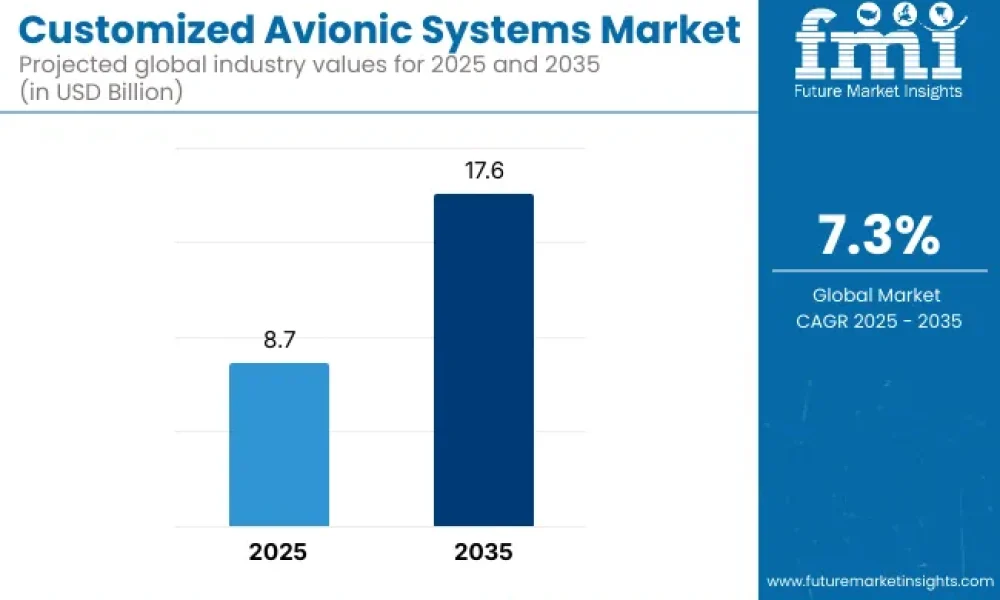
The global Customized Avionic System Market is entering a phase of accelerated expansion, driven by the urgent need for mission-specific, interoperable, and highly flexible aviation electronics across military, commercial, and unmanned aerial platforms. According to new market projections, the industry is expected to grow from USD 8.7 billion in 2025 to USD 17.6 billion by 2035, registering a steady CAGR of 7.3% over the forecast period.
This surge is powered by the convergence of cutting-edge technologies—including AI, edge computing, advanced navigation, and IoT—combined with significant investments in defense modernization and next-generation flight systems. The global aviation ecosystem’s shift toward connected, data-driven, and modular operating environments is positioning customized avionics as a central enabler of future aerospace capabilities.
Rising Need for Tailored, Mission-Ready Avionics
Customized avionic systems are rapidly becoming the core of modern flight operations. In contrast to conventional plug-and-play avionics, tailored solutions integrate seamlessly with specific aircraft layouts, mission needs, and operational environments—offering enhanced situational awareness, real-time data processing, and optimized control.
Military aviation remains the dominant demand center, requiring advanced electronic warfare systems, intelligence processing, cyber-secure communications, and adaptive flight control. Meanwhile, commercial operators are investing heavily in personalized cockpit displays, predictive maintenance modules, and fuel-optimized routing technologies to streamline operations and elevate aircraft longevity.
The proliferation of drones, UAVs, and emerging air mobility platforms is reinforcing the industry’s push toward miniaturized, lightweight, and modular avionics. With the evolution of urban air mobility (UAM), sustainable aviation, and autonomous systems, customization has transitioned from a value-added feature to a mission-critical necessity.
Subscribe for Year-Round Insights → Stay ahead with quarterly and annual data updates
https://www.futuremarketinsights.com/reports/sample/rep-gb-3060
Regional Outlook: North America and Asia-Pacific Propel Global Growth
North America
North America maintains a commanding position, backed by strong aerospace infrastructure, advanced defense programs, and active modernization initiatives in the U.S. Department of Defense. Programs such as the F-35, unmanned combat air vehicles, and NASA’s UAM platforms continue to integrate mission-adaptive avionics. The FAA’s NextGen initiative is accelerating the adoption of custom cockpit systems and cyber-secure flight management technologies.
Europe
Europe is reinforcing its role through advanced OEM networks and collaborative defense projects such as Eurofighter, FCAS, and SESAR. The region is prioritizing interoperability, cybersecurity, and modular architectures across both civil and military fleets. The growth of sustainable aviation and the rapid adoption of digital cockpit solutions are further boosting demand for customized avionics.
Asia-Pacific
Asia-Pacific is emerging as a global hotspot for customized avionics demand, driven by indigenous aircraft development in China, India, Japan, and South Korea. Growing defense budgets, local aerospace manufacturing, and rapid UAV adoption are contributing to robust market acceleration. Increasing air mobility initiatives and fleet modernization across Southeast Asia are further propelling regional expansion.
Key Market Challenges and Opportunities
Challenges
- High Development & Integration Costs: Precision engineering, extensive testing, and mission-specific hardware drive up development expenses. Integrating bespoke systems into legacy fleets remains a technical bottleneck.
- Certification Complexity: Customized systems require platform-specific certification, causing delays and increasing compliance costs. Regulatory bodies—including FAA, EASA, and military certifiers—demand exhaustive testing and validation.
Opportunities
- AI and Autonomous Flight: The rise of AI-driven decision-support systems, autonomous navigation, and digital flight assistants presents the largest opportunity for customized avionics.
- Modular Open Systems Architecture (MOSA): Scalable and reconfigurable avionics are in high demand among OEMs seeking lifecycle-extended, mission- adaptable systems.
- Urban Air Mobility & UAV Growth: The explosive growth of UAVs, eVTOLs, and hybrid-electric aircraft is driving demand for lightweight, software-defined avionics tailored to autonomous and semi-autonomous missions.
Market Evolution: 2020–2024 vs. 2025–2035
2020–2024
The market experienced widespread adoption of digital cockpit displays, ADS-B integration, and upgraded communication systems. Growth was dominated by military ISR platforms, commercial retrofits, and UAV expansion. Sustainability trends accelerated retrofitting and component modernization.
2025–2035
The next decade will see widespread deployment of:
- AI-enabled flight control
- Edge-computing avionics
- Satellite-based communication
- Machine learning-based navigation
- Modular, cyber-secure architectures
This period will be shaped by autonomous flight, eVTOL expansion, and stricter cybersecurity and performance-based navigation mandates globally.
Country-Level Insights
- United States (CAGR: 6.9%): Leads in mission-specific avionics, advanced fighter jet integration, and commercial digital cockpit deployments. Strong UAV growth and software-defined avionic ecosystems drive further demand.
- United Kingdom (CAGR: 6.4%): Growing in rotary-wing, surveillance, and autonomous aircraft avionics. High focus on open architecture systems.
- European Union (CAGR: 6.6%): Strong demand from fighter jets, UAM projects, and integrated mission-specific avionic solutions.
- Japan (CAGR: 6.2%): Leadership in microelectronics and robotics drives miniaturized avionics adoption across UAVs and regional jets.
- South Korea (CAGR: 6.8%): KF-21 program and UAV modernization initiatives accelerate domestic avionic development.
Personalize Your Experience: Ask for Customization to Meet Your Requirements
https://www.futuremarketinsights.com/customization-available/rep-gb-3060
Competitive Landscape
The market is moderately consolidated, with leading companies shaping technological advancements:
| Company | Market Share (%) |
| Honeywell Aerospace | 15–19% |
| Collins Aerospace | 13–17% |
| Thales Group | 10–14% |
| BAE Systems | 7–10% |
| Saab AB | 5–8% |
| Other Players | 35–45% |
Key Innovations from Market Leaders
- Honeywell Aerospace: AI-driven predictive maintenance, modular flight management, real-time analytics, scalable cockpit systems.
- Collins Aerospace: Synthetic vision, open-architecture avionics, integrated navigation systems, autonomy-ready platforms.
- Thales Group: Cyber-secure communication, software-defined avionics, digital flight control for mission-critical applications.
- BAE Systems: EW systems, data fusion, survivability-enhanced cockpits.
- Saab AB: High-redundancy avionics for fighter jets and advanced surveillance aircraft.
Conclusion
The customized avionic system market is positioned for transformative growth, driven by AI integration, modular system architectures, defense modernization, and the rapid expansion of UAV and next-gen aircraft platforms. As aviation becomes increasingly autonomous, connected, and mission-adaptive, customized avionics will remain essential in shaping the future of global airspace, ensuring operational efficiency, safety, and mission superiority across all aviation segments.
About Future Market Insights (FMI)
Future Market Insights, Inc. (FMI) is an ESOMAR-certified, ISO 9001:2015 market research and consulting organization, trusted by Fortune 500 clients and global enterprises. With operations in the U.S., UK, India, and Dubai, FMI provides data-backed insights and strategic intelligence across 30+ industries and 1200 markets worldwide.
Why Choose FMI: Empowering Decisions that Drive Real-World Outcomes: https://www.futuremarketinsights.com/why-fmi



