
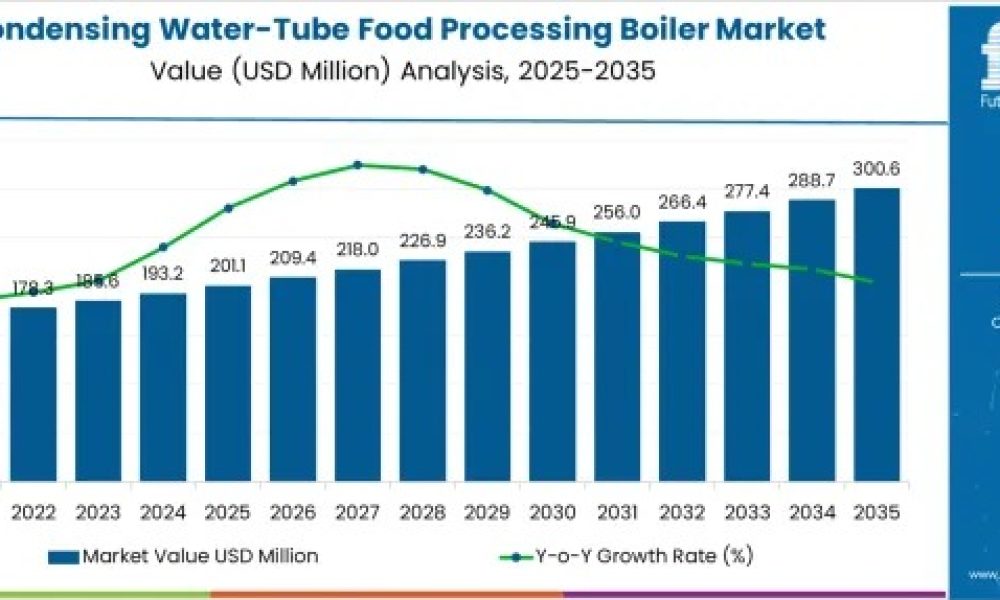
The global Condensing Water-Tube Food Processing Boiler Market is entering a decisive growth phase as food manufacturers prioritize high-efficiency, low-emission steam generation technologies to enhance operational resilience. According to recent industry data, the market is projected to expand from USD 201.1 million in 2025 to USD 300.6 million by 2035, registering a 4.1% CAGR over the forecast period. This steady rise reflects strong alignment between thermal efficiency improvement goals and regulatory pressure for cleaner industrial heating systems.
Subscribe for Year-Round Insights → Stay ahead with quarterly and annual data updates:
https://www.futuremarketinsights.com/reports/sample/rep-gb-22774
Growing energy costs, intensifying compliance mandates, and rising packaged food consumption—particularly in Asia-Pacific—are pushing food processors to replace aging boilers with advanced condensing water-tube systems. Their ability to recover latent heat from exhaust gases, delivering efficiencies above 95%, has made them the preferred choice for dairies, beverage plants, bakeries, confectionery units, and ready-meal manufacturers seeking both cost reduction and sustainability gains.
Market Drivers: Efficiency, Compliance, and Modernization
Food processing plants increasingly require consistent, high-volume steam output for cooking, heating, sterilization, and cleaning cycles. Traditional boiler systems often fail to meet modern energy benchmarks, prompting widespread adoption of condensing water-tube solutions.
Key growth factors include:
- Tightening emissions standards: Low-NOx and low-CO₂ requirements are compelling processors to prioritize condensing systems that ensure compliance without major process disruptions.
- Rising thermal energy costs: Higher natural gas and LPG prices are driving investments in heat recovery and energy-efficient boiler technology.
- Plant modernization: Medium and large food processors are accelerating equipment upgrades to support automated, digitally monitored production lines.
With operational reliability now directly linked to sustainability reporting, condensing water-tube boilers offer a compelling combination of energy performance, durability, and lifecycle value.
50 MMBTU/hr Segment Leads Capacity-Based Demand
In 2025, the 25–50 MMBTU/hr capacity category is expected to capture 29.4% of the global market—its largest share. This range has long been preferred by mid-to-large scale food manufacturing facilities due to its balance of scalability, operational efficiency, and manageable footprint.
Processors favor this segment for:
- ability to match fluctuating batch and continuous process loads
- modular installation flexibility for plant expansions and retrofits
- faster warm-up times that minimize downtime and energy waste
These attributes make the segment especially attractive for bakeries, beverage makers, and high-throughput meal production units.
Natural Gas Continues to Dominate Fuel Choice
Natural gas is anticipated to account for 64.7% of fuel-based market revenue in 2025, maintaining its position as the preferred energy source. Its advantages include cleaner combustion, cost-effectiveness, and ready availability in both developed and emerging markets.
Food processors are increasingly selecting natural-gas-fired condensing boilers to:
- meet clean-air requirements
- reduce operating expenses
- ensure stable and controllable heat output
- integrate with advanced flue-gas monitoring systems
With the global shift from coal and oil toward cleaner fuels, natural gas is expected to remain central to boiler procurement strategies throughout the forecast period.
Global Market Outlook by Country
Growth momentum varies across regions, with emerging economies leading adoption due to rapid industrial modernization.
- China (5.5% CAGR): Driven by urban industrial upgrades, dairy and beverage plant expansion, and carbon-credit-backed incentives.
- India (5.1% CAGR): Boosted by packaged food growth, PAT-driven efficiency targets, and dual-fuel compatible boiler installations.
- Germany (4.7% CAGR): Influenced by stringent eco-design standards, low-NOx priorities, and renewable gas readiness.
- UK (3.9% CAGR): Fueled by aging plant replacements and DEFRA mandates for energy-efficient heating.
- USA (3.5% CAGR): Growth tied to sustainability programs, decarbonization roadmaps, and modernization of thermal systems in brewing, dairy, and bakery industries.
Competitive Landscape
The market remains moderately fragmented, with global and regional players competing on heat-recovery technology, lifecycle service support, and clean-steam delivery. Major manufacturers include Cleaver-Brooks, Alfa Laval, Miura America, Thermax, Fulton, and Hurst Boiler—each investing in automation, corrosion-resistant materials, and modular boiler platforms tailored for food-grade applications.
As sustainability targets tighten, vendors focusing on smart monitoring, rapid-install modular units, and hybrid fuel compatibility are expected to gain the strongest competitive edge.
Get data that aligns with your strategic priorities — ask for report customization today:
https://www.futuremarketinsights.com/customization-available/rep-gb-22774
Have a specific Requirements and Need Assistant on Report Pricing or Limited Budget please contact us – [email protected]
About Future Market Insights (FMI)
Future Market Insights, Inc. (FMI) is an ESOMAR-certified, ISO 9001:2015 market research and consulting organization, trusted by Fortune 500 clients and global enterprises. With operations in the U.S., UK, India, and Dubai, FMI provides data-backed insights and strategic intelligence across 30+ industries and 1200 markets worldwide.
Contact Us:
Future Market Insights Inc.
Christiana Corporate, 200 Continental Drive,
Suite 401, Newark, Delaware – 19713, USA
T: +1-347-918-3531



