
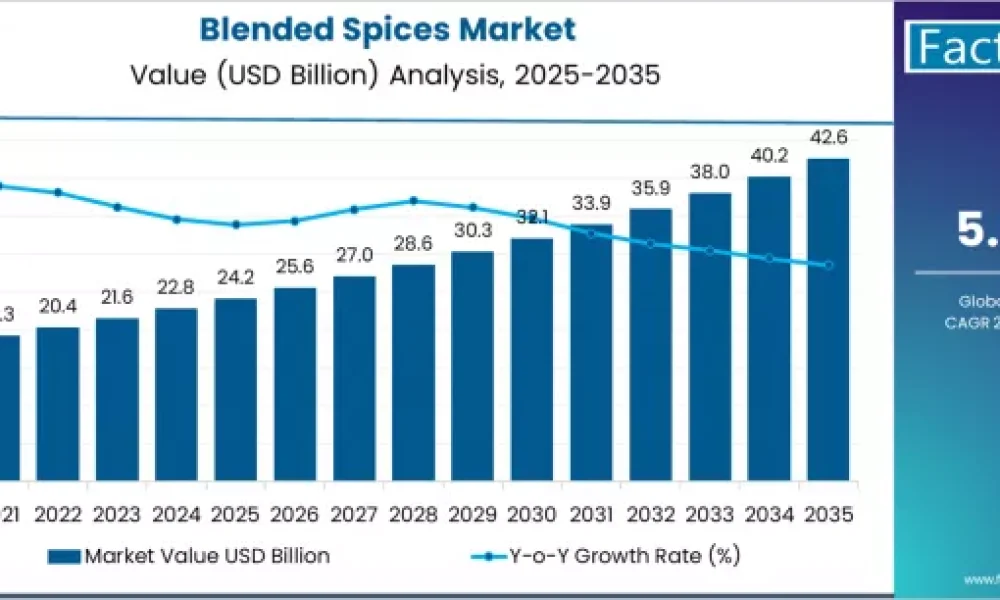
The global blended spices market is on a steady growth trajectory as consumers worldwide increasingly embrace diverse cuisines, convenient cooking solutions, and authentic flavor profiles. As of 2025, the blended spices market is estimated to be valued at approximately USD 24.15 billion. Over the next decade, demand is forecast to climb to around USD 42.55 billion by 2035, reflecting a robust compound annual growth rate (CAGR) of about 5.8%.
This growth reflects a major shift in global culinary behavior, with growing interest in ready-to-use spice blends that deliver consistent taste, save cooking time, and cater to growing multicultural and ethnic cuisine consumption. Both home cooks and food service operators are leaning more toward blended spice solutions that offer convenience without sacrificing authenticity.
Key Market Highlights (2025 Baseline)
Market Value (2025): ~ USD 24.15 billion
Forecast Value (2035): ~ USD 42.55 billion
Forecast CAGR (2025–2035): ~ 5.8%
Leading Spice Blend Type: Garam Masala (~ 36.0% share in 2025)
Leading Distribution Channel: B2B (~ 66.0% share in 2025)
Top Region: Asia‑Pacific (~ 56.1% share in 2025)
Other Key Growth Regions: North America and Europe
To access the complete data tables and in-depth insights, request a Discount On The Report here: https://www.factmr.com/connectus/sample?flag=S&rep_id=11915
Growth Drivers & Market Momentum
Ethnic Cuisine Adoption & Culinary Globalization
One of the primary drivers of the blended spices market is the global rise in interest toward ethnic cuisines. As more people explore Indian, Middle Eastern, Mediterranean, African, Latin American and other regional foods — both in restaurants and at home — demand for authentic spice blends has increased significantly.
This growing multicultural culinary exposure, supported by migration, travel, food media, and globalization of food culture, has expanded the market beyond traditional spice-consuming geographies. As such, spice blends once considered niche or regional are now mainstream in many global markets.
Convenience & Ready-to-Use Cooking Solutions
Modern consumers — especially in urban areas — increasingly value convenience. Blended spices provide a ready-to-use, time-saving alternative to sourcing and grinding multiple individual spices, allowing for quick meal preparation without compromising on flavor complexity or authenticity.
This convenience element appeals both to households and food service providers (restaurants, ready-meal manufacturers, catering services), driving recurring demand for standardized spice blends.
Clean‑Label, Health & Quality Consciousness Trends
Increasingly, consumers prefer spice blends that are natural, free from unnecessary additives, and potentially aligned with broader health and wellness trends. There is rising demand for organic, sustainably sourced, and clean-label spice blends.
Spice producers and brands are responding by offering premium blends, certified-origin spices, transparent sourcing, and sustainable packaging — adding to the attractiveness of blended spices for health- and quality-conscious buyers.
Growth of Foodservice, Packaged Foods & Retail Channels
Growth of the global foodservice industry (restaurants, quick-service outlets, catering) and expansion of packaged food and ready-to-eat meals boost the demand for blended spices. Such industries benefit from bulk spice procurement, consistency in flavor delivery, and ease of use.
At the same time, retail and e-commerce channels are facilitating easier access to branded spice blends — bringing variety and convenience to home cooks across different geographic regions.
Challenges & Market Constraints
Raw material price volatility: Spices are agricultural commodities, and fluctuating costs due to weather, crop yield, geopolitical factors or supply chain constraints can affect profitability and retail pricing of spice blends.
Quality consistency & sourcing issues: Ensuring consistent flavor, purity, safety and quality when blending spices sourced from different regions — sometimes multiple countries — can be complex. This can challenge standardization and customer trust.
Traditional cooking preferences & fresh spice alternatives: In many cultures, fresh spices and individual spice grinding are preferred over pre-blended mixes. This tradition may limit adoption of blended spices among some consumer segments.
Strategic Recommendations
For Spice Manufacturers & Brands
Focus on clean-label, organic, sustainably sourced blends to meet rising consumer demand for quality and transparency.
Invest in R&D to create specialty blends catering to regional cuisines, dietary trends (e.g. low-sodium, health‑oriented), and fusion cooking styles.
Develop robust sourcing and quality‑control frameworks to ensure consistency, traceability and adherence to safety standards.
For Retailers & Food‑Service Distributors
Expand product portfolios to include a wide range of spice blends — from budget-friendly everyday mixes to premium, artisanal or organic blends — to cater to diverse customer segments.
Educate consumers (both retail buyers and food‑service clients) about the benefits of blended spices: convenience, consistent flavor, authenticity and time-saving.
Leverage e‑commerce, subscription spice kits, and curated spice collections to attract modern, convenience-oriented consumers.
For Investors & Market Entrants
Recognize blended spices as a high-potential, steady-growth market with rising demand globally — especially in regions witnessing culinary globalization and increasing interest in ethnic cuisines.
Consider opportunities in premium spice blends, organic/spice‑origin certified products, and private-label spice development tailored for regional cuisines or food service chains.
Focus on supply‑chain resilience, sustainability sourcing, and quality assurance to differentiate and build brand credibility in a crowded market.
Market Outlook to 2035
By 2035, the global blended spices market is expected to grow to approximately USD 42.55 billion, nearly doubling in value compared to 2025.
This growth will be driven by sustained demand for convenience cooking solutions, rising consumption of global and ethnic cuisines, expansion of foodservice and ready-meal industries, and increased consumer emphasis on quality, authenticity, and clean-label spice products. As living patterns remain busy and culinary exploration increases, blended spices are likely to evolve from a niche or regional commodity into a staple of everyday cooking — both at home and in professional kitchens worldwide.
Spice manufacturers, retailers, and food-service providers that prioritize flavor authenticity, quality control, sustainable sourcing, and diversified blend portfolios are best positioned to lead in this evolving market. For stakeholders and investors alike, the coming decade represents a significant opportunity to tap into enhanced demand for global flavors, convenience, and culinary innovation through spice blends.
Have specific requirements or need assistance on report pricing or have a limited budget? Please contact [email protected]
About Fact.MR:
Fact.MR is a global market research and consulting firm, trusted by Fortune 500 companies and emerging businesses for reliable insights and strategic intelligence. With a presence across the U.S., UK, India, and Dubai, we deliver data-driven research and tailored consulting solutions across 30+ industries and 1,000+ markets. Backed by deep expertise and advanced analytics, Fact.MR helps organizations uncover opportunities, reduce risks, and make informed decisions for sustainable growth.



