
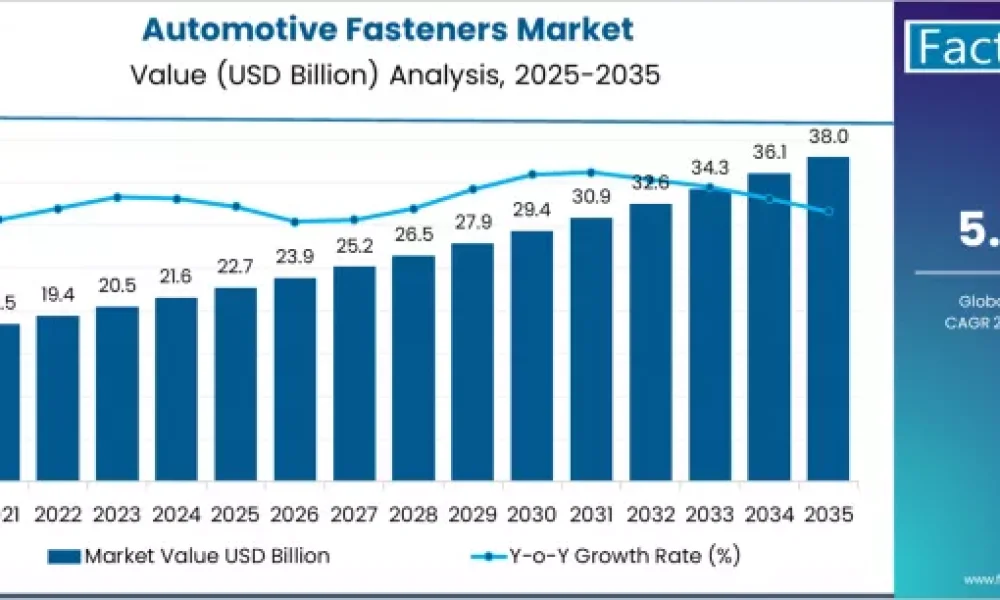
The market for automotive fasteners is expected to expand at a compound annual growth rate (CAGR) of 5.3%, from USD 22.7 billion in 2025 to USD 38.0 billion by 2035, adding USD 15.3 billion in new revenue.
The automotive fasteners market includes bolts, nuts, screws, rivets, clips, washers and specialty joining components used across vehicle assemblies. Fasteners are essential to structural integrity, safety, vibration control, serviceability and manufacturability. As vehicle architectures evolve toward electrification, mixed-material construction and modular platforms, the demand for advanced, lightweight and corrosion-resistant fasteners is growing steadily.
Quick Stats (2025–2035)
Estimated Market Value 2025: ~ USD 23.0 billion
Projected Market Value 2035: ~ USD 38.0 billion
Indicative CAGR (2025–2035): ~ 5–6% annually
Average Fasteners per Vehicle: Thousands (varies by vehicle class)
Leading Product Type: Threaded fasteners (bolts, nuts, screws)
Fastest-growing Application: Electric vehicle battery & powertrain assemblies
To access the complete data tables and in-depth insights, request a Discount On The Report here: https://www.factmr.com/connectus/sample?flag=S&rep_id=12368
Why Automotive Fasteners Matter
Provide mechanical strength and safety under dynamic loads.
Enable assembly-line efficiency and serviceability.
Must perform under vibration, temperature cycles, corrosion and impact.
Need to be compatible with new substrates (aluminum, composites, high-strength steels, polymers).
Influence vehicle weight, NVH (noise-vibration-harshness), and crash performance.
Key Market Drivers
1. Vehicle Production Growth & Fleet Expansion
Rising global vehicle production, including passenger and commercial vehicles, generates baseline demand for fasteners. Growth in vehicle parc and maintenance cycles adds aftermarket demand.
2. Electrification & Battery Systems
EVs require specialized fasteners for battery enclosures, high-voltage isolation, thermal management and motor mounts. Insulated, corrosion-resistant and torque-critical fasteners are in higher demand.
3. Lightweighting & Mixed-Material Designs
To improve efficiency and range, automakers are using aluminum, composites and high-strength alloys. Fasteners must adapt—lighter materials, coatings and novel designs are required to join dissimilar materials reliably.
4. Automation & High-Speed Assembly Needs
Modern production lines emphasize robotic fastening, torque control, and error-proofing. Fastener designs that support automated insertion, secure torquing and quick changeovers are preferred.
5. Aftermarket & Repair Demand
Aging vehicle fleets and repair/replacement cycles drive a consistent aftermarket for OEM-spec fasteners and upgraded performance options.
Market Segmentation & Insights
By Product Type
Threaded Fasteners (Bolts, Nuts, Screws): Largest segment due to reusability and structural applications.
Non-Threaded Fasteners (Rivets, Clips, Push-fits): Growing usage in body panels, interiors and plastic/composite assemblies.
Specialty Fasteners (Self-piercing, Clinching, Blind Rivets): For joining dissimilar or thin materials efficiently.
By Material
Steel & Stainless Steel: Dominant for structural and powertrain components.
Aluminum & Light Alloys: Increasing use for weight savings and corrosion resistance.
Composite & Polymer Fasteners: Emerging in interiors and non-structural applications.
Coated / Plated Finishes: Zinc, nickel, thermally sprayed and organic coatings to prevent corrosion, galvanic reactions and improve durability.
By Application Area
Powertrain & Chassis: High-strength fasteners for safety-critical joins.
Body-in-White & Exterior Panels: Clips, rivets and spot-fastening systems to meet design and finish requirements.
Interiors & Trim: Push-fits, self-tapping screws and decorative fasteners.
Battery Modules & EV Systems: Insulated and vibration-resistant fasteners designed for electrical safety and thermal cycles.
By Region
Asia-Pacific: Largest production hub and fastest growth due to manufacturing scale.
North America & Europe: High-value adoption of advanced fasteners for EVs and premium vehicles.
Latin America, Middle East & Africa: Growing demand tied to industrialization and fleet expansion.
Challenges & Constraints
Material Price Volatility: Steel, aluminum and specialty alloy price swings affect margins.
Joining Dissimilar Materials: Preventing galvanic corrosion and ensuring mechanical integrity require advanced design and coatings.
Certification & Safety Standards: Fasteners in critical systems must meet stringent testing and regulatory approvals.
Competition from Alternative Joining Methods: Welding, adhesive bonding and clinching sometimes replace mechanical fastening where weight or aesthetics dominate.
Customization & Engineering Costs: EV and composite applications require bespoke fastener designs, increasing NRE (non-recurring engineering) costs.
Opportunities & Strategic Directions
Lightweight Alloy & Composite Fasteners: Investment in high-strength aluminum, titanium and composite fasteners for EVs and lightweight platforms.
Coatings & Surface Treatments: Advanced anti-corrosion and insulating coatings to join dissimilar materials and protect battery systems.
Automation-Ready Fasteners: Development of fasteners optimized for robotic insertion, torque monitoring and in-line quality checks.
Aftermarket & Retrofit Kits: Growth in replacement fasteners, retrofit solutions for EV conversions and performance upgrades.
Sustainable Fastener Solutions: Recyclable materials and low-emission manufacturing to meet automaker sustainability goals.
Outlook (2025–2035)
The automotive fasteners market will grow steadily through 2035, reflecting broader automotive industry trends: electrification, lightweighting, higher production volumes and increased aftermarket activity. Suppliers that combine material innovation, corrosion protection, automation compatibility and cost-competitive manufacturing will capture the largest share of new growth. As vehicles become more complex and multi-material, fasteners will remain indispensable — evolving from simple components to engineered solutions that contribute to vehicle safety, performance and sustainability.
Have specific requirements or need assistance on report pricing or have a limited budget? Please contact [email protected]
About Fact.MR:
Fact.MR is a global market research and consulting firm, trusted by Fortune 500 companies and emerging businesses for reliable insights and strategic intelligence. With a presence across the U.S., UK, India, and Dubai, we deliver data-driven research and tailored consulting solutions across 30+ industries and 1,000+ markets. Backed by deep expertise and advanced analytics, Fact.MR helps organizations uncover opportunities, reduce risks, and make informed decisions for sustainable growth.



