
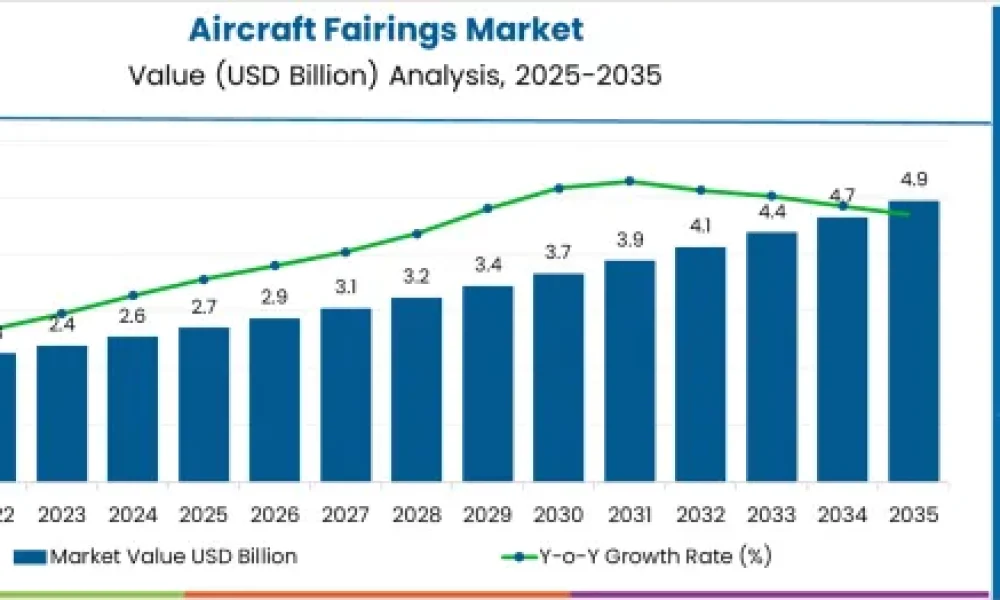
The global Aircraft Fairings Market, valued at USD 2.7 billion in 2025, is projected to reach USD 4.9 billion by 2035, expanding at a 6.2% CAGR. The market is experiencing accelerated growth driven by the renewed build-rate of commercial aircraft, adoption of next-generation aerodynamic structures, and rapid integration of lightweight composite materials.
With an absolute dollar opportunity of USD 2.2 billion, the market is entering a phase of high-value transformation, supported by rising aircraft production, sustainability imperatives, and advanced fairing design innovations.
Market Growth Dynamics
Between 2025 and 2030, the market is expected to grow from USD 2.7 billion to USD 3.7 billion, representing 45% of total growth. The demand during this period is fueled by:
- Recovery in global aircraft deliveries
- Airlines investing in fuel-efficient retrofit programs
- Wider adoption of composite-based fairings
From 2030 to 2035, growth accelerates further, adding USD 1.2 billion as OEMs introduce next-generation aircraft platforms featuring high-performance aerodynamic components. Additive manufacturing, thermoplastic composites, and digital engineering workflows amplify production scalability and design precision.
Subscribe for Year-Round Insights → Stay ahead with quarterly and annual data updates
https://www.futuremarketinsights.com/reports/sample/rep-gb-22948
Key Market Stats (2025–2035)
| Metric | Value |
| Market Value 2025 | USD 2.7 Billion |
| Market Value 2035 | USD 4.9 Billion |
| CAGR | 6.2% |
| Leading Segment (2025) | Commercial Aircraft (29.7%) |
| Top Regions | North America, Asia-Pacific, Europe |
| Top Companies | Boeing, Airbus, Triumph Group, NORDAM, FACC, AAR, Strata |
Why the Aircraft Fairings Market Is Growing
- Emphasis on Aerodynamic Optimization
Fairings significantly reduce drag by streamlining airflow across aircraft structures such as wing roots, landing gear, engine pylons, and flight control surfaces. OEMs are increasingly integrating:
- Low-drag fairing geometries
- Noise-reduction aerodynamic covers
- Computational fluid dynamics (CFD)–optimized fairing profiles
This directly enhances fuel efficiency, reduces carbon emissions, and improves aircraft performance.
- Lightweight Composite Revolution
The Composite Material Segment (36.5% share in 2025) is the fastest-growing category due to:
- High strength-to-weight ratio
- Superior corrosion resistance
- Compatibility with automated composite forming technologies
Thermoplastics and CFRP structures are becoming the industry standard for weight reduction and lifecycle durability.
- Next-Generation Aircraft & Electrification
The push toward hybrid-electric aircraft and new aerodynamic structures is increasing the need for:
- Heat-resistant materials
- Multifunctional fairings
- Integrated noise-dampening solutions
OEMs and Tier-1 suppliers are developing adaptive and morphing fairings to support future flight technologies.
Segmental Insights
Commercial Platform (29.7% Share, 2025)
- Strongest demand driver due to record aircraft backlogs
- Focus on fuel efficiency and noise reduction
- Rising global air traffic increases retrofit opportunities
Composite Fairings (36.5% Share, 2025)
- Most preferred due to weight reduction and complex shape capability
- Enhanced fatigue resistance and ease of maintenance
- Strong adoption across wing, fuselage, and engine applications
Flight Control Surface Fairings (18.9% Share, 2025)
- Critical for reducing turbulence and vibration
- Essential for improving aircraft stability
- High demand from both new aircraft and retrofitted fleets
Country-Level Market Growth (2025–2035)
| Country | CAGR |
| China | 8.4% |
| India | 7.8% |
| Germany | 7.1% |
| France | 6.5% |
| UK | 5.9% |
| USA | 5.3% |
| Brazil | 4.7% |
China (8.4% CAGR)
Driven by COMAC programs and growing domestic composite manufacturing.
India (7.8% CAGR)
Boosted by aerospace hubs, MRO expansion, and OEM collaborations.
Germany (7.1% CAGR)
Innovation in robotic assembly and additive manufacturing.
France (6.5% CAGR)
Advanced aero structure designs and strong retrofit growth.
UK (5.9% CAGR)
Major investments in digital simulation and lightweight materials.
Personalize Your Experience: Ask for Customization to Meet Your Requirements
https://www.futuremarketinsights.com/customization-available/rep-gb-22948
Competitive Landscape
The market is moderately consolidated with key players including:
- The Boeing Company
- Airbus
- Triumph Group
- The NORDAM Group
- FACC AG
- Strata Manufacturing
- Avcorp
- Daher
- Barnes Group
- Royal Engineered Composites
These companies focus on:
- High-performance composite fairings
- Automated manufacturing
- Digital twin–based design validation
- Advanced surface coatings for drag reduction
Entry barriers remain high due to certification requirements, stringent safety standards, and long product development cycles.
Recent Innovations
- AI-driven aerodynamic surface optimization
- Additive manufacturing for complex geometries
- Low-drag and noise-suppression coatings
- Thermoplastic composite fairings with faster processing
- Maintenance-friendly modular designs
These developments are reshaping the future of aircraft fairings through cost-efficient, lightweight, and high-performance solutions.
Why Choose FMI: Empowering Decisions that Drive Real-World Outcomes:
https://www.futuremarketinsights.com/why-fmi
About Future Market Insights (FMI)
Future Market Insights, Inc. (FMI) is an ESOMAR-certified, ISO 9001:2015 market research and consulting organization, trusted by Fortune 500 clients and global enterprises. With operations in the U.S., UK, India, and Dubai, FMI provides data-backed insights and strategic intelligence across 30+ industries and 1200 markets worldwide.



